Verdemont, San Bernardino
Updated · 11,840 residents
Verdemont is a quiet, suburban enclave in the northern foothills of San Bernardino, characterized by its dense tract housing and proximity to expansive natural terrain. While the area offers a walkable grid with safe sidewalks and access to public green spaces, it remains a primarily residential community with limited local commercial amenities.
Key Highlights
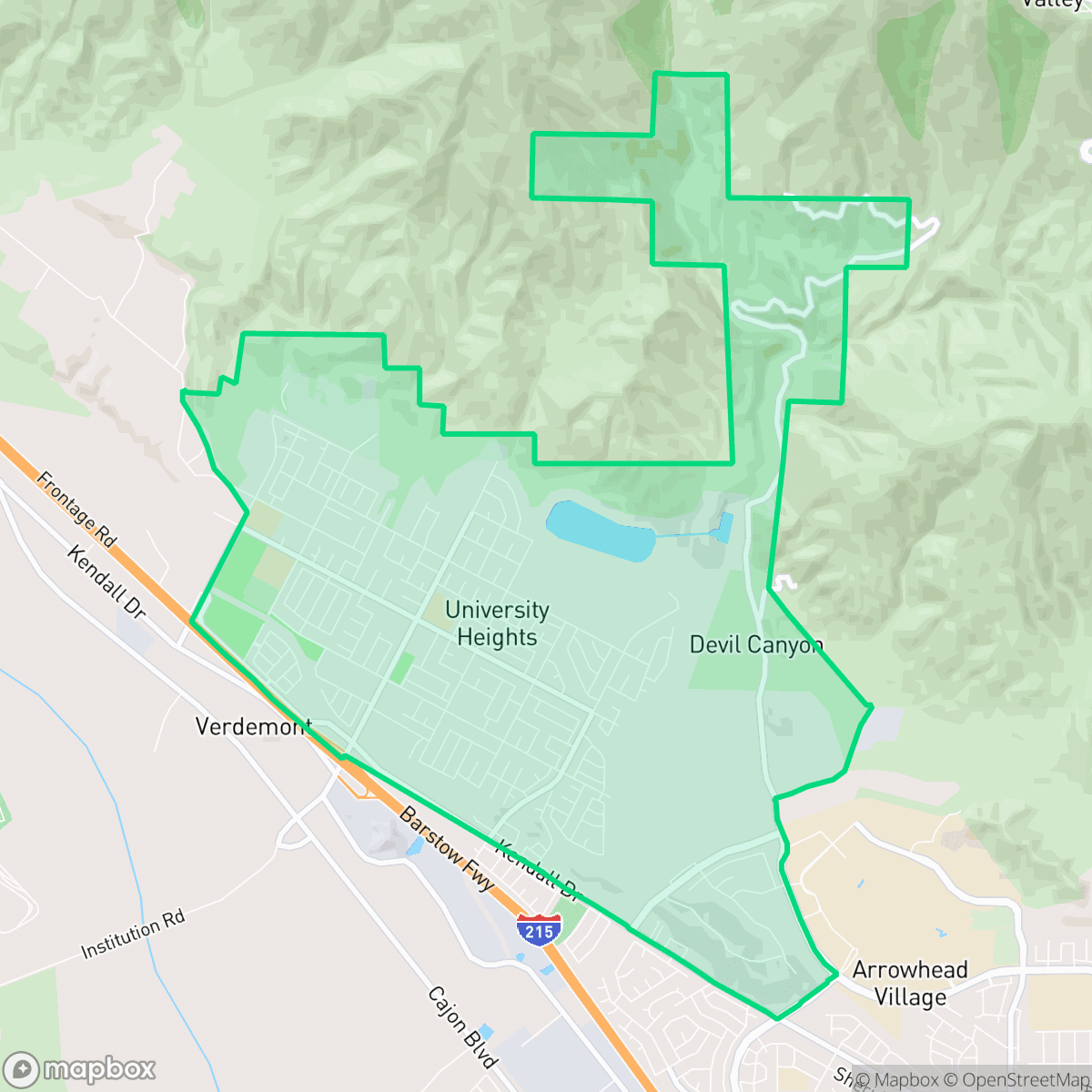
About Verdemont
Located in the northern foothills of San Bernardino, the suburban neighborhood of Verdemont has roots dating back to the late 19th century. In 1882, German immigrant Julius Meyer acquired 2,450 acres of land in the area, establishing a massive ranch where he successfully cultivated wine grapes. Despite early development challenges, including harsh winds from the nearby Cajon Pass, the area gradually transitioned from agricultural ranching into a highly desirable residential enclave. Today, Verdemont is well-known as the home of the Western Region Little League headquarters and Al Houghton Stadium, which draws significant regional attention each August. It is also characterized by its local parks, including Ronald Reagan Park, which uniquely features an authentic segment of the Berlin Wall.
The area serves as a residential retreat where dense suburban tracts meet the edge of undeveloped mountainous landscapes. Residents benefit from a consistent network of sidewalks and low-traffic streets, making the neighborhood accessible for pedestrians despite its car-oriented surroundings. The presence of municipal water infrastructure and nearby mining operations marks the transition between suburban development and the rugged foothills, creating a distinct visual contrast between manicured lawns and open, wildland fringes.
Prospective residents should note that the neighborhood is exceptionally quiet, with very few local businesses or social hubs within walking distance. While the community offers high rates of health insurance coverage and access to top-rated elementary education, it faces significant environmental challenges, including low fire and flood safety ratings. This area is best suited for families or individuals seeking a serene, residential-focused environment who are comfortable commuting for essential services and entertainment.
Neighborhood Scores Across 15 Qualities
Residential spacing provides a moderate level of separation between neighbors, sitting slightly above the San Bernardino average. Most homes feature standard suburban lot sizes with some buffer between structures, though certain areas exhibit higher density with closer proximity between houses.
Extensive sidewalk networks and dedicated pedestrian paths make navigating the neighborhood on foot easier than in most parts of San Bernardino. Residential streets and campus areas feature consistent infrastructure that separates pedestrians from vehicular traffic.
Residential views feature upscale amenities and larger homes, presenting a more polished landscape than the San Bernardino average. According to iHuus data, the area is characterized by a variety of suburban tract housing and private pools within a dense residential setting.
Public green spaces and school fields offer accessible walking areas for pets, making the area slightly more dog friendly than the San Bernardino average. While some residential blocks lack nearby parks, several central grassy zones provide useful outdoor space for animal owners.
A mix of suburban housing tracts and large industrial warehouses defines the landscape, providing a slightly more open feel than the San Bernardino average. Residents will find a blend of dense residential developments positioned alongside significant open lands and utility infrastructure.
Residential life in this area is largely characterized by a serene, low-density atmosphere with limited commercial activity. According to iHuus data, the level of local activity and access to amenities is slightly lower than the San Bernardino average.
Steady traffic noise from a nearby busy street is a common feature here, though levels are slightly more tranquil than the San Bernardino average according to iHuus data.
Air quality remains generally high with infrequent periods of elevated readings, though levels are slightly lower than the San Bernardino average according to iHuus data.
Industrial presence is minimal, offering a quieter environment than the San Bernardino average. While some utility infrastructure and warehouse activity exist on the periphery, the area is predominantly composed of residential, educational, and recreational spaces.
Health insurance accessibility is significantly higher here than the San Bernardino average, according to iHuus data.
Political leanings in Verdemont lean toward liberal values, though the area is notably less progressive than the San Bernardino city average according to iHuus data.
Residents live alongside a balanced mix of young adults, families, and seniors. This demographic spread is largely consistent with the broader San Bernardino area, according to iHuus data.
Flood risk in Verdemont is notably higher than the San Bernardino average due to its location within a designated floodplain. According to iHuus data, residents may need to consider specialized flood insurance for their properties.
Wildfire hazards in Verdemont are significantly higher than the San Bernardino average. According to iHuus data, the area requires maximum fire protection measures due to extreme vulnerability.
Address-Level Insights for Verdemont


iHuus Neighborhood Intelligence Insights
Get address-level neighborhood insights for Verdemont
- Street-level scores — see how individual blocks compare, not just neighborhood averages
- Micro-zone boundaries — identify quiet pockets, flood boundaries, and walkable clusters before you visit
- 15 dimensions in full — walkability, noise, air quality, school quality, insurance coverage, population age profile, urban/rural index, and more
- Boundary risk alerts — know if your address sits near a block boundary where scores drop, the kind of detail no listing will ever mention
- School insights — individual school ratings and insights, not just district-level data
- Compare before you commit — side-by-side data across neighborhoods, down to block precision
No credit card required
Compare with Any Neighborhood
| Dimension | Verdemont | Alessandro |
|---|---|---|
| 🚶 Walkabilityavg 7.12 | ||
| 🔊 Acoustic Comfortavg 4.28 | ||
| 🤫 Privacy Indexavg 5.05 | ||
| 🎨 Visual Appealavg 5.64 | ||
| 🐕 Dog Friendlinessavg 5.15 | ||
| 🗺️ Urban-Rural Indexavg 6.67 | ||
| ✨ Neighborhood Vibeavg 4.38 | ||
| 🏥 Health Insurance Coverageavg 5.05 | ||
| 🌿 Air Qualityavg 9.16 | ||
| 🏭 Industrial Proximityavg 6.81 | ||
| 🌊 Flood Safetyavg 1.26 | ||
| 🗳️ Ideological Leanavg 8.58 | ||
| 👥 Population Age Profileavg 4.36 | ||
| 🔥 Fire Safetyavg 0.3 | ||
| 🏫 School Quality |
Verdemont Rankings
School Districts Serving Verdemont
School Insights for Verdemont
Below average outcomes; significant attendance and academic challenges.
School Insights
See what's really behind every school rating near Verdemont
- Individual school ratings — each school's own score with outcome context, not just a district average
- Enrollment & class size data — student-to-teacher ratio and how it compares to the state average
- Full demographics breakdown — ethnicity and gender composition for every school in the enrollment zone
- Every school in the district — all schools within the enrollment boundary ranked by rating, not just the closest one
- Grade levels & benchmarks — elementary through high school, with below/above state-average flags
No credit card required