University, San Bernardino
Updated · 2,984 residents
The University neighborhood serves as a vibrant suburban college town defined by its proximity to California State University, San Bernardino. Residents enjoy a highly walkable environment with clean air and a tranquil atmosphere, though the area requires careful attention to environmental safety factors like wildfire and flood risks.
Key Highlights
About University
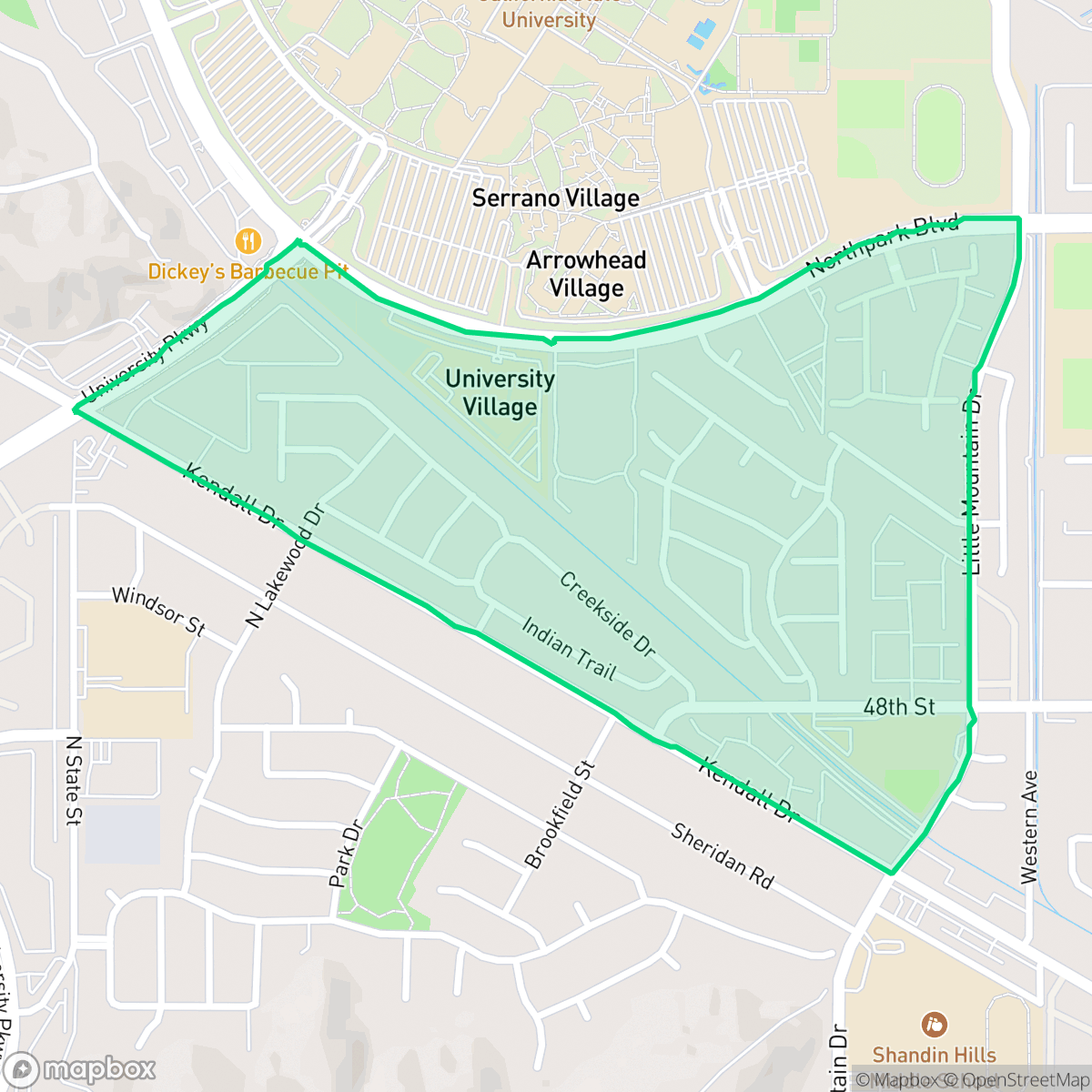
The University District, often referred to as University or University Hills, is a foothill community located in northern San Bernardino. Its development is fundamentally tied to the establishment of California State University, San Bernardino (CSUSB), which was founded in 1965 on a 440-acre site. Historically, the area was characterized by mid-desert farmland before transitioning into a college-oriented neighborhood. The district is bounded by the San Bernardino Mountains to the north and east, the Shandin Hills to the south, and Cajon Boulevard to the west. Today, it functions as a suburban college town, with University Parkway and Kendall Drive serving as its primary commercial corridors. The neighborhood’s identity is closely linked to the university’s growth, which has influenced local housing, student-focused nightlife, and the broader development of the surrounding foothill landscape.
The University neighborhood offers a distinct suburban atmosphere characterized by a blend of institutional campus buildings and residential tracts. It maintains a notably quiet environment compared to the rest of the city, supported by a diverse population and a liberal-leaning community. The area provides residents with high walkability, featuring extensive sidewalk networks and accessible green spaces that are well-suited for those who enjoy outdoor activities or dog walking. With high rates of health insurance coverage and consistently clean air, the district presents a stable living environment for students, faculty, and families alike.
Prospective residents should consider several trade-offs when choosing this location. While the neighborhood is orderly and convenient, it is situated within a region that faces extreme fire danger and high flood risk, necessitating proactive safety measures. Additionally, the presence of nearby industrial infrastructure and a former Superfund site warrants awareness regarding potential groundwater contamination. The local school district is currently in a state of transition, offering a mix of specialized magnet programs alongside facilities that are working to address systemic operational and performance challenges.
Neighborhood Scores Across 15 Qualities
Residential spacing provides a moderate level of separation between neighbors, slightly higher than the San Bernardino average. While some areas feature houses in close proximity, other sections include institutional buildings with larger buffer zones.
Extensive sidewalk networks and dedicated pedestrian paths on campus provide safer walking conditions than the San Bernardino average. Many residential streets and major roads feature wide, unobstructed crossings for easy foot travel.
Uniform tract housing and apartment complexes characterize the area, featuring closely spaced homes with modest yards and shared amenities. This visual landscape is slightly more orderly than the San Bernardino average, according to iHuus data.
Access to large campus lawns and public parks provides significantly more green space for pets than the San Bernardino average. Wide street verges and connected open fields offer several safe routes for walking animals away from heavy traffic.
Residential areas feature a blend of institutional campus buildings, multi-family housing, and single-family tracts. This landscape reflects a suburban density that is consistent with the city average according to iHuus data.
Lively pockets of dining and retail coexist with quiet, low-density residential areas. This neighborhood offers a more active atmosphere than the San Bernardino average, featuring a mix of suburban streets and accessible amenities according to iHuus data.
Acoustic levels are notably lower than the San Bernardino average, with noise typically limited to infrequent distant trains or sporadic vehicle traffic. According to iHuus data, the area maintains a more tranquil environment than most parts of the city.
Air quality remains consistently high with very few health concerns, performing nearly inline with the San Bernardino average according to iHuus data.
Warehouse activity and utility infrastructure create a mix of commercial and residential uses that is slightly higher than the San Bernardino average. Residents should be aware of a nearby EPA Superfund site and potential groundwater contamination risks noted in iHuus data.
Health insurance access is notably higher in this area than in the rest of San Bernardino. According to iHuus data, a significant majority of residents are covered by health plans.
Political leanings in this area align closely with the broader San Bernardino community, featuring a liberal majority and a modest opposing presence according to iHuus data.
Residents live alongside a balanced mix of young adults, families, and older populations. According to iHuus data, this demographic spread is slightly lower than the San Bernardino city average.
Significant flood risk exists here as parts of the area are located within a 100-year floodplain. This risk level is higher than the San Bernardino city average, and residents should expect that flood insurance is typically required.
Fire hazards in this area are significantly higher than the San Bernardino average. Residents should prepare for extreme fire danger and prioritize maximum protection measures according to iHuus data.
Address-Level Insights for University


iHuus Neighborhood Intelligence Insights
Get address-level neighborhood insights for University
- Street-level scores — see how individual blocks compare, not just neighborhood averages
- Micro-zone boundaries — identify quiet pockets, flood boundaries, and walkable clusters before you visit
- 15 dimensions in full — walkability, noise, air quality, school quality, insurance coverage, population age profile, urban/rural index, and more
- Boundary risk alerts — know if your address sits near a block boundary where scores drop, the kind of detail no listing will ever mention
- School insights — individual school ratings and insights, not just district-level data
- Compare before you commit — side-by-side data across neighborhoods, down to block precision
No credit card required
Compare with Any Neighborhood
| Dimension | University | Alessandro |
|---|---|---|
| 🚶 Walkabilityavg 7.12 | ||
| 🔊 Acoustic Comfortavg 4.28 | ||
| 🤫 Privacy Indexavg 5.05 | ||
| 🎨 Visual Appealavg 5.64 | ||
| 🐕 Dog Friendlinessavg 5.15 | ||
| 🗺️ Urban-Rural Indexavg 6.67 | ||
| ✨ Neighborhood Vibeavg 4.38 | ||
| 🏥 Health Insurance Coverageavg 5.05 | ||
| 🌿 Air Qualityavg 9.16 | ||
| 🏭 Industrial Proximityavg 6.81 | ||
| 🌊 Flood Safetyavg 1.26 | ||
| 🗳️ Ideological Leanavg 8.58 | ||
| 👥 Population Age Profileavg 4.36 | ||
| 🔥 Fire Safetyavg 0.3 | ||
| 🏫 School Quality |
University Rankings
School Districts Serving University
School Insights for University
Below average outcomes; significant attendance and academic challenges.
School Insights
See what's really behind every school rating near University
- Individual school ratings — each school's own score with outcome context, not just a district average
- Enrollment & class size data — student-to-teacher ratio and how it compares to the state average
- Full demographics breakdown — ethnicity and gender composition for every school in the enrollment zone
- Every school in the district — all schools within the enrollment boundary ranked by rating, not just the closest one
- Grade levels & benchmarks — elementary through high school, with below/above state-average flags
No credit card required