Shandin Hills, San Bernardino
Updated · 6,053 residents
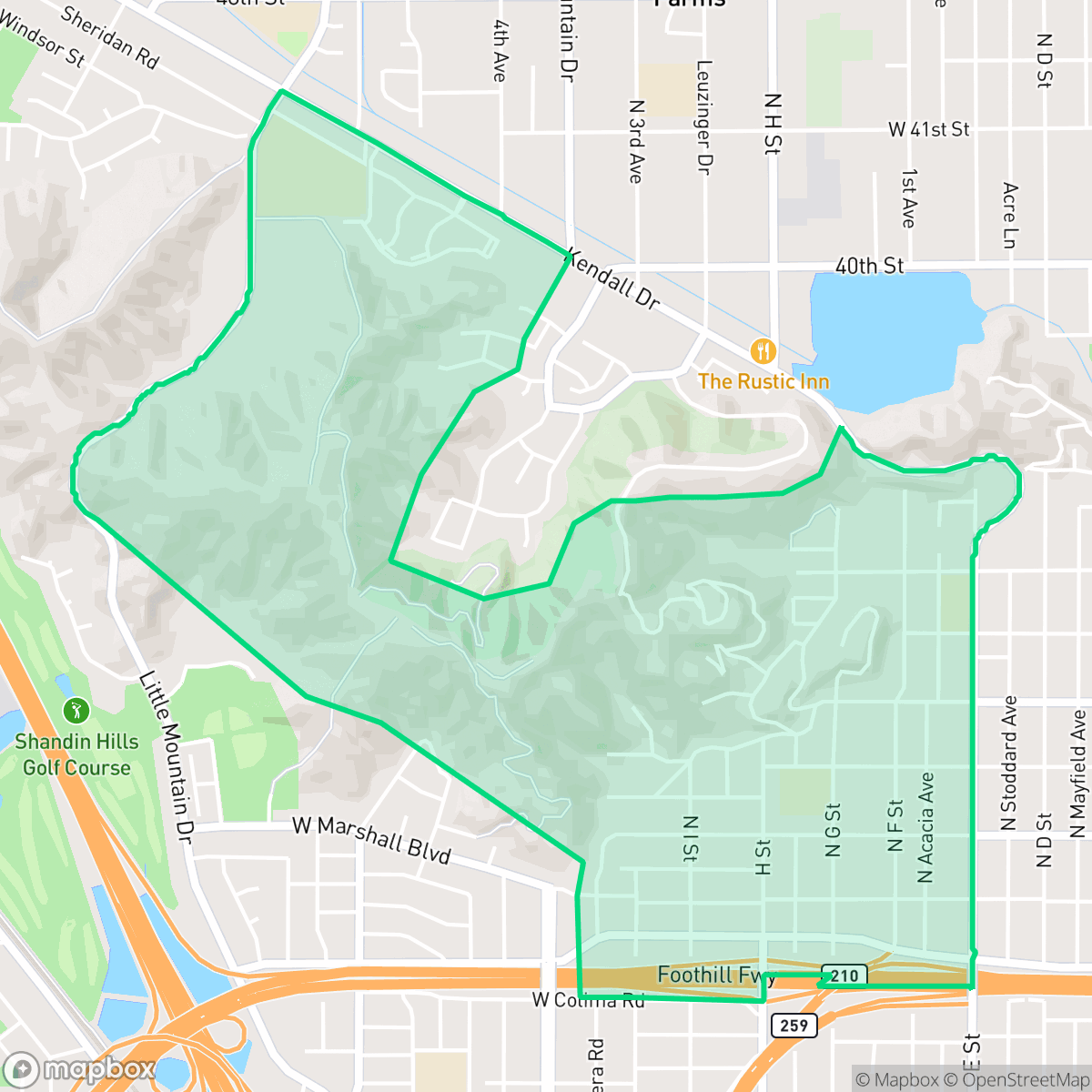
Shandin Hills is a quiet, suburban neighborhood in northern San Bernardino defined by its low-density residential layout and proximity to scenic hiking trails. While the area offers superior air quality and a peaceful acoustic environment, residents remain largely dependent on vehicles for daily errands and commercial access.
Key Highlights
About Shandin Hills
The Shandin Hills neighborhood in northern San Bernardino, California, is historically defined by its transition from 19th-century agriculture to mid-century suburban development. The area is anchored by Little Mountain, where Mormon pioneers established a massive 1,300-acre grain field in 1852. In the 20th century, the neighborhood transitioned from citriculture into a series of planned residential communities featuring mid-century single-family homes and developments like the Edgehill Condos. Local landmarks include Blair Park, which serves as a popular trailhead for hiking the scenic hills, and the Shandin Hills Golf Club. The golf club, originally gifted to the city by the Hodgdon family under the sign "exclusively public," remains a cornerstone of the neighborhood's recreational and cultural identity.
The area is characterized by a blend of mid-century single-family homes and multi-unit residential complexes, maintaining a serene, low-density atmosphere. Residents benefit from high air quality and a quiet acoustic environment, which stands out compared to other parts of the city. According to iHuus data, the neighborhood provides a stable residential setting, though it is primarily car-oriented with limited walkable access to essential commercial services. The presence of green space and nearby trails provides opportunities for outdoor recreation, contributing to the area's relaxed pace of life.
Prospective residents should consider the trade-offs associated with the location, including elevated risks related to local fire and flood safety. While the neighborhood offers a tranquil environment, the local school district presents challenges, with area schools currently facing performance and operational hurdles. The community is best suited for those prioritizing a quiet, suburban lifestyle who are comfortable with the necessity of driving for most daily needs, as confirmed by iHuus data regarding local accessibility.
Neighborhood Scores Across 15 Qualities
Property spacing is largely comparable to the San Bernardino average, featuring a mix of suburban layouts with shared fences and modest backyard buffers. Some residential clusters exhibit higher density with houses positioned closely together along shared property lines.
Sidewalks and safe crossings are widely available across residential streets and major roads, offering better pedestrian connectivity than the San Bernardino average. While the network is comprehensive, heavy traffic from nearby arterial roads and freeways can occasionally disrupt continuous walking paths.
Larger homes and frequent upscale amenities contribute to a visual landscape that is more polished than the San Bernardino average. According to iHuus data, the area features spacious driveways and prominent private pools within a well-maintained residential setting.
Access to open grass fields and large public parks is better than the city average for San Bernardino. While many residential streets feature narrow sidewalks and private yards, several nearby school parks and open areas provide space for walking dogs.
Frequent open land and scattered homes provide a semi-rural atmosphere that is slightly more expansive than the San Bernardino average.
Low density and significant open space create a serene, remote atmosphere, but the area lacks a walkable commercial character and falls below the city average for liveliness. Most essential services and dining options require a vehicle to access, as the landscape is primarily composed of quiet suburban and rural stretches.
Steady traffic sounds from a nearby busy street are common here. According to iHuus data, acoustic comfort is slightly lower than the San Bernardino average.
Air quality remains consistently high with minimal health concerns for residents. According to iHuus data, the atmosphere in Shandin Hills is slightly clearer than the San Bernardino average.
Residential streets coexist with light commercial units and large warehouse structures, creating more industrial presence than the San Bernardino average. Some areas near the western edge face increased noise from freeways and proximity to a nearby EPA Superfund site with potential groundwater implications.
Health insurance coverage levels in this area are slightly higher than the San Bernardino city average, according to iHuus data.
Political leanings in this area align closely with the broader San Bernardino average, characterized by a liberal majority and a modest opposing presence according to iHuus data.
Residents will find a varied demographic mix of young adults, families, and seniors. This demographic spread is consistent with the broader San Bernardino area, according to iHuus data.
Properties in this area are located within a designated floodplain, which may necessitate flood insurance. According to iHuus data, the risk levels in Shandin Hills are slightly higher than the San Bernardino average.
Elevated fire hazards are a primary concern in this area, with risk levels notably higher than the San Bernardino average according to iHuus data.
Address-Level Insights for Shandin Hills


iHuus Neighborhood Intelligence Insights
Get address-level neighborhood insights for Shandin Hills
- Street-level scores — see how individual blocks compare, not just neighborhood averages
- Micro-zone boundaries — identify quiet pockets, flood boundaries, and walkable clusters before you visit
- 15 dimensions in full — walkability, noise, air quality, school quality, insurance coverage, population age profile, urban/rural index, and more
- Boundary risk alerts — know if your address sits near a block boundary where scores drop, the kind of detail no listing will ever mention
- School insights — individual school ratings and insights, not just district-level data
- Compare before you commit — side-by-side data across neighborhoods, down to block precision
No credit card required
Compare with Any Neighborhood
| Dimension | Shandin Hills | Alessandro |
|---|---|---|
| 🚶 Walkabilityavg 7.12 | ||
| 🔊 Acoustic Comfortavg 4.28 | ||
| 🤫 Privacy Indexavg 5.05 | ||
| 🎨 Visual Appealavg 5.64 | ||
| 🐕 Dog Friendlinessavg 5.15 | ||
| 🗺️ Urban-Rural Indexavg 6.67 | ||
| ✨ Neighborhood Vibeavg 4.38 | ||
| 🏥 Health Insurance Coverageavg 5.05 | ||
| 🌿 Air Qualityavg 9.16 | ||
| 🏭 Industrial Proximityavg 6.81 | ||
| 🌊 Flood Safetyavg 1.26 | ||
| 🗳️ Ideological Leanavg 8.58 | ||
| 👥 Population Age Profileavg 4.36 | ||
| 🔥 Fire Safetyavg 0.3 | ||
| 🏫 School Quality |
Shandin Hills Rankings
School Districts Serving Shandin Hills
School Insights for Shandin Hills
Below average outcomes; significant attendance and academic challenges.
School Insights
See what's really behind every school rating near Shandin Hills
- Individual school ratings — each school's own score with outcome context, not just a district average
- Enrollment & class size data — student-to-teacher ratio and how it compares to the state average
- Full demographics breakdown — ethnicity and gender composition for every school in the enrollment zone
- Every school in the district — all schools within the enrollment boundary ranked by rating, not just the closest one
- Grade levels & benchmarks — elementary through high school, with below/above state-average flags
No credit card required