San Bernardino International Airport, San Bernardino
Updated · 2,639 residents
The San Bernardino International Airport neighborhood is a logistics and industrial hub defined by its active airfield and large-scale warehouse facilities. Residents experience a quiet, low-density environment with limited walkability and few local amenities.
Key Highlights
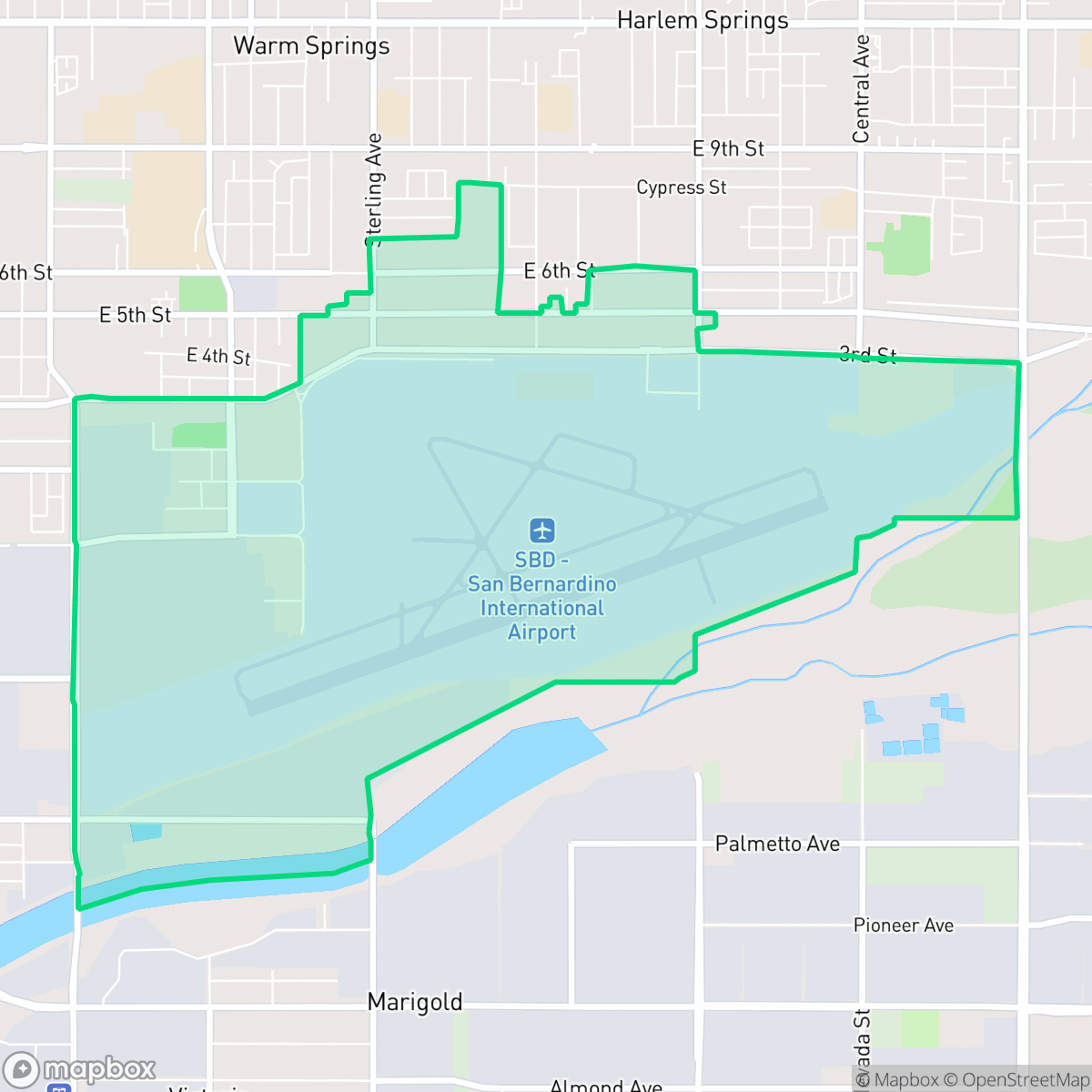
About San Bernardino International Airport
The San Bernardino International Airport neighborhood is deeply tied to its origins as a military hub. It began as the San Bernardino Municipal Airport in 1941, which was quickly converted into the San Bernardino Air Depot during World War II and renamed Norton Air Force Base in 1950 in honor of local WWII hero Captain Leland Francis Norton. For over half a century, the base served as a vital logistics, transport, and aircraft maintenance hub. Its closure in 1994 devastated the surrounding east-side neighborhoods. Today, the area has been revitalized as the San Bernardino International Airport, serving as a major cargo and commercial aviation hub. Key landmarks include the Norton AFB Museum on East 3rd Street, which preserves military memorabilia, including a section of the Berlin Wall and a monument featuring a model of the "Hanoi Taxi" aircraft.
The area functions primarily as a center for commercial aviation and freight operations. The landscape is dominated by expansive warehouses, asphalt logistics yards, and open airfield space, creating a distinct industrial atmosphere. While the neighborhood maintains a quiet, suburban feel in its scattered residential pockets, the environment is shaped by its proximity to heavy transit corridors and large-scale operational facilities. According to local data, the area offers a unique, albeit remote, setting for those working in the logistics or aviation sectors.
Living in this area requires navigating specific trade-offs regarding daily convenience and environmental factors. The neighborhood has low walkability and limited local services, making personal vehicles essential for daily tasks. Prospective residents should note the presence of an EPA Superfund site linked to historical manufacturing and maintenance activities. Educational options are split between the Redlands Unified and San Bernardino City Unified school districts, providing a range of academic environments for families considering the area.
Neighborhood Scores Across 15 Qualities
Housing density is moderate with a mix of closely spaced neighbors and larger, unmaintained lots. This provides slightly more buffer between properties than the San Bernardino average, according to iHuus data.
Walking is possible on quiet streets and main roads with sidewalks, but the overall walkability is notably lower than the San Bernardino average. According to iHuus data, the lack of continuous sidewalk networks throughout the area may limit pedestrian mobility.
Visual interest is limited by high-density housing, mobile home parks, and unpaved lots. According to iHuus data, the area is less visually developed than the San Bernardino average.
Limited access to public parks and narrow green verges make outdoor exercise difficult for pets. According to iHuus data, the availability of dog-friendly spaces is below the city average.
Large-scale warehouses, aviation infrastructure, and open desert scrubland characterize this area. According to iHuus data, the landscape is slightly less developed than the city average, featuring a mix of industrial hubs and undeveloped terrain.
Limited commercial activity and a landscape dominated by warehouses and freight corridors result in a much lower level of activity than the rest of San Bernardino. Residents will find few local businesses within walking distance, though a small number of essential services and dining spots are accessible near established housing blocks.
Local traffic from nearby busy streets creates a consistent background hum. This level of acoustic activity is slightly higher than the San Bernardino average, according to iHuus data.
Air quality remains consistently high with very few health concerns, performing notably better than the San Bernardino average according to iHuus data.
Heavy industrial activity and freight traffic are more prominent here than in most parts of the city. Residents should be aware of nearby manufacturing zones and an EPA Superfund site that may involve environmental contaminants in the area, according to iHuus data.
Health insurance accessibility is lower than the San Bernardino average, according to iHuus data. Residents may face more challenges accessing employer-sponsored or private coverage compared to other parts of the city.
Voting patterns and census indicators reflect a strong liberal leaning that is slightly more pronounced than the San Bernardino average, according to iHuus data.
The demographic profile shows a balanced mix of young adults, families, and seniors. This age distribution is slightly lower than the San Bernardino average, according to iHuus data.
Significant flood hazards exist in this area, with risks appearing notably higher than the San Bernardino average. According to iHuus data, residents should prepare for elevated or prohibitive flood insurance costs.
Fire hazards in this area are exceptionally high, representing a significant danger that is even more severe than the average for San Bernardino. Residents should be aware of the extreme precautions necessary due to the intense risk levels identified in iHuus data.
Address-Level Insights for San Bernardino International Airport


iHuus Neighborhood Intelligence Insights
Get address-level neighborhood insights for San Bernardino International Airport
- Street-level scores — see how individual blocks compare, not just neighborhood averages
- Micro-zone boundaries — identify quiet pockets, flood boundaries, and walkable clusters before you visit
- 15 dimensions in full — walkability, noise, air quality, school quality, insurance coverage, population age profile, urban/rural index, and more
- Boundary risk alerts — know if your address sits near a block boundary where scores drop, the kind of detail no listing will ever mention
- School insights — individual school ratings and insights, not just district-level data
- Compare before you commit — side-by-side data across neighborhoods, down to block precision
No credit card required
Compare with Any Neighborhood
| Dimension | San Bernardino International Airport | Alessandro |
|---|---|---|
| 🚶 Walkabilityavg 7.12 | ||
| 🔊 Acoustic Comfortavg 4.28 | ||
| 🤫 Privacy Indexavg 5.05 | ||
| 🎨 Visual Appealavg 5.64 | ||
| 🐕 Dog Friendlinessavg 5.15 | ||
| 🗺️ Urban-Rural Indexavg 6.67 | ||
| ✨ Neighborhood Vibeavg 4.38 | ||
| 🏥 Health Insurance Coverageavg 5.05 | ||
| 🌿 Air Qualityavg 9.16 | ||
| 🏭 Industrial Proximityavg 6.81 | ||
| 🌊 Flood Safetyavg 1.26 | ||
| 🗳️ Ideological Leanavg 8.58 | ||
| 👥 Population Age Profileavg 4.36 | ||
| 🔥 Fire Safetyavg 0.3 | ||
| 🏫 School Quality |
San Bernardino International Airport Rankings
School Districts Serving San Bernardino International Airport
School Insights for San Bernardino International Airport
Below average outcomes; significant attendance and academic challenges.
School Insights
See what's really behind every school rating near San Bernardino International Airport
- Individual school ratings — each school's own score with outcome context, not just a district average
- Enrollment & class size data — student-to-teacher ratio and how it compares to the state average
- Full demographics breakdown — ethnicity and gender composition for every school in the enrollment zone
- Every school in the district — all schools within the enrollment boundary ranked by rating, not just the closest one
- Grade levels & benchmarks — elementary through high school, with below/above state-average flags
No credit card required