Kendall, San Bernardino
Updated · 2,300 residents
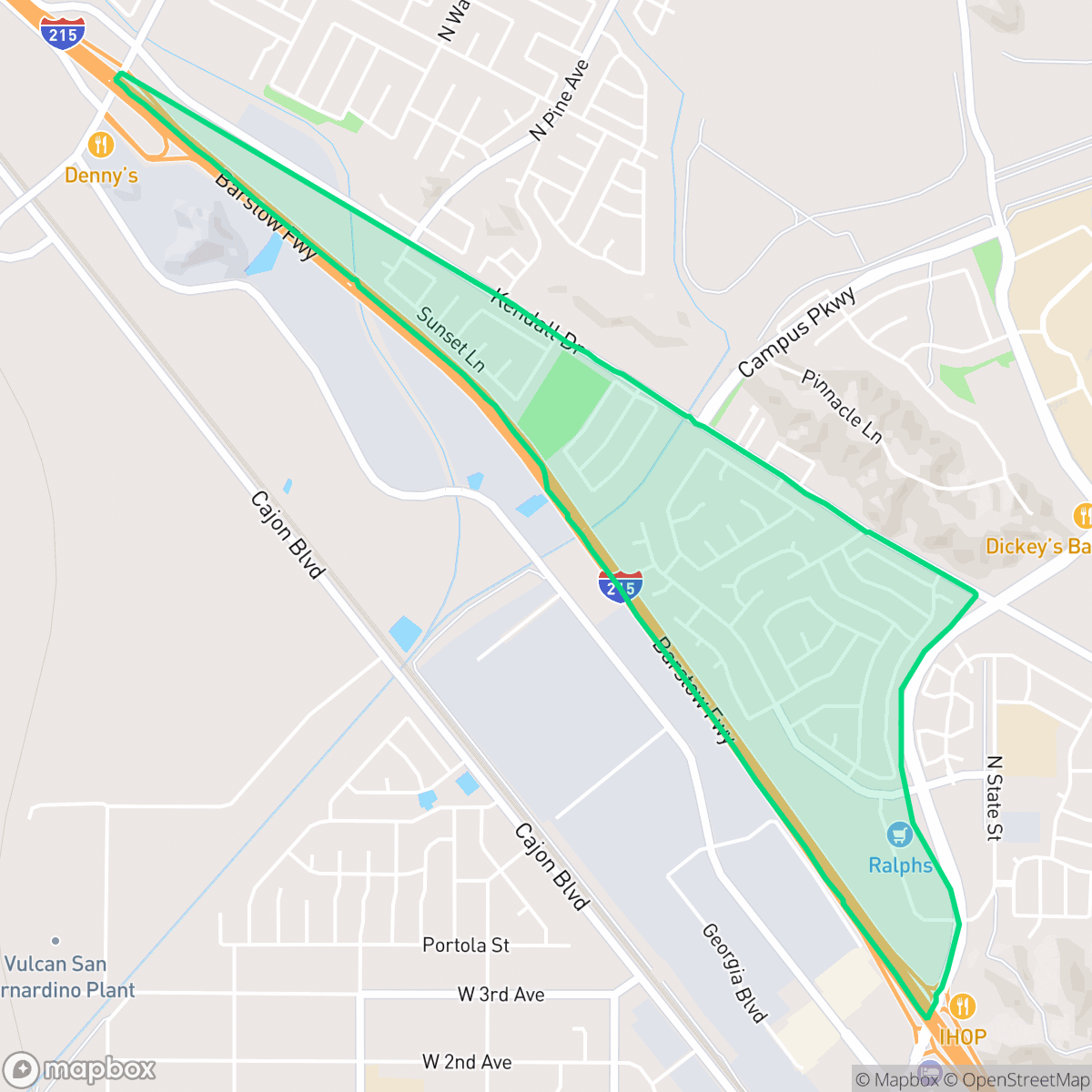
Kendall is a highly walkable suburban enclave in North San Bernardino characterized by 1980s-era tract housing and convenient access to local dining. While residents benefit from a comprehensive sidewalk network, the area features closely spaced homes with limited private outdoor space and proximity to regional industrial zones.
Key Highlights
About Kendall
The Kendall neighborhood in North San Bernardino is deeply rooted in the history of Kendall Drive, constructed between 1924 and 1926 as a safety bypass for Route 66’s dangerous “Death Curve”. The highway was named after Albert G. Kendall, a prominent San Bernardino County Supervisor and civic leader. Historically bordered by parallel rows of Victoria Palms planted by the Chamber of Commerce, the route became a popular motorist haven. Its famous rest stop, "The Junction," hosted cabins, the Junction Cafe, and was the site of the infamous 1954 car crash in which entertainer Sammy Davis Jr. lost his left eye. Today, the neighborhood, also known as Kendall Hills, is a relaxed residential enclave characterized by single-family homes and apartment complexes largely developed during the 1980s.
The neighborhood functions as a dense, suburban residential community. It is defined by a consistent layout of single-family homes and apartment complexes, which provide a uniform aesthetic throughout the area. According to iHuus data, the community maintains a high level of walkability due to an extensive sidewalk network that connects residential streets to local commercial hubs. Residents have access to a variety of dining options, including local favorites like Carnes Y Mariscos Luis and national chains, which contribute to a moderate level of neighborhood activity.
Living in this area involves specific trade-offs regarding environment and safety. While the neighborhood offers a relatively quiet acoustic environment for a suburban setting, it is located near industrial zones that house large warehouses. Prospective residents should note that the area lacks large public parks, making it less ideal for dog owners, and that it faces significant environmental risks regarding fire and flood safety. The local school district provides a mix of educational opportunities, though families should be aware of the varied performance levels across the district.
Neighborhood Scores Across 15 Qualities
Residential spacing provides a moderate level of separation between homes, staying in line with the typical density found across San Bernardino. According to iHuus data, houses are situated relatively close to one another with limited buffers between neighboring structures.
Sidewalks are widely available on residential streets and main arterials, providing a level of walkability that is consistent with the rest of San Bernardino. Low-traffic cul-de-sacs and marked crossings contribute to safe conditions for pedestrians throughout the area.
Standard tract housing defines the landscape, featuring closely spaced homes with small yards and occasional private pools. This area offers slightly more visual variety than the San Bernardino average according to iHuus data.
Narrow sidewalks and a lack of public parks within the residential grid make outdoor exercise for pets less convenient. According to iHuus data, this area offers fewer accessible green spaces for walking than the San Bernardino average.
Residential tracts and apartment complexes sit alongside large-scale warehouses and logistics hubs, creating a landscape that is slightly less open than the San Bernardino average. This area features a blend of dense suburban housing and significant industrial infrastructure according to iHuus data.
A blend of suburban streets and industrial warehouses creates a steady but subdued atmosphere. While diverse dining options are available, the area remains largely car-dependent and lacks the concentrated activity found in more vibrant parts of the city.
Steady sounds from nearby busy streets create a consistent ambient hum. This level of acoustic activity is slightly higher than the average seen across San Bernardino, according to iHuus data.
Air quality in this area is mostly clean with infrequent periods of elevated readings. According to iHuus data, the air quality is slightly lower than the average found across San Bernardino.
Residential areas coexist with active warehouse hubs and logistics facilities, resulting in slightly more industrial density than the San Bernardino average. Residents may encounter increased truck traffic and proximity to large-scale utility sites throughout the area.
Health insurance accessibility is notably higher in Kendall than the San Bernardino average, according to iHuus data. Most residents in this area have access to medical coverage.
Political leanings in Kendall are predominantly liberal, though the area is slightly less progressive than the San Bernardino city average according to iHuus data.
Residents live alongside a balanced mix of young adults, families, and older populations. This demographic spread is largely consistent with the broader San Bernardino area, according to iHuus data.
Flood vulnerability is significantly higher here than in the rest of San Bernardino. Residents should anticipate elevated or potentially prohibitive insurance costs due to the neighborhood's specific hazard profile.
High fire hazards are present in this area; according to iHuus data, the risk level is notably higher than the San Bernardino city average.
Address-Level Insights for Kendall


iHuus Neighborhood Intelligence Insights
Get address-level neighborhood insights for Kendall
- Street-level scores — see how individual blocks compare, not just neighborhood averages
- Micro-zone boundaries — identify quiet pockets, flood boundaries, and walkable clusters before you visit
- 15 dimensions in full — walkability, noise, air quality, school quality, insurance coverage, population age profile, urban/rural index, and more
- Boundary risk alerts — know if your address sits near a block boundary where scores drop, the kind of detail no listing will ever mention
- School insights — individual school ratings and insights, not just district-level data
- Compare before you commit — side-by-side data across neighborhoods, down to block precision
No credit card required
Compare with Any Neighborhood
| Dimension | Kendall | Alessandro |
|---|---|---|
| 🚶 Walkabilityavg 7.12 | ||
| 🔊 Acoustic Comfortavg 4.28 | ||
| 🤫 Privacy Indexavg 5.05 | ||
| 🎨 Visual Appealavg 5.64 | ||
| 🐕 Dog Friendlinessavg 5.15 | ||
| 🗺️ Urban-Rural Indexavg 6.67 | ||
| ✨ Neighborhood Vibeavg 4.38 | ||
| 🏥 Health Insurance Coverageavg 5.05 | ||
| 🌿 Air Qualityavg 9.16 | ||
| 🏭 Industrial Proximityavg 6.81 | ||
| 🌊 Flood Safetyavg 1.26 | ||
| 🗳️ Ideological Leanavg 8.58 | ||
| 👥 Population Age Profileavg 4.36 | ||
| 🔥 Fire Safetyavg 0.3 | ||
| 🏫 School Quality |
Kendall Rankings
School Districts Serving Kendall
School Insights for Kendall
Below average outcomes; significant attendance and academic challenges.
School Insights
See what's really behind every school rating near Kendall
- Individual school ratings — each school's own score with outcome context, not just a district average
- Enrollment & class size data — student-to-teacher ratio and how it compares to the state average
- Full demographics breakdown — ethnicity and gender composition for every school in the enrollment zone
- Every school in the district — all schools within the enrollment boundary ranked by rating, not just the closest one
- Grade levels & benchmarks — elementary through high school, with below/above state-average flags
No credit card required