DRNAG, San Bernardino
Updated · 20,641 residents
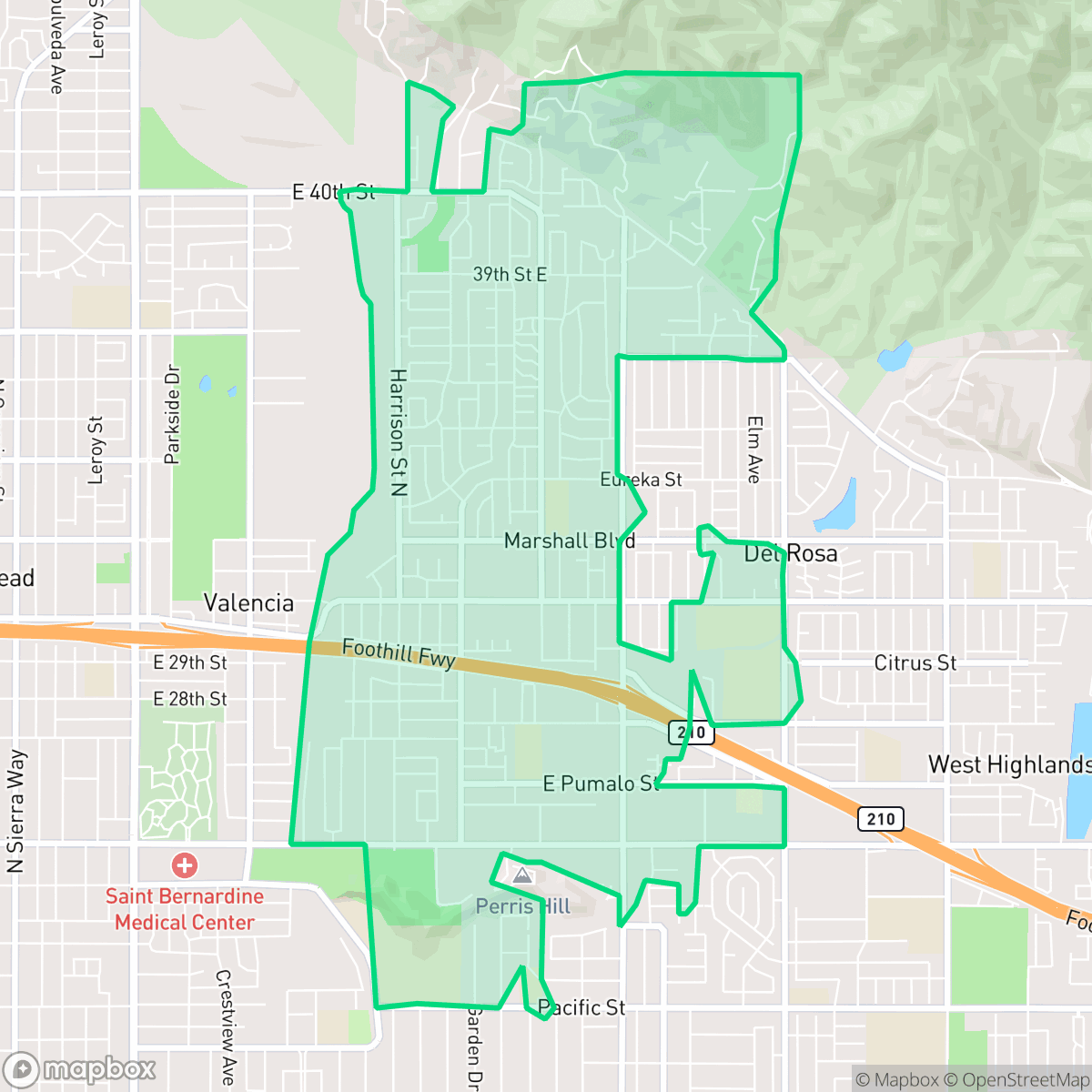
DRNAG is a dense suburban neighborhood in northeastern San Bernardino characterized by a mix of standard tract housing and light industrial pockets. According to iHuus data, the area offers excellent air quality and a moderate level of walkability, though residents often encounter noise from nearby arterial roads.
Key Highlights
About DRNAG
Located in northeastern San Bernardino, the Del Rosa neighborhood—frequently identified in local real estate listings as DRNAG after the Del Rosa Neighborhood Action Group—has a history rooted in early transit and agricultural development. Originally part of West Highland, the area was renamed Del Rosa (a corruption of the Spanish *de la Rosa*) following the arrival of the railroad in 1911 and the establishment of a local post office. Historically, the area featured a foothill Native American settlement, including an 1860s adobe home preserved on Del Rosa Avenue. In 1946, the neighborhood lent its name to the Del Rosa Hotshots, an elite wildland firefighting crew established at a former Civilian Conservation Corps camp. Following severe water shortages in the 1950s, residents voted to annex Del Rosa into San Bernardino.
The neighborhood features a grid layout dominated by single-family homes, mobile home parks, and low-rise commercial developments. While the area maintains a quiet, suburban atmosphere, it is punctuated by pockets of activity near major highways where diverse dining options and local services are concentrated. The presence of numerous private backyard pools and standard tract housing gives the community a consistent visual character that reflects its middle-class suburban roots.
Prospective residents should consider the trade-offs of living in this part of San Bernardino. While the area benefits from superior air quality, walkability is limited by large arterial roads and industrial proximity. Educational opportunities within the local school district show significant variance in performance, and the community experiences challenges regarding health insurance coverage and environmental safety risks. The area is best suited for those seeking a balance between established suburban residential life and access to major transit routes.
Neighborhood Scores Across 15 Qualities
Residential spacing offers a moderate level of separation between neighbors, slightly higher than the San Bernardino average. Some areas feature closely packed homes with minimal setbacks, while other sections provide more traditional suburban buffers.
Consistent sidewalks and safe crossings characterize much of the residential grid, matching the city average for walkability. While some major arterial roads and highway overpasses can create barriers, low traffic streets provide dependable routes for pedestrians.
Large homes and frequent private backyard pools contribute to an appearance that is more upscale than the San Bernardino average. According to iHuus data, the presence of well-maintained properties and spacious driveways enhances the overall visual quality of the area.
Public parks and athletic fields are sparse within the neighborhood, making most greenery dependent on private fenced backyards. Walking routes for pets are constrained by narrow sidewalk verges, which is typical for this area compared to the city average.
Predominantly suburban in character, this area features a mix of single-family housing tracts and commercial strips that closely aligns with the city average. According to iHuus data, the landscape is defined by dense residential development and paved infrastructure rather than significant open or rural land.
Active pockets of dining and local amenities provide more vitality than the city average, though many areas remain quiet and car-dependent. While some blocks feature social hubs and diverse eateries, other sections are characterized by serene, low-density residential landscapes.
Steady sounds from nearby busy streets are common here. According to iHuus data, acoustic levels are slightly higher than the San Bernardino average.
Air quality remains consistently high with minimal health concerns, performing better than the San Bernardino average according to iHuus data.
Residential tranquility is maintained by a lack of heavy industry, though some truck traffic and noise may occur near southern warehouses and utility yards. This area remains significantly clearer of large-scale industrial manufacturing than the San Bernardino average, according to iHuus data.
Health insurance coverage among residents is slightly below the San Bernardino city average, according to iHuus data. This indicates that a significant portion of the local population lacks employer-sponsored or private medical coverage.
Political leanings in this area trend liberal, though this presence is slightly less pronounced than the San Bernardino average according to iHuus data.
Residents live alongside a balanced mix of young adults, families, and seniors. This demographic spread is consistent with the broader San Bernardino area, according to iHuus data.
Significant flood risk exists due to the area's location within a 100-year floodplain, which is notably higher than the San Bernardino average. Residents should be aware that flood insurance is typically required for properties in this neighborhood according to iHuus data.
Fire hazards in this area are exceptionally high, presenting a severe risk that is slightly more pronounced than the San Bernardino city average. Residents should be aware of the extreme fire danger according to iHuus data.
Address-Level Insights for DRNAG


iHuus Neighborhood Intelligence Insights
Get address-level neighborhood insights for DRNAG
- Street-level scores — see how individual blocks compare, not just neighborhood averages
- Micro-zone boundaries — identify quiet pockets, flood boundaries, and walkable clusters before you visit
- 15 dimensions in full — walkability, noise, air quality, school quality, insurance coverage, population age profile, urban/rural index, and more
- Boundary risk alerts — know if your address sits near a block boundary where scores drop, the kind of detail no listing will ever mention
- School insights — individual school ratings and insights, not just district-level data
- Compare before you commit — side-by-side data across neighborhoods, down to block precision
No credit card required
Compare with Any Neighborhood
| Dimension | DRNAG | Alessandro |
|---|---|---|
| 🚶 Walkabilityavg 7.12 | ||
| 🔊 Acoustic Comfortavg 4.28 | ||
| 🤫 Privacy Indexavg 5.05 | ||
| 🎨 Visual Appealavg 5.64 | ||
| 🐕 Dog Friendlinessavg 5.15 | ||
| 🗺️ Urban-Rural Indexavg 6.67 | ||
| ✨ Neighborhood Vibeavg 4.38 | ||
| 🏥 Health Insurance Coverageavg 5.05 | ||
| 🌿 Air Qualityavg 9.16 | ||
| 🏭 Industrial Proximityavg 6.81 | ||
| 🌊 Flood Safetyavg 1.26 | ||
| 🗳️ Ideological Leanavg 8.58 | ||
| 👥 Population Age Profileavg 4.36 | ||
| 🔥 Fire Safetyavg 0.3 | ||
| 🏫 School Quality |
DRNAG Rankings
School Districts Serving DRNAG
School Insights for DRNAG
Below average outcomes; significant attendance and academic challenges.
School Insights
See what's really behind every school rating near DRNAG
- Individual school ratings — each school's own score with outcome context, not just a district average
- Enrollment & class size data — student-to-teacher ratio and how it compares to the state average
- Full demographics breakdown — ethnicity and gender composition for every school in the enrollment zone
- Every school in the district — all schools within the enrollment boundary ranked by rating, not just the closest one
- Grade levels & benchmarks — elementary through high school, with below/above state-average flags
No credit card required