California State College San Bernardino, San Bernardino
Updated · 1,939 residents
The California State College San Bernardino neighborhood is a quiet, foothill community defined by its proximity to the university campus and expansive green spaces. Residents benefit from high walkability and excellent air quality, creating a serene environment well-suited for students and families.
Key Highlights
About California State College San Bernardino
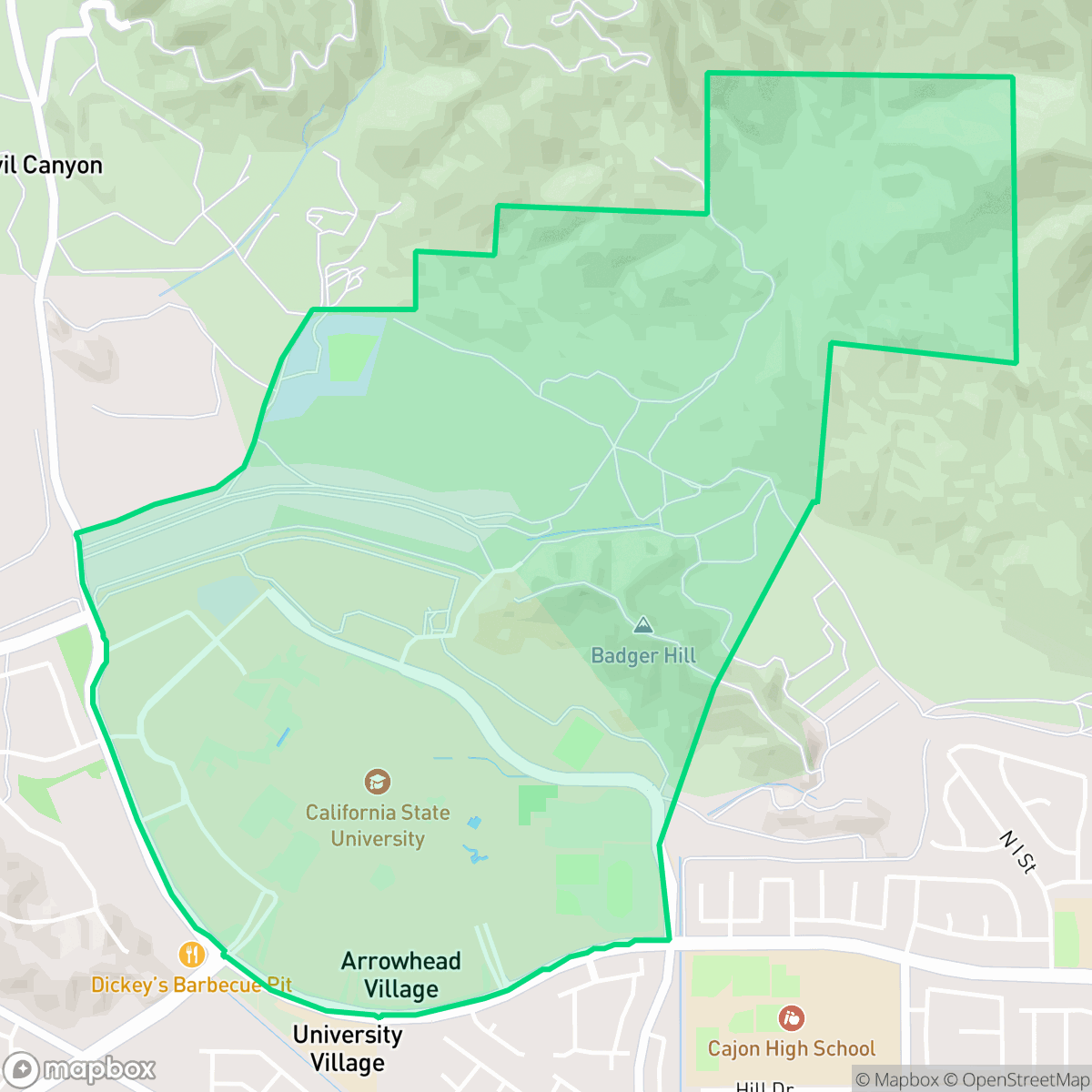
The California State College San Bernardino neighborhood, historically known as the University District or University Hills, is a foothill college town situated at the base of the San Bernardino Mountains. Before the campus was established, the area consisted primarily of mid-desert farmland and agricultural acreage, which included 50 acres of active vineyards originally owned by the Ellena Brothers of Rancho Cucamonga. The neighborhood’s modern identity began to take shape in 1963 when the California State College system's board of trustees selected a 430-acre site for the new campus, which officially opened to students in 1965. Framed by University Parkway and Kendall Drive—the district's primary commercial corridors and student nightlife hubs—the neighborhood transitioned rapidly from agricultural land into a thriving suburban university community.
This neighborhood functions as a suburban hub centered around higher education, featuring a blend of apartment complexes and single-family homes. With its high walkability and extensive network of pedestrian paths, the area facilitates easy movement between residential zones and student-oriented commercial spots along University Parkway and Kendall Drive. The environment is notably quiet, offering a peaceful atmosphere that stands out within the broader San Bernardino region.
Prospective residents should weigh the benefits of high air quality and strong community health coverage against potential environmental considerations, such as the proximity of an EPA-monitored site. While the area offers significant outdoor recreational opportunities and pet-friendly spaces, the regional fire risk remains a factor for homeowners to consider. Overall, the community is well-suited for those seeking a balance of academic-adjacent living and suburban tranquility.
Neighborhood Scores Across 15 Qualities
Residential and institutional layouts offer a mix of spacing, with some areas featuring larger buffers and others characterized by closely situated structures. This level of separation is roughly in line with the San Bernardino average, according to iHuus data.
Extensive sidewalk networks and dedicated campus paths prioritize pedestrian movement away from vehicles. This area offers significantly better walkability than the San Bernardino average.
Typical tract housing and apartment complexes define the area, featuring modest yards and shared amenities. The visual landscape is slightly more varied than the San Bernardino average due to a mix of residential densities.
Abundant grassy lawns and large public parks offer extensive areas for pets to roam. This level of access to open green space is significantly higher than the San Bernardino city average, according to iHuus data.
Large patches of open land and low-density structures create a semi-rural atmosphere that is slightly more open than the typical San Bernardino setting. This area features a mix of institutional campus buildings and vast open spaces characteristic of a desert fringe.
Daily activity is characterized by a balanced mix of residential life and essential services, mirroring the general level of liveliness found across San Bernardino. The area provides a quiet atmosphere with occasional social spots and local amenities scattered throughout the suburban landscape.
A steady hum of local traffic from nearby busy streets is common here. According to iHuus data, acoustic comfort is notably higher than the San Bernardino city average.
Air quality in this area is exceptionally high with minimal health concerns. According to iHuus data, the air remains cleaner than the San Bernardino city average.
Mixed-use development featuring educational and residential zones is interspersed with earthworks and nearby environmental concerns related to groundwater contamination. According to iHuus data, the level of industrial proximity is lower than the San Bernardino city average.
Health insurance accessibility is significantly higher here than the San Bernardino city average, according to iHuus data.
Voting patterns and census indicators reflect a predominantly liberal political leaning that is slightly more pronounced than the San Bernardino city average, according to iHuus data.
A high concentration of students and young adults defines the area, resulting in a demographic profile that is more skewed toward a younger age range than the San Bernardino average.
Located within a designated floodplain, this area faces a much higher risk of flooding than the San Bernardino average. Residents should be aware that flood insurance is typically required for properties in this zone according to iHuus data.
Fire hazards are significantly more prevalent here than in the rest of San Bernardino, necessitating heightened awareness and enhanced mitigation measures. According to iHuus data, this area presents a much greater risk of fire incidents compared to the city average.
Address-Level Insights for California State College San Bernardino


iHuus Neighborhood Intelligence Insights
Get address-level neighborhood insights for California State College San Bernardino
- Street-level scores — see how individual blocks compare, not just neighborhood averages
- Micro-zone boundaries — identify quiet pockets, flood boundaries, and walkable clusters before you visit
- 15 dimensions in full — walkability, noise, air quality, school quality, insurance coverage, population age profile, urban/rural index, and more
- Boundary risk alerts — know if your address sits near a block boundary where scores drop, the kind of detail no listing will ever mention
- School insights — individual school ratings and insights, not just district-level data
- Compare before you commit — side-by-side data across neighborhoods, down to block precision
No credit card required
Compare with Any Neighborhood
| Dimension | California State College San Bernardino | Alessandro |
|---|---|---|
| 🚶 Walkabilityavg 7.12 | ||
| 🔊 Acoustic Comfortavg 4.28 | ||
| 🤫 Privacy Indexavg 5.05 | ||
| 🎨 Visual Appealavg 5.64 | ||
| 🐕 Dog Friendlinessavg 5.15 | ||
| 🗺️ Urban-Rural Indexavg 6.67 | ||
| ✨ Neighborhood Vibeavg 4.38 | ||
| 🏥 Health Insurance Coverageavg 5.05 | ||
| 🌿 Air Qualityavg 9.16 | ||
| 🏭 Industrial Proximityavg 6.81 | ||
| 🌊 Flood Safetyavg 1.26 | ||
| 🗳️ Ideological Leanavg 8.58 | ||
| 👥 Population Age Profileavg 4.36 | ||
| 🔥 Fire Safetyavg 0.3 | ||
| 🏫 School Quality |
California State College San Bernardino Rankings
School Districts Serving California State College San Bernardino
School Insights for California State College San Bernardino
Below average outcomes; significant attendance and academic challenges.
School Insights
See what's really behind every school rating near California State College San Bernardino
- Individual school ratings — each school's own score with outcome context, not just a district average
- Enrollment & class size data — student-to-teacher ratio and how it compares to the state average
- Full demographics breakdown — ethnicity and gender composition for every school in the enrollment zone
- Every school in the district — all schools within the enrollment boundary ranked by rating, not just the closest one
- Grade levels & benchmarks — elementary through high school, with below/above state-average flags
No credit card required