Cajon, San Bernardino
Updated · 4,675 residents
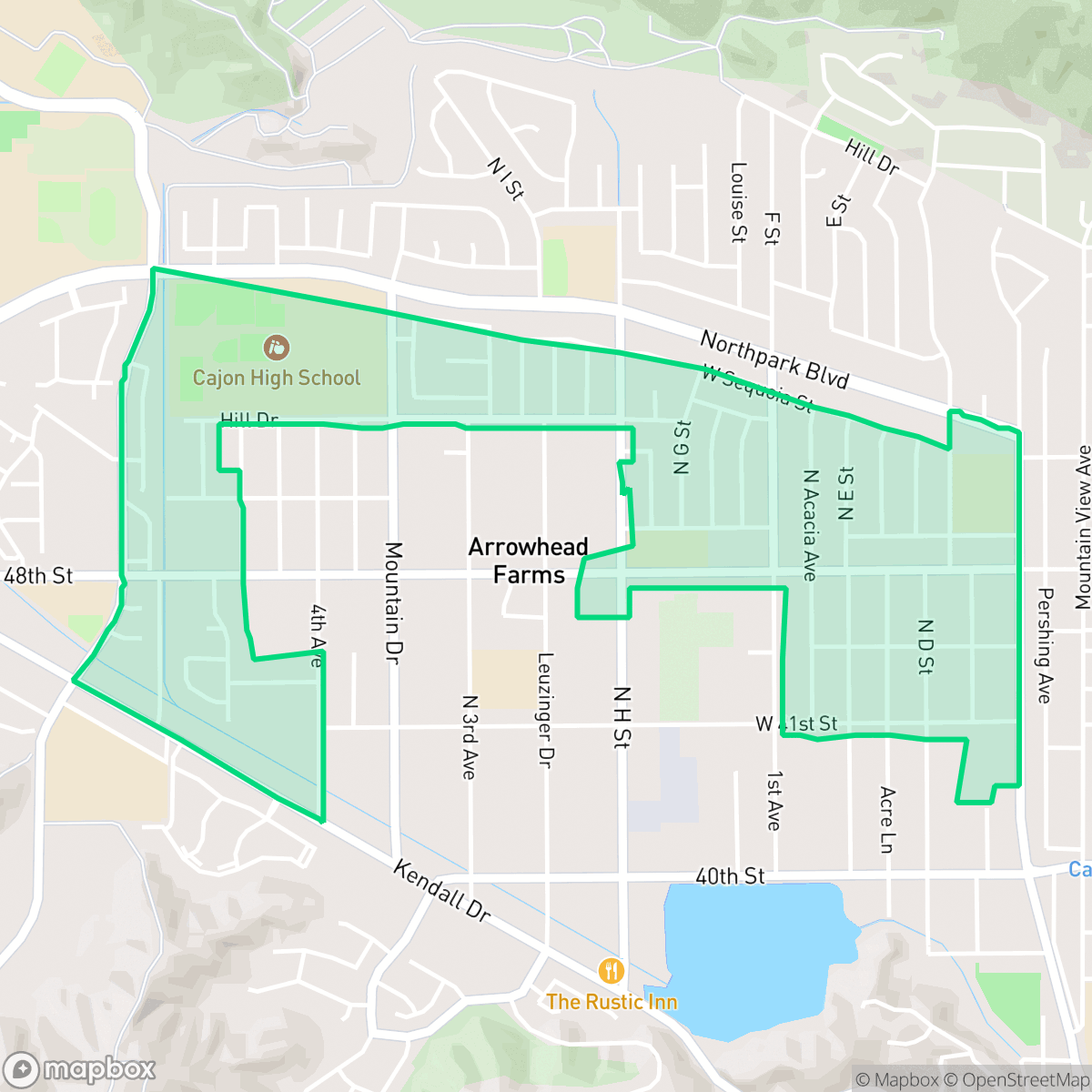
Cajon is a quiet, semi-rural residential community known for its proximity to the San Bernardino Mountains and clean air. While the neighborhood offers a generally walkable layout with sidewalks on most streets, it remains a car-dependent area with limited local commercial amenities.
Key Highlights
About Cajon
The Cajon neighborhood in San Bernardino is a residential community situated approximately 5.5 miles from downtown, known for its proximity to the San Bernardino Mountains and California State University, San Bernardino. Developed largely with mid-century, ranch-style, and Spanish-inspired architecture, the area is characterized by its tree-lined streets and boulevard designs that incorporate central landscaping. A significant local landmark is Tom Gold Park, which offers residents access to playgrounds and mountain hiking trails. The neighborhood’s cultural identity is anchored by long-standing local establishments like Rosa Maria’s, a staple for authentic Mexican cuisine for over four decades. Positioned near the 210 and 215 freeways, Cajon serves as a gateway for outdoor enthusiasts while maintaining a distinct residential character shaped by its natural surroundings and established housing stock.
The area features a mix of standard suburban tracts and lower-density pockets that provide a semi-rural atmosphere. Residents benefit from higher-than-average air quality and better access to health insurance compared to the broader San Bernardino city average. The neighborhood maintains a moderate level of privacy, though some residential pockets feature higher density, and the overall landscape is defined by uniform roof geometries and modest yards. According to iHuus data, residents should be aware of potential groundwater contamination risks linked to historical industrial activity in the region.
Prospective residents should consider the elevated fire risk prevalent in this region, which necessitates proactive mitigation efforts. Additionally, while the area is generally walkable, some blocks still feature dirt shoulders that can limit ease of movement. The local school district, San Bernardino City Unified, faces ongoing challenges with teacher retention and academic proficiency, though it continues to invest in facility upgrades and career-focused pathways for students.
Neighborhood Scores Across 15 Qualities
Housing density in Cajon is slightly higher than the San Bernardino average, featuring a mix of closely spaced homes and standard suburban layouts. Some areas include apartment clusters and higher density residential pockets where houses are positioned near one another.
Sidewalks are present on most streets and residential cul-de-sacs, making the area slightly more walkable than the San Bernardino average. While major roads feature consistent crossings, some larger blocks still contain dirt shoulders that may limit ease of movement.
Uniform tract housing and repetitive roof geometries define the landscape, which is largely consistent with the San Bernardino average. Residents will find modest yards and some private pools, though many properties feature unpaved or dirt-covered lot sections.
Public parks and school sports fields offer decent space for exercise, though access to public greenery is somewhat limited compared to the San Bernardino average. Most greenery in the area is contained within private, fenced backyards.
Open land and scattered homes characterize this area, which maintains a slightly more rural atmosphere than the San Bernardino average. Resident surroundings vary from dense suburban housing tracts to low-density pockets featuring large vacant lots and woodland edges.
Low business density and a car-oriented layout make local amenities less accessible than in other parts of the city. Residents can expect a calm, suburban atmosphere characterized by significant open space and light industrial pockets.
Steady traffic sounds from a nearby busy street are noticeable, though levels remain higher than the San Bernardino average. Residents can expect a consistent hum of local activity throughout the day.
Air quality remains consistently high with minimal health concerns for residents. According to iHuus data, these levels are notably better than the San Bernardino city average.
Heavy industrial activity is significantly lower here than the San Bernardino average, featuring a mix of residential life and hotel presence. However, proximity to an EPA Superfund site means residents should be aware of potential groundwater contamination risks identified by iHuus data.
Health insurance access in Cajon is notably higher than the San Bernardino city average, according to iHuus data.
Political leanings in this area are largely liberal, though the neighborhood is slightly less progressive than the San Bernardino average according to iHuus data.
Residents live alongside a balanced mix of young adults, families, and older individuals. This demographic spread is consistent with the average found across San Bernardino.
Flood risk levels in Cajon are higher than the San Bernardino average, though official FEMA studies for this specific area remain incomplete. Residents should remain aware of potential drainage concerns since detailed flood mapping has not been finalized for this neighborhood.
Fire hazards are significantly more prevalent in Cajon than in the rest of San Bernardino. According to iHuus data, residents should be prepared for enhanced mitigation requirements due to the elevated risk levels.
Address-Level Insights for Cajon


iHuus Neighborhood Intelligence Insights
Get address-level neighborhood insights for Cajon
- Street-level scores — see how individual blocks compare, not just neighborhood averages
- Micro-zone boundaries — identify quiet pockets, flood boundaries, and walkable clusters before you visit
- 15 dimensions in full — walkability, noise, air quality, school quality, insurance coverage, population age profile, urban/rural index, and more
- Boundary risk alerts — know if your address sits near a block boundary where scores drop, the kind of detail no listing will ever mention
- School insights — individual school ratings and insights, not just district-level data
- Compare before you commit — side-by-side data across neighborhoods, down to block precision
No credit card required
Compare with Any Neighborhood
| Dimension | Cajon | Alessandro |
|---|---|---|
| 🚶 Walkabilityavg 7.12 | ||
| 🔊 Acoustic Comfortavg 4.28 | ||
| 🤫 Privacy Indexavg 5.05 | ||
| 🎨 Visual Appealavg 5.64 | ||
| 🐕 Dog Friendlinessavg 5.15 | ||
| 🗺️ Urban-Rural Indexavg 6.67 | ||
| ✨ Neighborhood Vibeavg 4.38 | ||
| 🏥 Health Insurance Coverageavg 5.05 | ||
| 🌿 Air Qualityavg 9.16 | ||
| 🏭 Industrial Proximityavg 6.81 | ||
| 🌊 Flood Safetyavg 1.26 | ||
| 🗳️ Ideological Leanavg 8.58 | ||
| 👥 Population Age Profileavg 4.36 | ||
| 🔥 Fire Safetyavg 0.3 | ||
| 🏫 School Quality |
Cajon Rankings
School Districts Serving Cajon
School Insights for Cajon
Below average outcomes; significant attendance and academic challenges.
School Insights
See what's really behind every school rating near Cajon
- Individual school ratings — each school's own score with outcome context, not just a district average
- Enrollment & class size data — student-to-teacher ratio and how it compares to the state average
- Full demographics breakdown — ethnicity and gender composition for every school in the enrollment zone
- Every school in the district — all schools within the enrollment boundary ranked by rating, not just the closest one
- Grade levels & benchmarks — elementary through high school, with below/above state-average flags
No credit card required