Arrowhead, San Bernardino
Updated · 9,014 residents
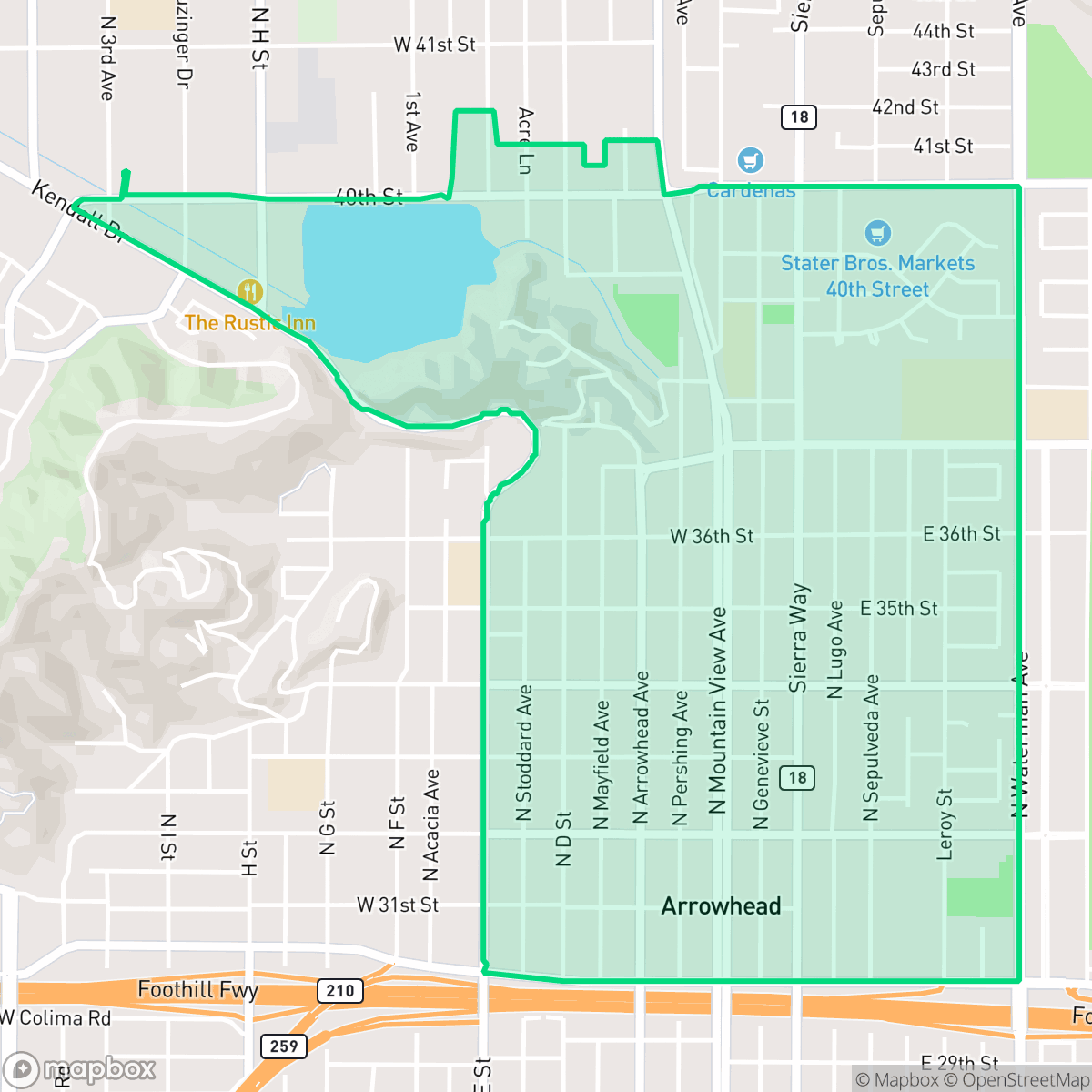
Arrowhead is defined by its proximity to the iconic geological landmark and a semi-rural landscape that balances suburban density with quiet residential streets. The area offers high air quality and surprising pedestrian connectivity, making it a distinct pocket within the broader San Bernardino region.
Key Highlights
About Arrowhead
The Arrowhead neighborhood, particularly the Arrowhead Springs area, is defined by its proximity to the iconic 'Arrowhead' geological monument, a 7.5-acre natural quartz formation on the San Bernardino Mountains designated as California Historical Landmark #977. For centuries, the Serrano people regarded the site as sacred, believing the landmark pointed toward the area's natural hot mineral springs. In the late 19th and early 20th centuries, the region developed into a premier health resort destination, culminating in the 1939 construction of the Arrowhead Springs Hotel. Designed by architects Paul R. Williams and Gordon Kaufmann with interiors by Dorothy Draper, the hotel became a glamorous retreat for Hollywood celebrities. While the resort later served as a naval hospital during World War II and headquarters for Campus Crusade for Christ, it remains a central cultural touchstone for the city.
The neighborhood maintains a steady suburban rhythm characterized by modest tract housing and a layout that feels more open than much of the surrounding city. Residents benefit from exceptionally clean air and a grid system that supports easy pedestrian movement, providing a sense of space in a semi-rural setting. While the area is primarily residential, its proximity to the mountains creates a unique environment where private backyard pools and green spaces contribute to the visual landscape. According to iHuus data, the area offers a quieter, more tranquil acoustic environment than the city average despite the presence of some nearby traffic.
Prospective residents should weigh the area's natural appeal against specific environmental and infrastructure considerations. The neighborhood faces significant wildfire vulnerability and elevated flood risks, which are important factors for long-term planning. While the local school district is working through systemic transitions and facility upgrades, families should research specific school performance as the district contains a mix of both high-performing magnet programs and underperforming schools. The area is best suited for those who prioritize clean air and a quieter suburban pace, provided they are prepared for the realities of living in a high-risk natural environment.
Neighborhood Scores Across 15 Qualities
Residential spacing is largely average for the city, though density increases significantly near apartment clusters and trailer parks. Houses in certain areas share close property lines with minimal buffer between neighbors.
Pedestrian movement is easy due to a consistent grid with dedicated sidewalks and safe crossings. This connectivity is notably higher than the San Bernardino average, according to iHuus data.
Typical tract housing characterizes the area, featuring modest yards and closely spaced homes. According to iHuus data, the visual landscape is slightly more varied than the San Bernardino average due to the presence of private backyard pools.
Most greenery is found within private fenced backyards, as public park access and wide sidewalk verges are limited. According to iHuus data, this area offers slightly more opportunities for pet activity than the San Bernardino average.
Frequent open land and scattered homes characterize this area, offering a layout that is slightly more rural than the San Bernardino average.
A balanced mix of residential streets, green spaces, and local dining provides a steady energy that is slightly more active than the San Bernardino average. While various social hubs and eateries are present, the area remains largely car-dependent with limited walkability for daily errands.
Steady sounds from nearby busy streets are present, though acoustic conditions are slightly more tranquil than the San Bernardino average according to iHuus data.
Air quality remains consistently high with minimal health concerns. According to iHuus data, levels of atmospheric pollutants are notably lower than the San Bernardino city average.
Industrial presence is minimal and remains slightly lower than the San Bernardino average. While most streets are quiet, some western edges near the freeway feature warehouse structures, and residents should be aware of a nearby EPA Superfund site according to iHuus data.
Health insurance access in Arrowhead is slightly higher than the San Bernardino city average, according to iHuus data. Residents may encounter a moderate level of uninsured individuals within the community.
Political leanings in this area trend liberal, though the concentration is slightly lower than the San Bernardino city average according to iHuus data.
Residents live alongside a diverse range of age groups, ranging from young adults to older populations. According to iHuus data, this age distribution is consistent with the broader San Bernardino area.
Flood vulnerability is elevated in this area because portions of the neighborhood fall within a designated floodplain. According to iHuus data, this risk is higher than the average for San Bernardino.
High wildfire vulnerability is a primary concern in this area, with fire safety levels sitting slightly below the San Bernardino city average according to iHuus data.
Address-Level Insights for Arrowhead


iHuus Neighborhood Intelligence Insights
Get address-level neighborhood insights for Arrowhead
- Street-level scores — see how individual blocks compare, not just neighborhood averages
- Micro-zone boundaries — identify quiet pockets, flood boundaries, and walkable clusters before you visit
- 15 dimensions in full — walkability, noise, air quality, school quality, insurance coverage, population age profile, urban/rural index, and more
- Boundary risk alerts — know if your address sits near a block boundary where scores drop, the kind of detail no listing will ever mention
- School insights — individual school ratings and insights, not just district-level data
- Compare before you commit — side-by-side data across neighborhoods, down to block precision
No credit card required
Compare with Any Neighborhood
| Dimension | Arrowhead | Alessandro |
|---|---|---|
| 🚶 Walkabilityavg 7.12 | ||
| 🔊 Acoustic Comfortavg 4.28 | ||
| 🤫 Privacy Indexavg 5.05 | ||
| 🎨 Visual Appealavg 5.64 | ||
| 🐕 Dog Friendlinessavg 5.15 | ||
| 🗺️ Urban-Rural Indexavg 6.67 | ||
| ✨ Neighborhood Vibeavg 4.38 | ||
| 🏥 Health Insurance Coverageavg 5.05 | ||
| 🌿 Air Qualityavg 9.16 | ||
| 🏭 Industrial Proximityavg 6.81 | ||
| 🌊 Flood Safetyavg 1.26 | ||
| 🗳️ Ideological Leanavg 8.58 | ||
| 👥 Population Age Profileavg 4.36 | ||
| 🔥 Fire Safetyavg 0.3 | ||
| 🏫 School Quality |
Arrowhead Rankings
School Districts Serving Arrowhead
School Insights for Arrowhead
Below average outcomes; significant attendance and academic challenges.
School Insights
See what's really behind every school rating near Arrowhead
- Individual school ratings — each school's own score with outcome context, not just a district average
- Enrollment & class size data — student-to-teacher ratio and how it compares to the state average
- Full demographics breakdown — ethnicity and gender composition for every school in the enrollment zone
- Every school in the district — all schools within the enrollment boundary ranked by rating, not just the closest one
- Grade levels & benchmarks — elementary through high school, with below/above state-average flags
No credit card required