Arrowhead Farms, San Bernardino
Updated · 3,861 residents
Arrowhead Farms is a quiet, semi-rural enclave in San Bernardino known for its tranquil atmosphere and superior air quality. While the neighborhood offers a peaceful residential setting with a diverse age profile, residents rely heavily on personal vehicles for daily errands due to limited local services.
Key Highlights
About Arrowhead Farms
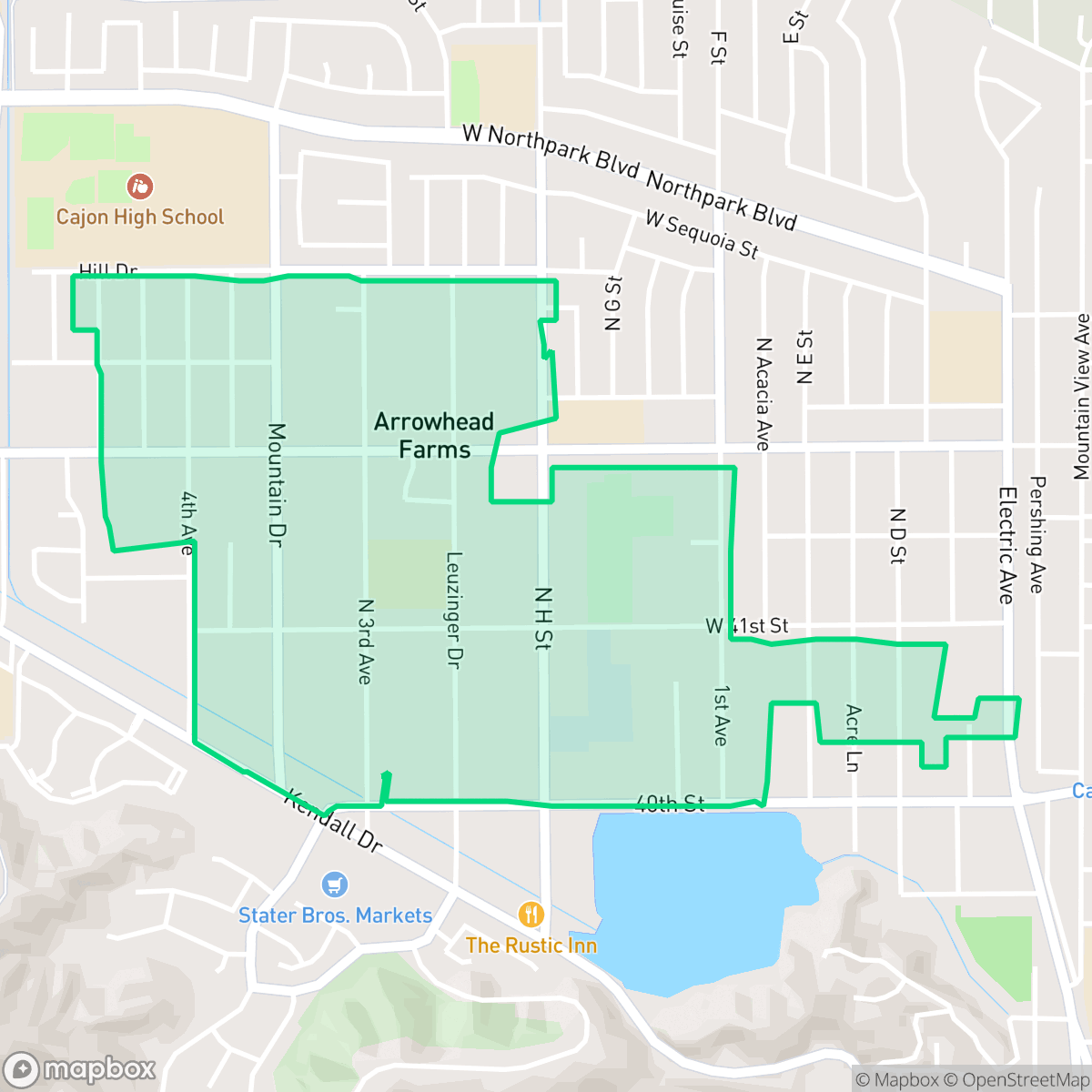
Arrowhead Farms is an unincorporated community and 'county island' situated within the city of San Bernardino, California. Its history traces back to the 1870s as part of the broader Arrowhead Settlement, established by pioneers on fertile land near mountain creeks. The area was formally promoted as 'Arrowhead Suburban Farms' in 1919 by the Newmark Grain Company, which subdivided tracts for small-scale agriculture, including citrus and nut orchards. Named for the iconic arrowhead-shaped rock formation visible in the San Bernardino Mountains, the neighborhood has maintained a distinct identity as an unincorporated enclave. While much of the surrounding region was annexed by the city, Arrowhead Farms retains remnants of its rural, agricultural origins, currently undergoing modern infrastructure transitions, such as municipal sewer integration, to support its long-standing residential character.
The area maintains a distinct semi-rural character defined by standard tract housing and open land. Residents enjoy a notably quiet environment with minimal noise pollution, complemented by excellent air quality that ranks among the best in the city. The layout provides a moderate level of privacy, with housing density that offers more separation between neighbors than is typical for the broader San Bernardino region.
Living in this community requires a car, as most services and amenities are not within walking distance. While the area is generally peaceful, prospective residents should be aware of specific environmental considerations, including a heightened risk of fire and potential groundwater concerns related to nearby legacy industrial sites. Families should also consider that local schools are part of a district facing systemic operational challenges, though the area remains a stable option for those prioritizing a quiet, suburban lifestyle over urban density.
Neighborhood Scores Across 15 Qualities
Residential spacing is moderately varied, offering more separation between neighbors than the San Bernardino average. While some apartment clusters and trailer parks feature closely spaced homes, much of the area maintains standard suburban distances between houses.
Sidewalks are available on many residential streets, though high-traffic arterials and occasional dirt shoulders make walking less convenient than in other parts of the city.
Standard tract housing with repetitive rooflines and small yards characterizes this area. Visual variety is limited, though some properties feature private pools and paved landscaping, making the aesthetic roughly comparable to the San Bernardino average.
Most green space is contained within private, fenced backyards, as the neighborhood lacks the wide sidewalks or frequent public parks found elsewhere in San Bernardino. Walking routes for pets are primarily restricted to residential streets with narrow verges.
Frequent open land and scattered homes among fields define this area, offering a setting very similar to the broader San Bernardino average. According to iHuus data, the landscape features a mix of low-density residential layouts and large vacant lots.
Suburban streets and green spaces offer a calm atmosphere, but the area is less lively than the San Bernardino average due to a reliance on vehicles for errands. While local dining and churches are present, most services require driving as few businesses are within walking distance.
Acoustic levels are notably lower than the San Bernardino average, consisting primarily of infrequent distant trains and sporadic vehicle noise. According to iHuus data, this area provides a much more tranquil setting than most parts of the city.
Air quality in this area is consistently high with minimal health concerns. According to iHuus data, the air purity in Arrowhead Farms remains notably better than the San Bernardino city average.
Industrial activity is significantly lower here than in the rest of San Bernardino. While heavy commercial operators are not visible within the immediate residential area, proximity to a nearby EPA Superfund site may present potential groundwater contamination risks.
Health insurance access is slightly higher than the San Bernardino average, according to iHuus data.
Political leanings in this area are predominantly liberal, though the community shows slightly less progressive density than the San Bernardino average according to iHuus data.
A balanced mix of young adults, families, and older residents characterizes the area, reflecting the same demographic spread found across San Bernardino.
Flood risk in this area remains undetermined because FEMA has not completed a detailed study for this specific location. According to iHuus data, the risk level is higher than the San Bernardino city average.
High fire hazards persist in this area, representing a much higher risk level than the San Bernardino average. Residents should be aware of the increased need for enhanced fire mitigation measures according to iHuus data.
Address-Level Insights for Arrowhead Farms


iHuus Neighborhood Intelligence Insights
Get address-level neighborhood insights for Arrowhead Farms
- Street-level scores — see how individual blocks compare, not just neighborhood averages
- Micro-zone boundaries — identify quiet pockets, flood boundaries, and walkable clusters before you visit
- 15 dimensions in full — walkability, noise, air quality, school quality, insurance coverage, population age profile, urban/rural index, and more
- Boundary risk alerts — know if your address sits near a block boundary where scores drop, the kind of detail no listing will ever mention
- School insights — individual school ratings and insights, not just district-level data
- Compare before you commit — side-by-side data across neighborhoods, down to block precision
No credit card required
Compare with Any Neighborhood
| Dimension | Arrowhead Farms | Alessandro |
|---|---|---|
| 🚶 Walkabilityavg 7.12 | ||
| 🔊 Acoustic Comfortavg 4.28 | ||
| 🤫 Privacy Indexavg 5.05 | ||
| 🎨 Visual Appealavg 5.64 | ||
| 🐕 Dog Friendlinessavg 5.15 | ||
| 🗺️ Urban-Rural Indexavg 6.67 | ||
| ✨ Neighborhood Vibeavg 4.38 | ||
| 🏥 Health Insurance Coverageavg 5.05 | ||
| 🌿 Air Qualityavg 9.16 | ||
| 🏭 Industrial Proximityavg 6.81 | ||
| 🌊 Flood Safetyavg 1.26 | ||
| 🗳️ Ideological Leanavg 8.58 | ||
| 👥 Population Age Profileavg 4.36 | ||
| 🔥 Fire Safetyavg 0.3 | ||
| 🏫 School Quality |
Arrowhead Farms Rankings
School Districts Serving Arrowhead Farms
School Insights for Arrowhead Farms
Below average outcomes; significant attendance and academic challenges.
School Insights
See what's really behind every school rating near Arrowhead Farms
- Individual school ratings — each school's own score with outcome context, not just a district average
- Enrollment & class size data — student-to-teacher ratio and how it compares to the state average
- Full demographics breakdown — ethnicity and gender composition for every school in the enrollment zone
- Every school in the district — all schools within the enrollment boundary ranked by rating, not just the closest one
- Grade levels & benchmarks — elementary through high school, with below/above state-average flags
No credit card required