Amber Hills, San Bernardino
Updated · 12,204 residents
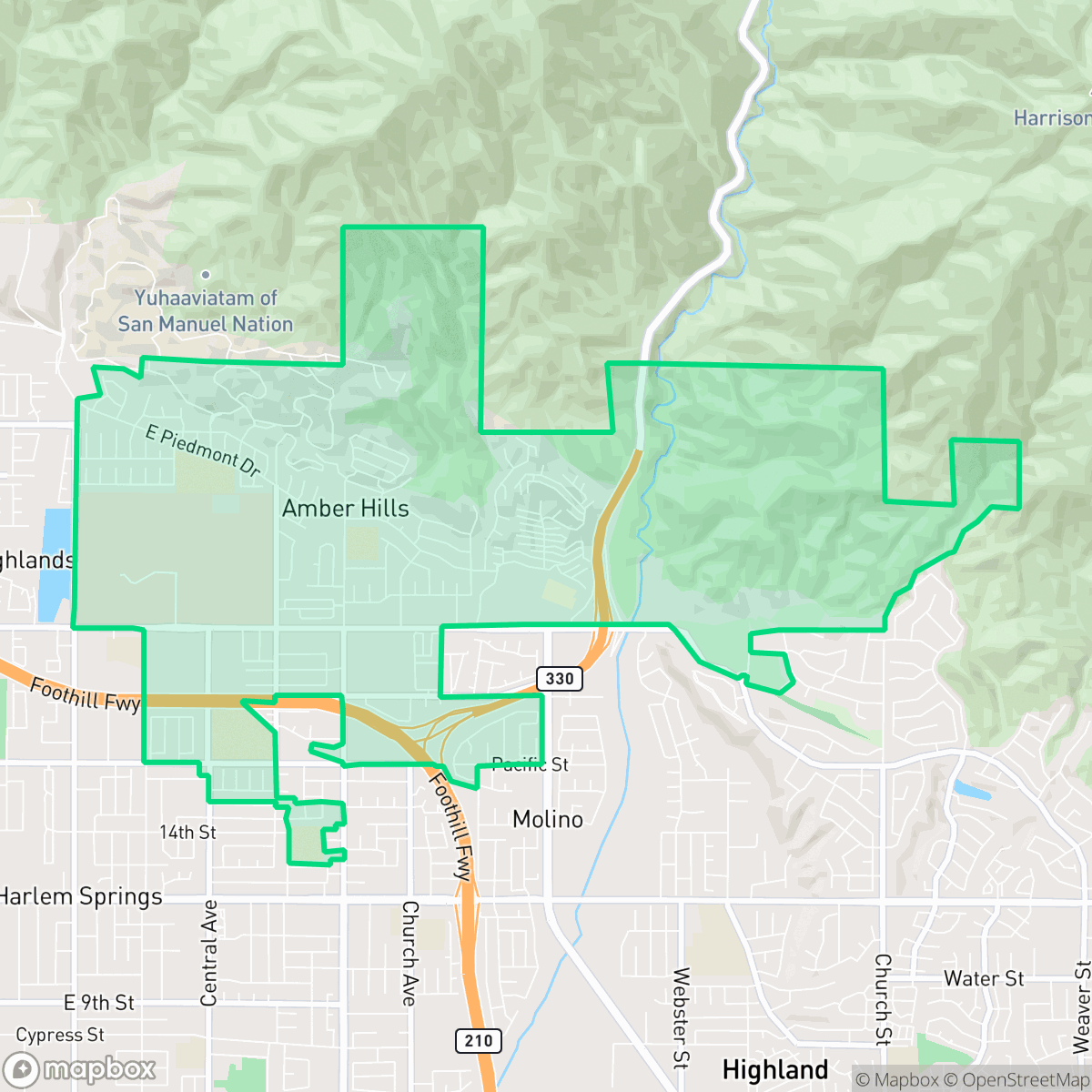
Amber Hills is a quiet suburban neighborhood in San Bernardino characterized by standard tract housing and proximity to rugged, undeveloped hillsides. While the area offers high air quality and consistent residential sidewalks, residents face limited local commercial options and proximity to industrial zones.
Key Highlights
About Amber Hills
Amber Hills serves as a residential enclave that blends dense suburban development with transitions into mountainous terrain. The neighborhood features a mix of tract housing and multi-family complexes, often complemented by private backyard pools. According to iHuus data, the area maintains a high air quality rating and a moderate walkability score, though the presence of major freeway infrastructure and nearby industrial warehouses contributes to a steady ambient noise level from road traffic.
Living here involves certain trade-offs, particularly regarding environmental safety, as the region faces elevated risks for both fire and flooding. While the neighborhood provides a serene atmosphere with access to open green spaces and school fields, it lacks a robust selection of local businesses, requiring residents to travel for most essential services. This area is best suited for those who prioritize a quiet, suburban lifestyle and proximity to natural landscapes over immediate access to urban amenities.
Neighborhood Scores Across 15 Qualities
Residential density varies from closely packed housing units to more spacious suburban lots, providing slightly more separation between neighbors than the San Bernardino average. According to iHuus data, some areas feature shared walls in high-density complexes while others maintain moderate setbacks.
Sidewalk networks are consistent across residential blocks and major transit corridors, though the adjacent highway acts as a significant barrier to movement. This level of connectivity is slightly higher than the San Bernardino average according to iHuus data.
Residential streetscapes feature a variety of tract housing and multi-family complexes with frequent private backyard pools. This area offers a more visually pleasant environment than the San Bernardino average according to iHuus data.
Access to large soccer complexes and expansive green fields offers more space for pet exercise than the San Bernardino average. Some residential pockets feature narrower verges and rely more heavily on private fenced yards.
Residential pockets consist of suburban housing interspersed with large undeveloped hillsides and open land. This landscape offers a slightly more open feel compared to the typical San Bernardino urban density.
A mix of serene residential pockets and light industrial zones creates a steady but low-key atmosphere, remaining largely in line with the San Bernardino average. While some areas offer accessible dining and social hubs, much of the neighborhood is car-dependent and lacks a dense commercial center.
Frequent noise from nearby freeways and railroad tracks characterizes the area. According to iHuus data, acoustic comfort in Amber Hills is notably lower than the San Bernardino average.
Air quality in Amber Hills remains exceptionally high with minimal health concerns. According to iHuus data, the air quality here is notably cleaner than the San Bernardino average.
Residential life remains largely undisturbed by heavy industry, though some light utility infrastructure and warehouse areas exist near the northern borders. According to iHuus data, this lack of significant industrial activity is notably lower than the San Bernardino average.
Health insurance access in Amber Hills is slightly above the San Bernardino city average. According to iHuus data, a significant portion of the resident population remains uninsured.
Political leanings in Amber Hills are relatively balanced, representing a more even split between conservative and liberal perspectives than the more strongly partisan city average.
Residents live among a varied demographic of young adults, families, and seniors. This age distribution is slightly more balanced than the typical profile found across San Bernardino.
Significant flood risk exists within this area due to its location inside a designated floodplain. According to iHuus data, this risk is notably higher than the average for San Bernardino.
High levels of fire hazard persist in this area, representing a risk that is slightly higher than the San Bernardino average. Residents should prepare for extreme fire safety requirements according to iHuus data.
Address-Level Insights for Amber Hills


iHuus Neighborhood Intelligence Insights
Get address-level neighborhood insights for Amber Hills
- Street-level scores — see how individual blocks compare, not just neighborhood averages
- Micro-zone boundaries — identify quiet pockets, flood boundaries, and walkable clusters before you visit
- 15 dimensions in full — walkability, noise, air quality, school quality, insurance coverage, population age profile, urban/rural index, and more
- Boundary risk alerts — know if your address sits near a block boundary where scores drop, the kind of detail no listing will ever mention
- School insights — individual school ratings and insights, not just district-level data
- Compare before you commit — side-by-side data across neighborhoods, down to block precision
No credit card required
Compare with Any Neighborhood
| Dimension | Amber Hills | Alessandro |
|---|---|---|
| 🚶 Walkabilityavg 7.12 | ||
| 🔊 Acoustic Comfortavg 4.28 | ||
| 🤫 Privacy Indexavg 5.05 | ||
| 🎨 Visual Appealavg 5.64 | ||
| 🐕 Dog Friendlinessavg 5.15 | ||
| 🗺️ Urban-Rural Indexavg 6.67 | ||
| ✨ Neighborhood Vibeavg 4.38 | ||
| 🏥 Health Insurance Coverageavg 5.05 | ||
| 🌿 Air Qualityavg 9.16 | ||
| 🏭 Industrial Proximityavg 6.81 | ||
| 🌊 Flood Safetyavg 1.26 | ||
| 🗳️ Ideological Leanavg 8.58 | ||
| 👥 Population Age Profileavg 4.36 | ||
| 🔥 Fire Safetyavg 0.3 | ||
| 🏫 School Quality |
Amber Hills Rankings
School Districts Serving Amber Hills
School Insights for Amber Hills
Below average outcomes; significant attendance and academic challenges.
School Insights
See what's really behind every school rating near Amber Hills
- Individual school ratings — each school's own score with outcome context, not just a district average
- Enrollment & class size data — student-to-teacher ratio and how it compares to the state average
- Full demographics breakdown — ethnicity and gender composition for every school in the enrollment zone
- Every school in the district — all schools within the enrollment boundary ranked by rating, not just the closest one
- Grade levels & benchmarks — elementary through high school, with below/above state-average flags
No credit card required