Shirrells, San Bernardino
Updated · 3,737 residents
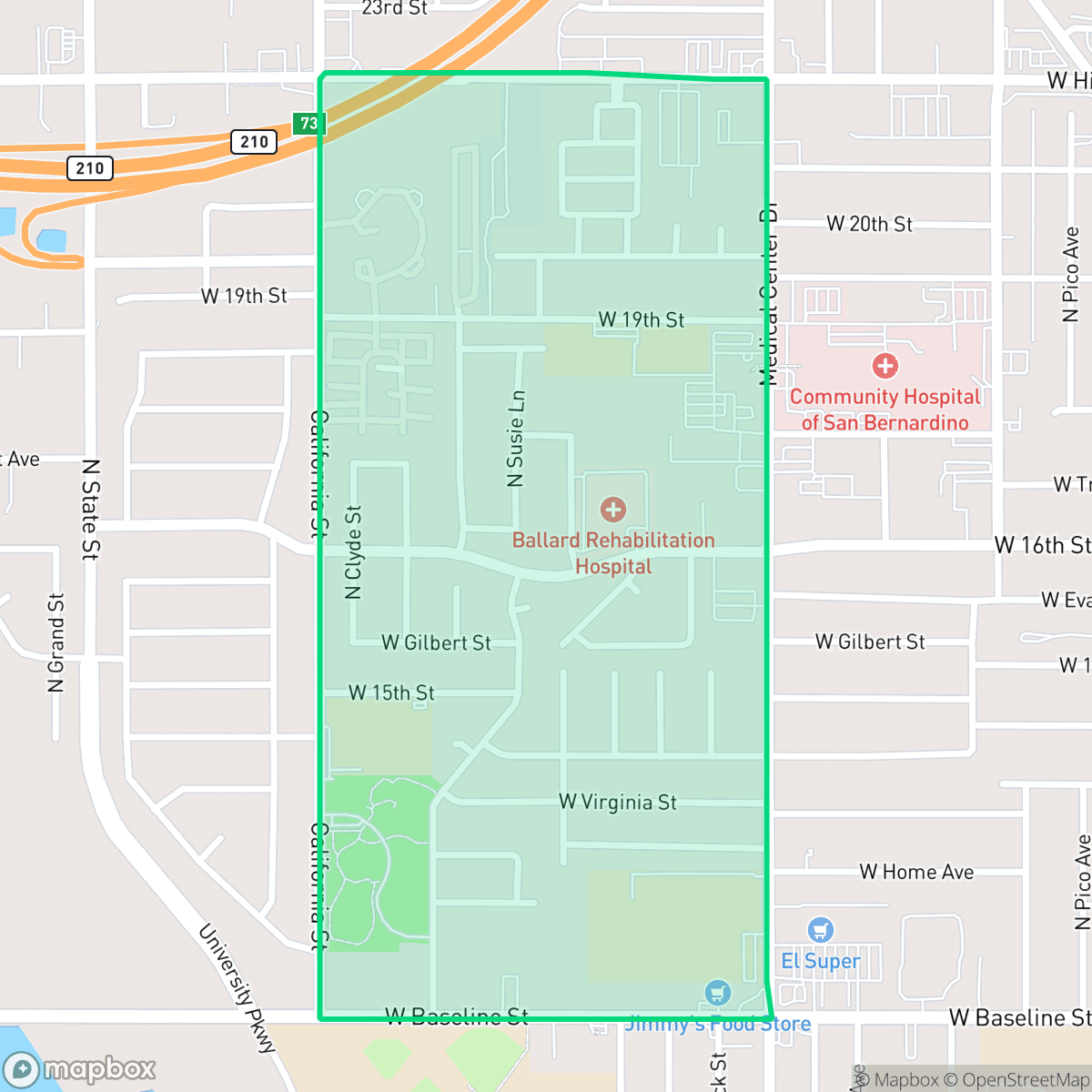
Shirrells is a residential neighborhood in San Bernardino characterized by a traditional grid layout and close-knit suburban housing. Residents benefit from moderate walkability and access to public green space, though the area experiences consistent road traffic noise and limited privacy due to high-density development.
Key Highlights
About Shirrells
Located on the historically rich Westside of San Bernardino, California, the Shirrells neighborhood is deeply tied to the city's mid-20th-century African American civil rights movement. The neighborhood is anchored by the 12-acre Anne Shirrells Park and Community Center, named in honor of Anne Shirrells, a prominent local NAACP president and community leader who championed youth engagement and civil rights activism from the 1940s through the 1970s. Shirrells famously managed Johnson Hall, a vital social hub on the Westside that hosted dances and recreational programs for local youth. Today, the neighborhood's cultural legacy is carried forward by the Akoma Unity Center, based within the park, which spearheads community development, youth mentorship, and the revitalization of the Anne Shirrells Community Garden.
The area features a mix of single-family homes and suburban tract developments, creating a dense residential environment with consistent street connectivity. According to iHuus data, the neighborhood provides a functional, if modest, living experience where residents are within reach of local schools and essential services. While the environment is largely quiet, the presence of nearby freight corridors and arterial roads contributes to a consistent baseline of traffic noise that defines the local acoustic landscape.
Prospective residents should consider the trade-offs between the neighborhood's accessibility and its high-density layout, which results in limited backyard space and close proximity to neighbors. While the area offers a stable suburban atmosphere, those seeking a secluded environment may find the compact housing and industrial proximity in certain sectors less ideal. Families will find a variety of educational options through the local school district, though performance ratings vary significantly across the region.
Neighborhood Scores Across 15 Qualities
Residential spacing in Shirrells is roughly in line with the San Bernardino average. Residents may encounter closely packed homes and limited natural buffers between neighbors, particularly in denser suburban sections.
Pedestrian transit can be difficult due to fragmented sidewalks and high-speed intersections near major arterials. While some residential blocks offer quiet walking paths, the overall walkability is lower than the San Bernardino average according to iHuus data.
Residential views consist of high-density tract housing and mobile home parks with small lots and minimal greenery. According to iHuus data, the visual landscape is less manicured than the San Bernardino average, often featuring unpaved yards and simple rooflines.
Available green space for pet owners is roughly average for the city. While local school fields and some sidewalk verges provide walking options, much of the area relies on private fenced yards due to limited public park access.
Suburban development characterizes this area, featuring a mix of single-family homes, apartment complexes, and commercial zones. This landscape is slightly less open than the San Bernardino average, as according to iHuus data, the area leans toward denser residential and light industrial use.
Daily activity is subdued, primarily consisting of light industrial zones and essential services that are largely car-dependent. According to iHuus data, the area offers a more tranquil and less active atmosphere than the San Bernardino average.
A continuous hum from nearby busy streets characterizes the area, which is slightly higher than the San Bernardino average according to iHuus data.
Air quality in this area remains mostly clean with rare instances of elevated readings, though it is slightly lower than the San Bernardino city average according to iHuus data.
Largely residential and institutional, this area contains fewer heavy industrial hazards than the San Bernardino average. While most of the neighborhood is free from large warehouses, some portions near the highway interchange feature truck storage lots and warehouse facilities.
Health insurance accessibility is lower in Shirrells than in the rest of San Bernardino. According to iHuus data, a minority of residents in this area are covered by health insurance plans.
Voting patterns and census indicators show a notably more liberal leaning than the San Bernardino average, according to iHuus data.
A balanced mix of young adults, families, and seniors resides here, closely mirroring the broader San Bernardino area. This demographic variety, according to iHuus data, indicates a multi-generational community.
Address-Level Insights for Shirrells


iHuus Neighborhood Intelligence Insights
Get address-level neighborhood insights for Shirrells
- Street-level scores — see how individual blocks compare, not just neighborhood averages
- Micro-zone boundaries — identify quiet pockets, flood boundaries, and walkable clusters before you visit
- 15 dimensions in full — walkability, noise, air quality, school quality, insurance coverage, population age profile, urban/rural index, and more
- Boundary risk alerts — know if your address sits near a block boundary where scores drop, the kind of detail no listing will ever mention
- School insights — individual school ratings and insights, not just district-level data
- Compare before you commit — side-by-side data across neighborhoods, down to block precision
No credit card required
Compare with Any Neighborhood
| Dimension | Shirrells | Alessandro |
|---|---|---|
| 🚶 Walkabilityavg 7.12 | ||
| 🔊 Acoustic Comfortavg 4.28 | ||
| 🤫 Privacy Indexavg 5.05 | ||
| 🎨 Visual Appealavg 5.64 | ||
| 🐕 Dog Friendlinessavg 5.15 | ||
| 🗺️ Urban-Rural Indexavg 6.67 | ||
| ✨ Neighborhood Vibeavg 4.38 | ||
| 🏥 Health Insurance Coverageavg 5.05 | ||
| 🌿 Air Qualityavg 9.16 | ||
| 🏭 Industrial Proximityavg 6.81 | ||
| 🌊 Flood Safetyavg 1.26 | ||
| 🗳️ Ideological Leanavg 8.58 | ||
| 👥 Population Age Profileavg 4.36 | ||
| 🔥 Fire Safetyavg 0.3 | ||
| 🏫 School Quality |
Shirrells Rankings
School Districts Serving Shirrells
School Insights for Shirrells
Below average outcomes; significant attendance and academic challenges.
School Insights
See what's really behind every school rating near Shirrells
- Individual school ratings — each school's own score with outcome context, not just a district average
- Enrollment & class size data — student-to-teacher ratio and how it compares to the state average
- Full demographics breakdown — ethnicity and gender composition for every school in the enrollment zone
- Every school in the district — all schools within the enrollment boundary ranked by rating, not just the closest one
- Grade levels & benchmarks — elementary through high school, with below/above state-average flags
No credit card required