Perris Hills, San Bernardino
Updated · 6,586 residents
Perris Hills is a dense, walkable residential community defined by its proximity to expansive parkland and a consistent street grid. Residents benefit from excellent air quality and a lack of industrial activity, though the area features closely packed housing with limited privacy and moderate road noise.
Key Highlights
About Perris Hills
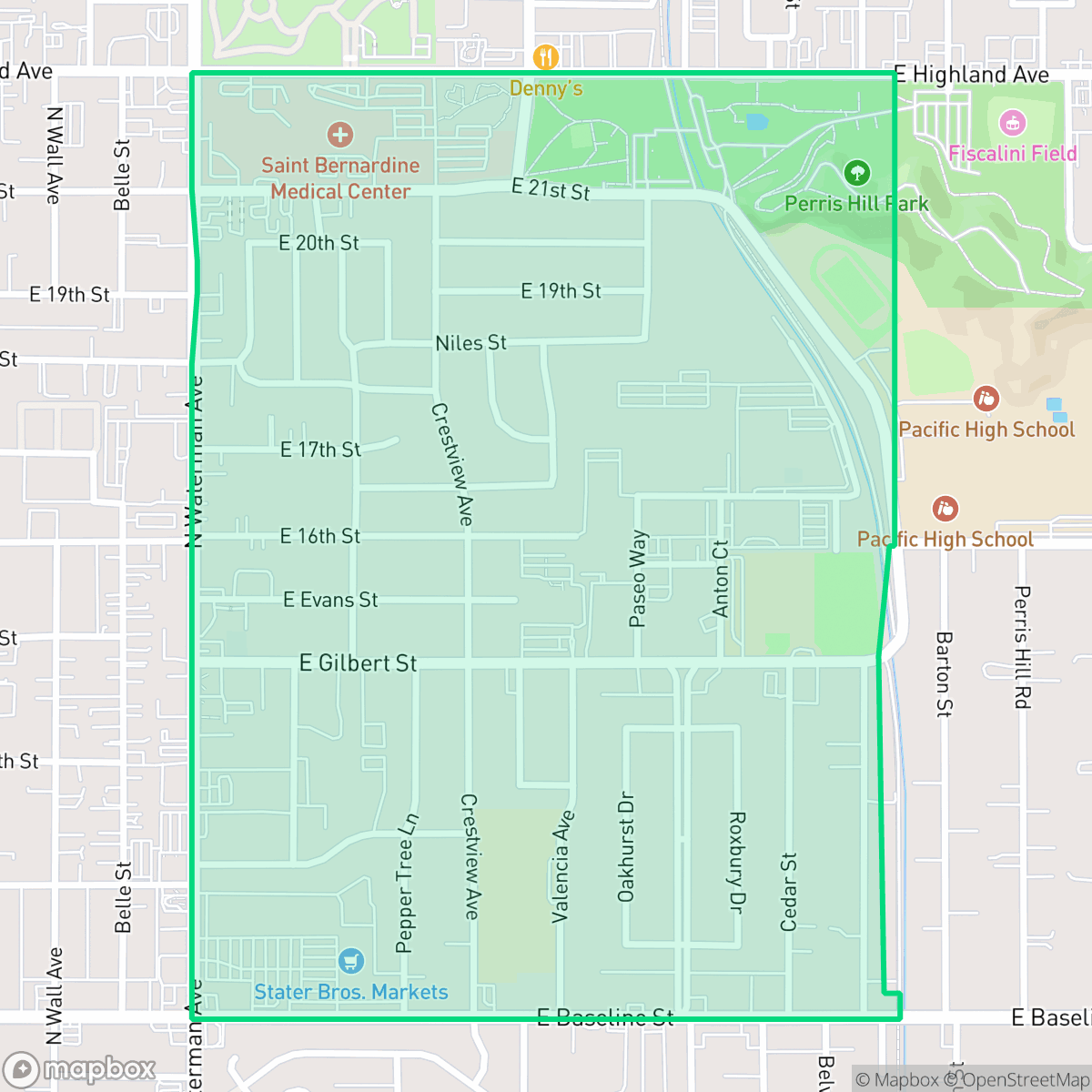
The Perris Hills neighborhood in San Bernardino is named after Frederick Thomas Perris, a pioneering 19th-century surveyor, civil engineer, and city water commissioner who helped bring the railroad to the region. The neighborhood's historical development is closely tied to its centerpiece, Perris Hill Park. In 1911, the top of the hill was leveled to construct a major municipal water reservoir. By the 1930s, the area transformed into a vibrant civic and recreational hub. Significant landmarks include the Roosevelt Bowl, a Works Progress Administration-funded outdoor amphitheater dedicated in 1935, and a historic baseball park that hosted spring training for the Major League Pittsburgh Pirates in the 1950s. Additionally, the neighborhood was a prominent national tennis center, hosting early tournaments for tennis legend Jack Kramer.
The neighborhood offers a calm suburban environment characterized by its integration with local green spaces. While the area lacks a heavy industrial presence, it maintains a steady level of activity through its mix of single-family homes, schools, and local dining options. According to iHuus data, the community ranks well for pedestrian accessibility, supported by a reliable grid system and consistent sidewalk coverage on both residential and collector streets. This infrastructure makes it easy for residents to navigate the local landscape on foot.
Prospective residents should consider the trade-offs of this dense suburban setting, which includes tightly spaced homes and consistent noise levels from local road traffic. While the neighborhood provides a stable, institutional-focused environment, it faces challenges regarding fire and flood safety. It is best suited for those prioritizing walkability and proximity to public athletic facilities over complete acoustic seclusion or large private lots.
Neighborhood Scores Across 15 Qualities
Residential spacing is somewhat varied, featuring some closely packed homes and narrow setbacks that offer slightly less separation than the San Bernardino average. According to iHuus data, certain pockets of the neighborhood include high-density housing and minimal buffers between neighbors.
A consistent grid and clear crosswalks at main intersections make much of the area easy to navigate on foot. Sidewalk availability is slightly above the San Bernardino average, though some residential streets lack dedicated paths.
Uniform tract housing and small yards characterize the area, which presents a less varied landscape than the San Bernardino average. Industrial encroachment and some unpaved lots contribute to a functional but plain visual environment according to iHuus data.
Public athletic fields and nearby cemetery grounds provide decent walking areas, though residential sidewalk verges are often narrow. This level of accessibility is roughly in line with the San Bernardino average according to iHuus data.
Open land and scattered homes provide a landscape that is slightly less developed than the typical San Bernardino suburban layout. According to iHuus data, the area maintains a balance of residential pockets nestled among fields and woodland.
Diverse dining options and local parks provide a more active atmosphere than the San Bernardino average. While some blocks offer quiet suburban living, other areas feature a notable selection of restaurants and amenities.
A steady hum from nearby busy streets is present; however, acoustic comfort remains slightly higher than the San Bernardino average according to iHuus data.
Air quality remains consistently high with minimal health concerns, performing slightly better than the San Bernardino average according to iHuus data.
Residential life is largely undisturbed by heavy industry, as the area lacks the large warehouses and logistics hubs found in other parts of San Bernardino. Most streets consist of housing, medical facilities, and parkland, with only occasional light commercial activity nearby.
Health insurance access in this area is roughly in line with the broader San Bernardino average. According to iHuus data, a significant portion of the resident population remains uninsured.
Voting patterns and census indicators in this area reflect a more liberal leaning than the San Bernardino average, according to iHuus data.
A balanced mix of young adults, families, and older residents characterizes the community. This age distribution is slightly lower than the San Bernardino city average, according to iHuus data.
Address-Level Insights for Perris Hills


iHuus Neighborhood Intelligence Insights
Get address-level neighborhood insights for Perris Hills
- Street-level scores — see how individual blocks compare, not just neighborhood averages
- Micro-zone boundaries — identify quiet pockets, flood boundaries, and walkable clusters before you visit
- 15 dimensions in full — walkability, noise, air quality, school quality, insurance coverage, population age profile, urban/rural index, and more
- Boundary risk alerts — know if your address sits near a block boundary where scores drop, the kind of detail no listing will ever mention
- School insights — individual school ratings and insights, not just district-level data
- Compare before you commit — side-by-side data across neighborhoods, down to block precision
No credit card required
Compare with Any Neighborhood
| Dimension | Perris Hills | Alessandro |
|---|---|---|
| 🚶 Walkabilityavg 7.12 | ||
| 🔊 Acoustic Comfortavg 4.28 | ||
| 🤫 Privacy Indexavg 5.05 | ||
| 🎨 Visual Appealavg 5.64 | ||
| 🐕 Dog Friendlinessavg 5.15 | ||
| 🗺️ Urban-Rural Indexavg 6.67 | ||
| ✨ Neighborhood Vibeavg 4.38 | ||
| 🏥 Health Insurance Coverageavg 5.05 | ||
| 🌿 Air Qualityavg 9.16 | ||
| 🏭 Industrial Proximityavg 6.81 | ||
| 🌊 Flood Safetyavg 1.26 | ||
| 🗳️ Ideological Leanavg 8.58 | ||
| 👥 Population Age Profileavg 4.36 | ||
| 🔥 Fire Safetyavg 0.3 | ||
| 🏫 School Quality |
Perris Hills Rankings
School Districts Serving Perris Hills
School Insights for Perris Hills
Below average outcomes; significant attendance and academic challenges.
School Insights
See what's really behind every school rating near Perris Hills
- Individual school ratings — each school's own score with outcome context, not just a district average
- Enrollment & class size data — student-to-teacher ratio and how it compares to the state average
- Full demographics breakdown — ethnicity and gender composition for every school in the enrollment zone
- Every school in the district — all schools within the enrollment boundary ranked by rating, not just the closest one
- Grade levels & benchmarks — elementary through high school, with below/above state-average flags
No credit card required