Muscupiabe, San Bernardino
Updated · 4,571 residents
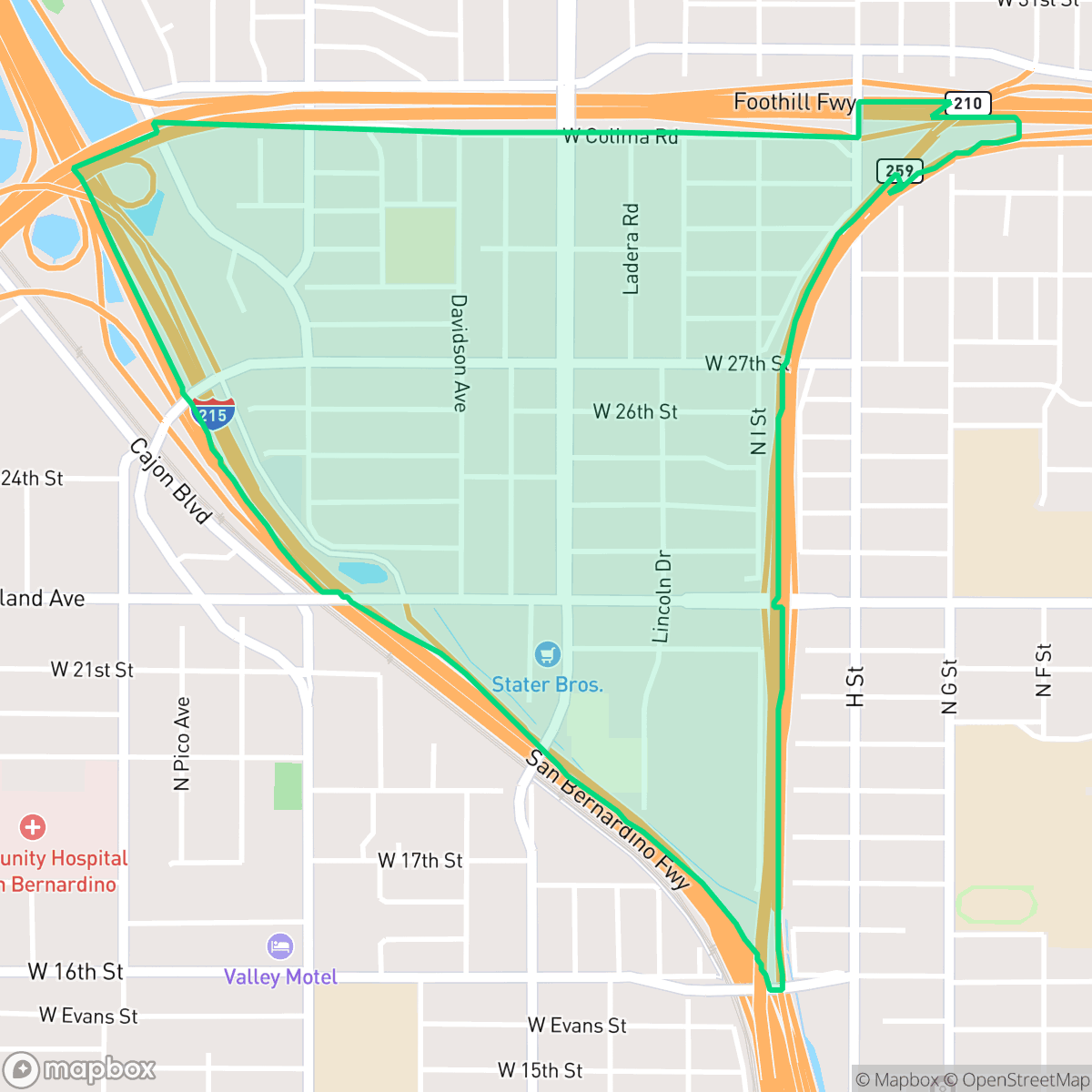
Muscupiabe is a dense suburban neighborhood in San Bernardino characterized by mid-century tract housing and a grid-based street layout. While the area offers proximity to local dining and schools like Davidson Elementary, residents experience significant noise from nearby freeways and a car-dependent environment.
Key Highlights
About Muscupiabe
The Muscupiabe neighborhood in San Bernardino traces its name to the Serrano Indian village of Amuscopiabit ("place of little pines"), which historically existed in the nearby Cajon Pass. In 1843, Governor Manuel Micheltorena granted the land to Michael C. White (known locally as Miguel Blanco), establishing Rancho Muscupiabe as the eighth and final Mexican land grant in San Bernardino County. White constructed a fortress-like log and earth home on the piedmont to defend the valley's ranchos against desert horse thieves, though he abandoned the site after only nine months due to stock losses. Modern development of the Muscupiabe neighborhood began primarily in the mid-20th century, with a significant stock of well-established single-family homes and apartment complexes built between 1940 and 1969.
The area functions as a quiet residential enclave defined by its mid-century suburban architecture and standard tract housing. The landscape is dominated by single-family homes with private, fenced yards, though the proximity to major freeways and large-scale logistics centers creates a distinct industrial edge to the west and south. According to iHuus data, the neighborhood maintains a consistent suburban grid, providing a functional, if modest, living environment for families and commuters who prioritize access to major arterial roads over walkability.
Prospective residents should note that the neighborhood faces challenges regarding acoustic comfort, as traffic noise levels are notably high due to the surrounding highway infrastructure. While the area provides essential services and local dining options, it is largely car-oriented, with limited public park space and narrow sidewalk verges that may not be ideal for pet owners. The community is served by the San Bernardino City Unified School District, with Davidson Elementary standing out as a high-performing local option for families.
Neighborhood Scores Across 15 Qualities
Residential spacing is slightly higher than the San Bernardino average, providing a mix of closely situated homes and properties with modest setbacks. According to iHuus data, many lots feature shared property lines, though some areas maintain clear buffers between structures.
Sidewalks and crosswalks are available on residential streets, but the network is frequently interrupted by high-traffic arterial roads and major freeway infrastructure. This level of connectivity is slightly below the San Bernardino city average according to iHuus data.
Standard tract housing with small yards and boxy rooflines characterizes the area. This level of visual density is slightly above the San Bernardino average according to iHuus data.
Minimal public park access and narrow sidewalk verges mean there are few opportunities for outdoor exercise outside of private yards. This availability is slightly below the San Bernardino city average, according to iHuus data.
A blend of residential streets and large industrial warehouses defines the landscape, mirroring the broader urban-rural balance found across San Bernardino.
Suburban streets and industrial corridors create a calm environment, though the area lacks the density of services found in more active parts of San Bernardino. Most dining and retail options require a vehicle, as few businesses are located within easy walking distance.
Constant noise from nearby airport runways and heavy rail infrastructure makes this area significantly louder than the San Bernardino average. Residents can expect persistent acoustic disruptions throughout the day.
Air quality remains generally clear with only infrequent periods of elevated readings. According to iHuus data, the air quality in this area is slightly lower than the San Bernardino city average.
Large logistics warehouses and heavy truck traffic are prevalent near the southern and western borders, making the industrial density slightly higher than the San Bernardino average. While much of the area remains residential, proximity to major freeways and rail hubs introduces significant commercial activity into the landscape.
Health insurance coverage among residents is higher than the San Bernardino city average, according to iHuus data. This level of coverage represents a moderate rate of access to healthcare benefits within the community.
Voting patterns and census indicators show a predominantly liberal political leaning that is slightly more pronounced than the San Bernardino city average, according to iHuus data.
Residents live among a diverse range of age groups, including young adults, families, and seniors. This demographic distribution is consistent with the broader San Bernardino area, according to iHuus data.
Extreme fire hazards are present in this area, representing a significantly higher risk level than the San Bernardino average according to iHuus data.
Address-Level Insights for Muscupiabe


iHuus Neighborhood Intelligence Insights
Get address-level neighborhood insights for Muscupiabe
- Street-level scores — see how individual blocks compare, not just neighborhood averages
- Micro-zone boundaries — identify quiet pockets, flood boundaries, and walkable clusters before you visit
- 15 dimensions in full — walkability, noise, air quality, school quality, insurance coverage, population age profile, urban/rural index, and more
- Boundary risk alerts — know if your address sits near a block boundary where scores drop, the kind of detail no listing will ever mention
- School insights — individual school ratings and insights, not just district-level data
- Compare before you commit — side-by-side data across neighborhoods, down to block precision
No credit card required
Compare with Any Neighborhood
| Dimension | Muscupiabe | Alessandro |
|---|---|---|
| 🚶 Walkabilityavg 7.12 | ||
| 🔊 Acoustic Comfortavg 4.28 | ||
| 🤫 Privacy Indexavg 5.05 | ||
| 🎨 Visual Appealavg 5.64 | ||
| 🐕 Dog Friendlinessavg 5.15 | ||
| 🗺️ Urban-Rural Indexavg 6.67 | ||
| ✨ Neighborhood Vibeavg 4.38 | ||
| 🏥 Health Insurance Coverageavg 5.05 | ||
| 🌿 Air Qualityavg 9.16 | ||
| 🏭 Industrial Proximityavg 6.81 | ||
| 🌊 Flood Safetyavg 1.26 | ||
| 🗳️ Ideological Leanavg 8.58 | ||
| 👥 Population Age Profileavg 4.36 | ||
| 🔥 Fire Safetyavg 0.3 | ||
| 🏫 School Quality |
Muscupiabe Rankings
School Districts Serving Muscupiabe
School Insights for Muscupiabe
Below average outcomes; significant attendance and academic challenges.
School Insights
See what's really behind every school rating near Muscupiabe
- Individual school ratings — each school's own score with outcome context, not just a district average
- Enrollment & class size data — student-to-teacher ratio and how it compares to the state average
- Full demographics breakdown — ethnicity and gender composition for every school in the enrollment zone
- Every school in the district — all schools within the enrollment boundary ranked by rating, not just the closest one
- Grade levels & benchmarks — elementary through high school, with below/above state-average flags
No credit card required