Alessandro, San Bernardino
Updated · 4,858 residents
Alessandro is a historic San Bernardino community defined by its mid-century tract housing and deep cultural roots near the iconic Mitla Café. While the area offers a walkable grid layout, residents experience a dense suburban environment with limited privacy and notable road traffic noise.
Key Highlights
About Alessandro
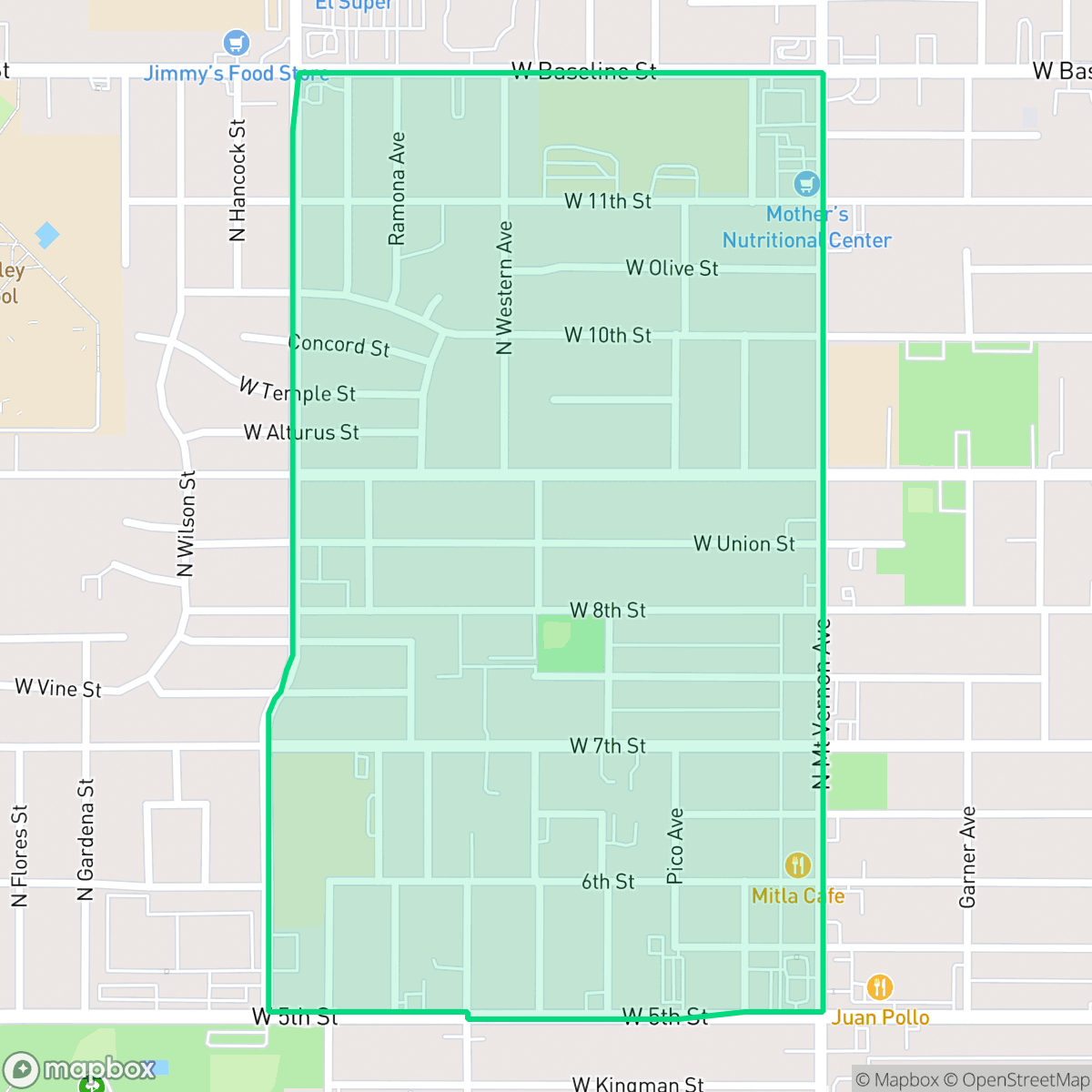
The Alessandro neighborhood in San Bernardino, California, is a historically rich community located west of Mount Vernon Avenue. Developed primarily in the mid-20th century, the neighborhood features the "Carverdale" tract, a 1949 housing development planned by Velma Grant and designed by pioneering African American architect Paul R. Williams for Black home buyers. Historically a hub for the local Mexican-American community, Alessandro was served by Ramona Elementary (established in 1921 for Spanish-speaking students) and Alessandro Junior High, which later merged into Ramona-Alessandro Elementary. The neighborhood is culturally anchored by the historic Mitla Café. Founded in 1937, this landmark Mexican restaurant was a vital gathering space during the segregation era and famously inspired Taco Bell founder Glen Bell. Nearby, the 22-acre Nunez Park serves as a central recreational hub closely linked to the neighborhood’s 1950s growth.
The neighborhood functions as a dense, low-rise residential enclave characterized by its grid-based street network and modest housing stock. According to iHuus data, the area maintains a consistent sidewalk presence that supports local pedestrian activity, though the proximity to major transit corridors contributes to a consistent ambient noise level of approximately 61 decibels. The landscape is primarily institutional and residential, featuring established school facilities that serve the local population.
Prospective residents should consider the trade-offs of living in a high-density environment where houses are closely spaced and private outdoor buffers are minimal. While the area benefits from proximity to community spaces like Nunez Park, the southern edge is impacted by industrial storage and heavy vehicle traffic. This neighborhood is best suited for those prioritizing access to historic local landmarks and a central urban location over suburban seclusion or expansive private yards.
Neighborhood Scores Across 15 Qualities
Closely packed housing and narrow lots with minimal buffer zones lead to lower privacy levels than the San Bernardino average. According to iHuus data, some residential areas feature homes positioned very near one another.
Sidewalks and safe crossings are available along many residential streets, though proximity to heavy industrial routes and high traffic arterials can impact pedestrian comfort. This level of walkability is roughly comparable to the San Bernardino average, according to iHuus data.
Standard tract housing on small lots characterizes this area. Visual appeal is lower than the San Bernardino average due to high density, small yards, and occasional unpaved patches.
Public parks and school fields provide some accessible areas for pets, but many residential streets lack wide grass verges or significant greenery. This level of dog friendliness is consistent with the city average according to iHuus data.
Residential areas feature a dense suburban layout with a mix of single-family homes and industrial infrastructure. This built environment is slightly more urbanized than the average for San Bernardino.
Industrial corridors and warehouses create a subdued atmosphere with limited social density. While various dining options exist, the area is primarily car-oriented and lacks the active street life found elsewhere in San Bernardino.
Frequent noise from nearby railroad tracks and freeway traffic characterizes this area. Acoustic comfort is lower than the San Bernardino average according to iHuus data.
Air quality remains consistently high with minimal health concerns; levels are nearly identical to the San Bernardino city average according to iHuus data.
Industrial presence is minimal throughout most of the area, though large logistics hubs and heavy truck traffic are noticeable along the southern and western edges. This level of industrial proximity is slightly lower than the San Bernardino average, according to iHuus data.
Health insurance coverage is notably lower than the San Bernardino average. Residents in Alessandro may face greater challenges accessing employer-sponsored or private medical plans according to iHuus data.
Voting patterns and census indicators show a predominantly liberal leaning that is more pronounced than the San Bernardino city average, according to iHuus data.
A balanced mix of young adults, families, and older residents lives here, mirroring the broader age distribution found across San Bernardino.
Address-Level Insights for Alessandro


iHuus Neighborhood Intelligence Insights
Get address-level neighborhood insights for Alessandro
- Street-level scores — see how individual blocks compare, not just neighborhood averages
- Micro-zone boundaries — identify quiet pockets, flood boundaries, and walkable clusters before you visit
- 15 dimensions in full — walkability, noise, air quality, school quality, insurance coverage, population age profile, urban/rural index, and more
- Boundary risk alerts — know if your address sits near a block boundary where scores drop, the kind of detail no listing will ever mention
- School insights — individual school ratings and insights, not just district-level data
- Compare before you commit — side-by-side data across neighborhoods, down to block precision
No credit card required
Compare with Any Neighborhood
| Dimension | Alessandro | Amber Hills |
|---|---|---|
| 🚶 Walkabilityavg 7.12 | ||
| 🔊 Acoustic Comfortavg 4.28 | ||
| 🤫 Privacy Indexavg 5.05 | ||
| 🎨 Visual Appealavg 5.64 | ||
| 🐕 Dog Friendlinessavg 5.15 | ||
| 🗺️ Urban-Rural Indexavg 6.67 | ||
| ✨ Neighborhood Vibeavg 4.38 | ||
| 🏥 Health Insurance Coverageavg 5.05 | ||
| 🌿 Air Qualityavg 9.16 | ||
| 🏭 Industrial Proximityavg 6.81 | ||
| 🌊 Flood Safetyavg 1.26 | ||
| 🗳️ Ideological Leanavg 8.58 | ||
| 👥 Population Age Profileavg 4.36 | ||
| 🔥 Fire Safetyavg 0.3 | ||
| 🏫 School Quality |
Alessandro Rankings
School Districts Serving Alessandro
School Insights for Alessandro
Below average outcomes; significant attendance and academic challenges.
School Insights
See what's really behind every school rating near Alessandro
- Individual school ratings — each school's own score with outcome context, not just a district average
- Enrollment & class size data — student-to-teacher ratio and how it compares to the state average
- Full demographics breakdown — ethnicity and gender composition for every school in the enrollment zone
- Every school in the district — all schools within the enrollment boundary ranked by rating, not just the closest one
- Grade levels & benchmarks — elementary through high school, with below/above state-average flags
No credit card required