Rainbow Park, Miami Gardens
Updated · 1,497 residents
Rainbow Park is a quiet, suburban community defined by its mid-century ranch-style homes and the long-standing presence of its local elementary school. The neighborhood offers a consistent residential landscape, though residents should expect noticeable noise from nearby transit corridors and major roadways.
Key Highlights
About Rainbow Park
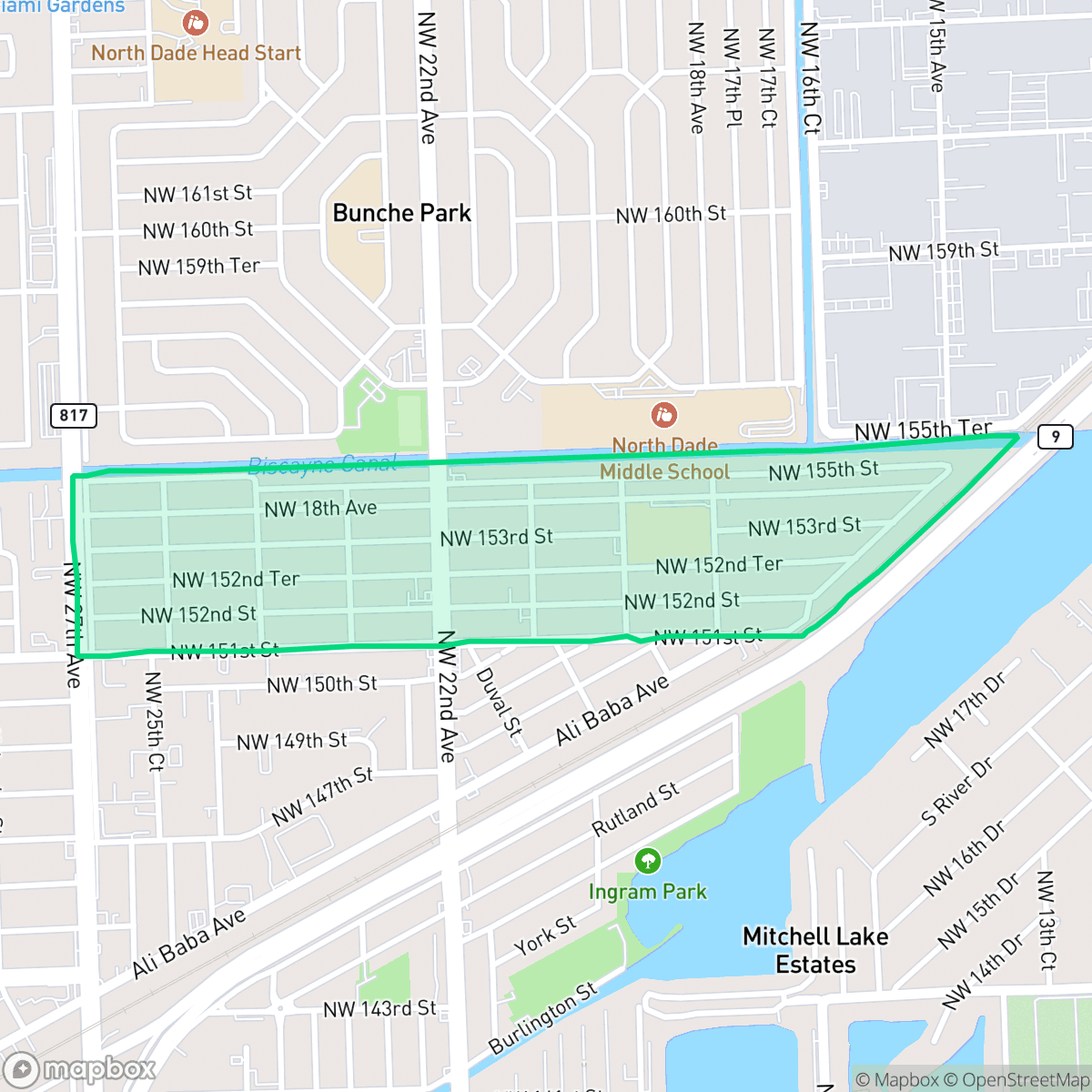
Rainbow Park, located in Miami Gardens, traces its roots to the 1950s Black veteran housing boom, a period when it flourished alongside nearby communities like Bunche Park. Historically associated with the development of the Opa-locka area, the neighborhood was later integrated into the City of Miami Gardens upon its 2003 incorporation. Architecturally, the area is defined by mid-20th-century ranch-style homes, some featuring Spanish-inspired elements such as stucco siding and terracotta roofing. A significant local landmark is Rainbow Park Elementary School, which has served the community since its opening in 1956. Today, the neighborhood is recognized as a Neighborhood Revitalization Strategy Area, reflecting its ongoing efforts to preserve its residential character while addressing local economic development goals.
The area maintains a stable, suburban atmosphere characterized by a diverse mix of families and seniors living in traditional single-story residences. Its layout provides a uniform aesthetic that reflects its mid-twentieth-century origins, while the neighborhood remains a focal point for local revitalization efforts. The community benefits from moderate walkability, allowing residents to navigate local streets despite occasional physical barriers like canal crossings and highway proximity.
Prospective residents should be aware of specific livability trade-offs, including higher ambient noise levels due to the proximity to major transit routes and light industrial zones. While the neighborhood offers a sense of privacy, those considering a move should note the uncertain flood risk and limited availability of comprehensive health insurance coverage among the local population. It is best suited for individuals seeking a quiet, established community that balances suburban life with access to essential city services.
Neighborhood Scores Across 15 Qualities
Residential spacing offers a modest level of seclusion with some buffer between neighbors. According to iHuus data, this degree of privacy is slightly higher than the Miami Gardens average.
Sidewalks and safe crossings are available throughout much of the area, though major highways and rail corridors occasionally disrupt the grid. Pedestrian connectivity is slightly below the city average due to these physical barriers and canal crossings.
Standard single-story homes feature boxy rooflines and modest yards that are consistent with the city average. Some properties include private backyard pools, though certain sections sit adjacent to industrial warehouses.
Walking routes for pets are limited by narrow sidewalks and a lack of wide grassy verges. According to iHuus data, the availability of open public park space in this area is slightly below the city average.
Residential street patterns consist of a mix of single-family homes and industrial zones, matching the city average for semi-rural development. According to iHuus data, the area features a dense suburban fabric with varying levels of building lot coverage.
Local activity levels are slightly below the city average, characterized by a quiet residential atmosphere with sparse commercial density. Residents will find a low-key environment focused on suburban living and essential local services rather than high-energy social hubs.
Persistent sounds from nearby major roadways and transit corridors characterize this area. According to iHuus data, acoustic comfort in Rainbow Park is lower than the typical level found across Miami Gardens.
Air quality in Rainbow Park fluctuates between acceptable and unhealthy levels, matching the typical conditions found across Miami Gardens. Residents with respiratory sensitivities should monitor local reports for days when air quality may pose a concern.
Commercial warehouses and light industrial services are present alongside residential areas, creating more industrial activity than the Miami Gardens average. Residents should note the proximity to a Superfund site and the presence of transit-related traffic from nearby gas stations and truck depots.
Health insurance access among residents is lower than the Miami Gardens average. According to iHuus data, fewer individuals in this area possess comprehensive medical coverage compared to the rest of the city.
Voting patterns and census indicators show a predominantly liberal leaning that is more pronounced than the Miami Gardens city average, according to iHuus data.
Residents live among a diverse mix of young adults, families, and seniors. This age distribution is consistent with the broader Miami Gardens area according to iHuus data.
Flood risk levels in this area are difficult to precisely determine because official federal studies have not been completed for this specific zone. According to iHuus data, the potential for flooding is slightly higher than the average seen across Miami Gardens.
Address-Level Insights for Rainbow Park


iHuus Neighborhood Intelligence Insights
Get address-level neighborhood insights for Rainbow Park
- Street-level scores — see how individual blocks compare, not just neighborhood averages
- Micro-zone boundaries — identify quiet pockets, flood boundaries, and walkable clusters before you visit
- 15 dimensions in full — walkability, noise, air quality, school quality, insurance coverage, population age profile, urban/rural index, and more
- Boundary risk alerts — know if your address sits near a block boundary where scores drop, the kind of detail no listing will ever mention
- School insights — individual school ratings and insights, not just district-level data
- Compare before you commit — side-by-side data across neighborhoods, down to block precision
No credit card required
Compare with Any Neighborhood
| Dimension | Rainbow Park | Andover |
|---|---|---|
| 🚶 Walkabilityavg 6.78 | ||
| 🔊 Acoustic Comfortavg 2.97 | ||
| 🤫 Privacy Indexavg 5.39 | ||
| 🎨 Visual Appealavg 6 | ||
| 🐕 Dog Friendlinessavg 5 | ||
| 🗺️ Urban-Rural Indexavg 6.55 | ||
| ✨ Neighborhood Vibeavg 3.42 | ||
| 🏥 Health Insurance Coverageavg 4.78 | ||
| 🌿 Air Qualityavg 6 | ||
| 🏭 Industrial Proximityavg 6.05 | ||
| 🌊 Flood Safetyavg 4.36 | ||
| 🗳️ Ideological Leanavg 8.79 | ||
| 👥 Population Age Profileavg 4.81 | ||
| 🔥 Fire Safety | ||
| 🏫 School Quality |
Rainbow Park Rankings
School Districts Serving Rainbow Park
School Insights for Rainbow Park
Below average outcomes; significant attendance and academic challenges.
School Insights
See what's really behind every school rating near Rainbow Park
- Individual school ratings — each school's own score with outcome context, not just a district average
- Enrollment & class size data — student-to-teacher ratio and how it compares to the state average
- Full demographics breakdown — ethnicity and gender composition for every school in the enrollment zone
- Every school in the district — all schools within the enrollment boundary ranked by rating, not just the closest one
- Grade levels & benchmarks — elementary through high school, with below/above state-average flags
No credit card required