Pine Tree Park/ Golden Highlands, Miami Gardens
Updated · 3,536 residents
Pine Tree Park and Golden Highlands offer a quiet, semi-rural atmosphere defined by a consistent mid-century residential aesthetic. While the neighborhood provides a balanced demographic mix and functional walkability, residents should anticipate higher noise levels due to nearby transit corridors and flight paths.
Key Highlights
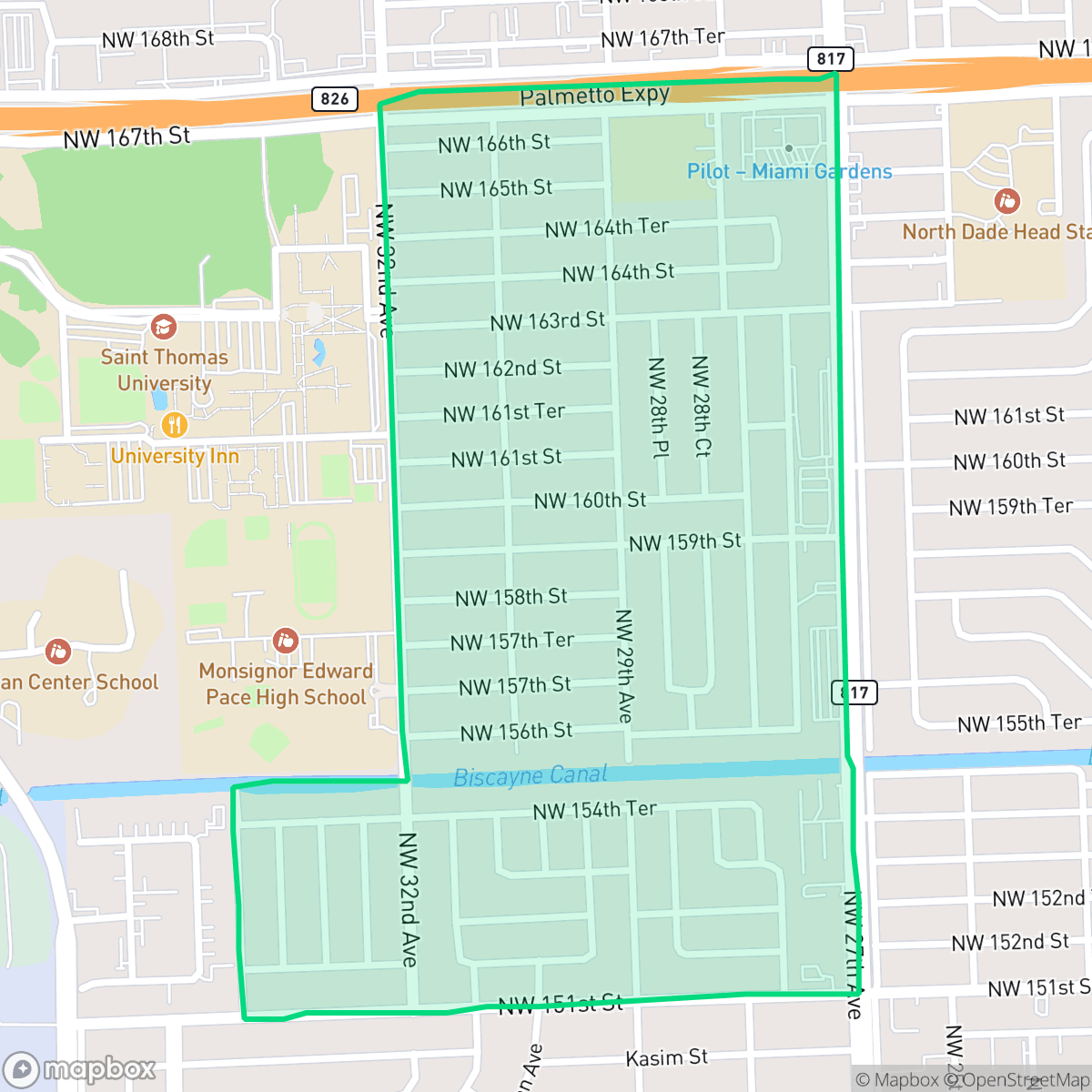
About Pine Tree Park/ Golden Highlands
Pine Tree Park and Golden Highlands are residential subdivisions in Miami Gardens that emerged as part of the post-World War II suburban expansion in Northwest Miami-Dade County. Developed primarily in the early 1950s, these neighborhoods reflect the era's focus on efficient suburban housing. Golden Highlands, specifically, was a 300-home project established in 1953 that utilized distinctive mid-century construction techniques. Builders of the period experimented with modern materials, incorporating features such as aluminum-frame windows, acoustical perlite plaster interiors, and cement enamel window sills into their designs. Today, the area remains characterized by its original mid-century single-family home stock, serving as a representative example of the post-war suburban growth that defined the development of the region.
The area is characterized by its uniform suburban layout, featuring single-family homes that maintain a consistent visual appearance across the neighborhood. It offers a relatively quiet pace of life, anchored by a community that values a functional and low-key environment. While it maintains a semi-rural feel with pockets of open land, the presence of light commercial activity and small-scale dining options provides necessary conveniences for daily life.
Prospective residents should consider the trade-offs of living in this location, including higher noise levels from nearby transit corridors and flight paths. The area faces moderate flood risks and limited access to health insurance, which are important factors for long-term planning. Families may also want to research the local public schools, which are part of a district currently navigating significant budget and enrollment transitions. This neighborhood is well-suited for those who prioritize community stability and a modest, predictable suburban environment over high-density urban excitement.
Neighborhood Scores Across 15 Qualities
Residential structures are spaced with typical suburban setbacks, providing slightly more separation between neighbors than the Miami Gardens average. Most homes feature small gaps or shared property lines, though larger institutional buildings in the area offer more significant buffers.
Residential blocks feature a consistent sidewalk network and safe crossings, though major highways and canals create significant pedestrian barriers. This level of connectivity is slightly below the Miami Gardens average according to iHuus data.
Standard tract housing with uniform rooflines and small yards defines the area, appearing consistent with the broader city average. Some residential blocks feature backyard pools, though houses are generally closely spaced.
Public parks and school fields offer accessible green space, though residential sidewalks often feature narrow verges. This level of accessibility for pet owners is consistent with the city average.
Open land and scattered residential pockets provide a semi-rural atmosphere that aligns with the city average. According to iHuus data, the landscape features a mix of single-family homes interspersed with woodland and industrial zones.
Local activity remains subdued, with most commercial presence centered around educational institutions, transit hubs, and small-scale dining. This area offers a pace of life that is largely in line with the city average.
Frequent noise from nearby transit corridors and flight paths makes this area significantly louder than the Miami Gardens average, according to iHuus data.
Air quality levels in this area typically fluctuate between acceptable and unhealthy, matching the city average. Residents sensitive to pollutants may experience occasional concern during certain periods according to iHuus data.
Residential life remains the primary focus here, though some light commercial activity and warehouse depots exist near the eastern and southern edges. This level of industrial proximity is slightly higher than the Miami Gardens average due to occasional transit traffic and local service businesses.
Health insurance coverage among residents is notably lower than the Miami Gardens average, according to iHuus data. This indicates a higher proportion of uninsured individuals within the community.
Voting patterns and census indicators show a predominantly liberal leaning that is more pronounced than the Miami Gardens average, according to iHuus data.
Residents live among a diverse mix of young adults, families, and seniors. This age distribution is slightly more varied than the average seen across Miami Gardens.
Flood risk in this area is moderate, as official federal studies for the neighborhood have not yet been finalized. According to iHuus data, the level of risk is slightly higher than the average seen across Miami Gardens.
Address-Level Insights for Pine Tree Park/ Golden Highlands


iHuus Neighborhood Intelligence Insights
Get address-level neighborhood insights for Pine Tree Park/ Golden Highlands
- Street-level scores — see how individual blocks compare, not just neighborhood averages
- Micro-zone boundaries — identify quiet pockets, flood boundaries, and walkable clusters before you visit
- 15 dimensions in full — walkability, noise, air quality, school quality, insurance coverage, population age profile, urban/rural index, and more
- Boundary risk alerts — know if your address sits near a block boundary where scores drop, the kind of detail no listing will ever mention
- School insights — individual school ratings and insights, not just district-level data
- Compare before you commit — side-by-side data across neighborhoods, down to block precision
No credit card required
Compare with Any Neighborhood
| Dimension | Pine Tree Park/ Golden Highlands | Andover |
|---|---|---|
| 🚶 Walkabilityavg 6.78 | ||
| 🔊 Acoustic Comfortavg 2.97 | ||
| 🤫 Privacy Indexavg 5.39 | ||
| 🎨 Visual Appealavg 6 | ||
| 🐕 Dog Friendlinessavg 5 | ||
| 🗺️ Urban-Rural Indexavg 6.55 | ||
| ✨ Neighborhood Vibeavg 3.42 | ||
| 🏥 Health Insurance Coverageavg 4.78 | ||
| 🌿 Air Qualityavg 6 | ||
| 🏭 Industrial Proximityavg 6.05 | ||
| 🌊 Flood Safetyavg 4.36 | ||
| 🗳️ Ideological Leanavg 8.79 | ||
| 👥 Population Age Profileavg 4.81 | ||
| 🔥 Fire Safety | ||
| 🏫 School Quality |
Pine Tree Park/ Golden Highlands Rankings
School Districts Serving Pine Tree Park/ Golden Highlands
School Insights for Pine Tree Park/ Golden Highlands
Below average outcomes; significant attendance and academic challenges.
School Insights
See what's really behind every school rating near Pine Tree Park/ Golden Highlands
- Individual school ratings — each school's own score with outcome context, not just a district average
- Enrollment & class size data — student-to-teacher ratio and how it compares to the state average
- Full demographics breakdown — ethnicity and gender composition for every school in the enrollment zone
- Every school in the district — all schools within the enrollment boundary ranked by rating, not just the closest one
- Grade levels & benchmarks — elementary through high school, with below/above state-average flags
No credit card required