Norwood, Miami Gardens
Updated · 10,908 residents
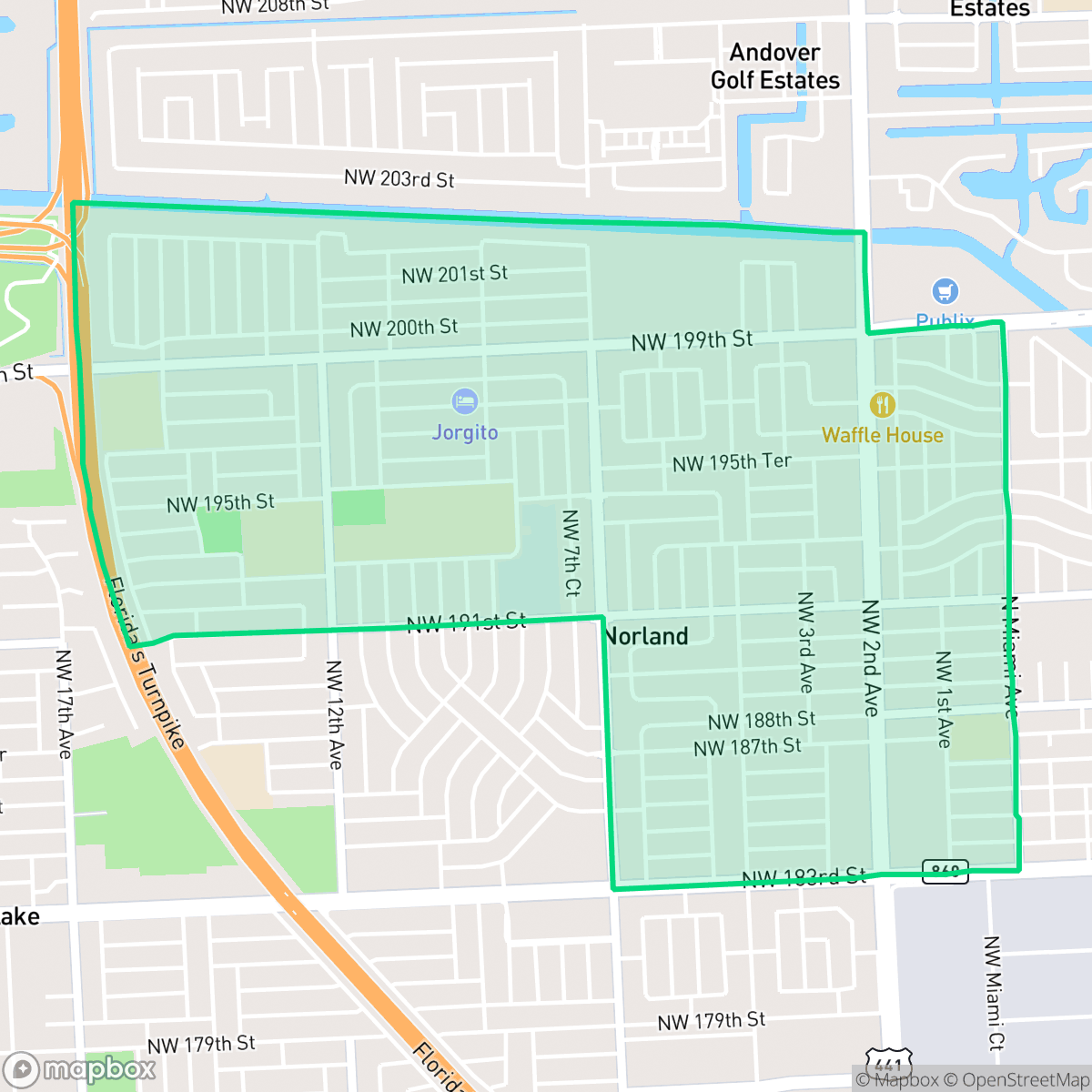
Norwood is a quiet, residential enclave in Miami Gardens defined by its mid-century suburban layout and proximity to local green spaces. While it offers moderate walkability along its residential streets, residents often experience noticeable noise from nearby transit corridors and major roadways.
Key Highlights
About Norwood
Norwood is a residential neighborhood in Miami Gardens, Florida, that developed as part of the post-World War II suburban expansion in northern Miami-Dade County. Previously an unincorporated area, it was incorporated into the City of Miami Gardens in 2003. The neighborhood is characterized by a high concentration of mid-century single-family homes, with nearly all of its housing stock built between 1940 and 1969. Historically, the area served as a destination for middle- and upper-income African American and West Indian American families migrating from Miami’s urban core in the late 1960s following the construction of I-95 and the passage of the Fair Housing Act. Today, Norwood remains a predominantly residential community, defined by its traditional suburban layout and the local landmark of Norwood Park.
The area maintains a consistent suburban aesthetic with uniform housing and modest yard spaces. It functions as a quiet residential community where the landscape is a blend of single-family homes and larger apartment complexes. According to iHuus data, the neighborhood features a diverse age range, creating a balanced demographic mix of young families and older residents. While it provides a functional living environment, the presence of light commercial sites and utility facilities near residential pockets introduces minor transit traffic to the local streets.
Prospective residents should weigh the benefits of a stable, established community against specific environmental factors. The area experiences moderate flood risks during heavy rain events, and air quality fluctuates in line with broader regional trends. Although the neighborhood offers better pedestrian access than many parts of the city, the proximity to major transit arteries results in higher acoustic levels. It is well-suited for individuals seeking a traditional suburban atmosphere who are comfortable with the trade-offs of living near major infrastructure and commercial corridors.
Neighborhood Scores Across 15 Qualities
Residential spacing varies between shared-wall multi-family units and closely packed single-family homes, resulting in a level of privacy that is roughly comparable to the city average. According to iHuus data, some areas feature houses with minimal distance between structures.
Sidewalks are generally available on residential streets and main roads, providing a level of pedestrian accessibility that is slightly above the city average. While low-traffic loops allow for safe movement, high-traffic arterial roads can act as barriers to navigating the wider area.
Uniform tract housing and apartment complexes characterize the area, featuring consistent rooflines and modest yard spaces. This visual landscape aligns with the city average for residential density and aesthetic variety.
Abundant canal-side greenery and residential yards provide space for pets, but access to formal public parks is slightly below the city average. Walking routes are primarily found along narrow sidewalk verges and private residential boundaries.
A blend of single-family homes and larger apartment complexes defines the landscape, matching the city average for semi-rural development. Residents will find a mix of residential pockets interspersed with industrial warehouses and commercial corridors.
Subdued residential streets and institutional campuses define this area, which offers a slightly more active atmosphere than the Miami Gardens average due to pockets of local dining near nearby colleges. While some sections are purely functional and car-oriented, other areas feature high walkability around local eateries and green spaces like Rolling Oaks Park.
Frequent sound from nearby transit corridors and infrastructure characterizes the area. According to iHuus data, acoustic levels are slightly higher than the Miami Gardens average due to proximity to major roadways.
Air quality in Norwood typically fluctuates between acceptable and unhealthy levels, mirroring the overall average for Miami Gardens. Residents with respiratory sensitivities should remain mindful of occasional periods of poor air quality according to iHuus data.
Occasional light utility and commercial sites are present near residential pockets, making the industrial presence slightly higher than the Miami Gardens average. Residents should note some proximity to gas stations and small-scale storage facilities that may introduce minor transit traffic.
Health insurance access for residents is consistent with the city average. According to iHuus data, a portion of the population lacks coverage, presenting a moderate level of accessibility to certain medical services.
Voting patterns and census indicators show a predominantly liberal leaning that is notably higher than the Miami Gardens city average, according to iHuus data.
Residents live among a balanced mix of young adults, families, and older community members. This demographic spread is largely consistent with the broader Miami Gardens area according to iHuus data.
Flood risk in this area is higher than the Miami Gardens average, though official FEMA studies for the neighborhood are currently incomplete. Residents should remain aware of potential vulnerabilities during heavy rain events according to iHuus data.
Address-Level Insights for Norwood


iHuus Neighborhood Intelligence Insights
Get address-level neighborhood insights for Norwood
- Street-level scores — see how individual blocks compare, not just neighborhood averages
- Micro-zone boundaries — identify quiet pockets, flood boundaries, and walkable clusters before you visit
- 15 dimensions in full — walkability, noise, air quality, school quality, insurance coverage, population age profile, urban/rural index, and more
- Boundary risk alerts — know if your address sits near a block boundary where scores drop, the kind of detail no listing will ever mention
- School insights — individual school ratings and insights, not just district-level data
- Compare before you commit — side-by-side data across neighborhoods, down to block precision
No credit card required
Compare with Any Neighborhood
| Dimension | Norwood | Andover |
|---|---|---|
| 🚶 Walkabilityavg 6.78 | ||
| 🔊 Acoustic Comfortavg 2.97 | ||
| 🤫 Privacy Indexavg 5.39 | ||
| 🎨 Visual Appealavg 6 | ||
| 🐕 Dog Friendlinessavg 5 | ||
| 🗺️ Urban-Rural Indexavg 6.55 | ||
| ✨ Neighborhood Vibeavg 3.42 | ||
| 🏥 Health Insurance Coverageavg 4.78 | ||
| 🌿 Air Qualityavg 6 | ||
| 🏭 Industrial Proximityavg 6.05 | ||
| 🌊 Flood Safetyavg 4.36 | ||
| 🗳️ Ideological Leanavg 8.79 | ||
| 👥 Population Age Profileavg 4.81 | ||
| 🔥 Fire Safety | ||
| 🏫 School Quality |
Norwood Rankings
School Districts Serving Norwood
School Insights for Norwood
Below average outcomes; significant attendance and academic challenges.
School Insights
See what's really behind every school rating near Norwood
- Individual school ratings — each school's own score with outcome context, not just a district average
- Enrollment & class size data — student-to-teacher ratio and how it compares to the state average
- Full demographics breakdown — ethnicity and gender composition for every school in the enrollment zone
- Every school in the district — all schools within the enrollment boundary ranked by rating, not just the closest one
- Grade levels & benchmarks — elementary through high school, with below/above state-average flags
No credit card required