Lake Lucerne, Miami Gardens
Updated · 1,995 residents
Lake Lucerne is a quiet, residential community in Miami Gardens defined by its mid-century suburban layout and diverse cultural heritage. Residents experience a low-key atmosphere, though the area is notably impacted by frequent aircraft noise and requires careful attention to flood safety.
Key Highlights
About Lake Lucerne
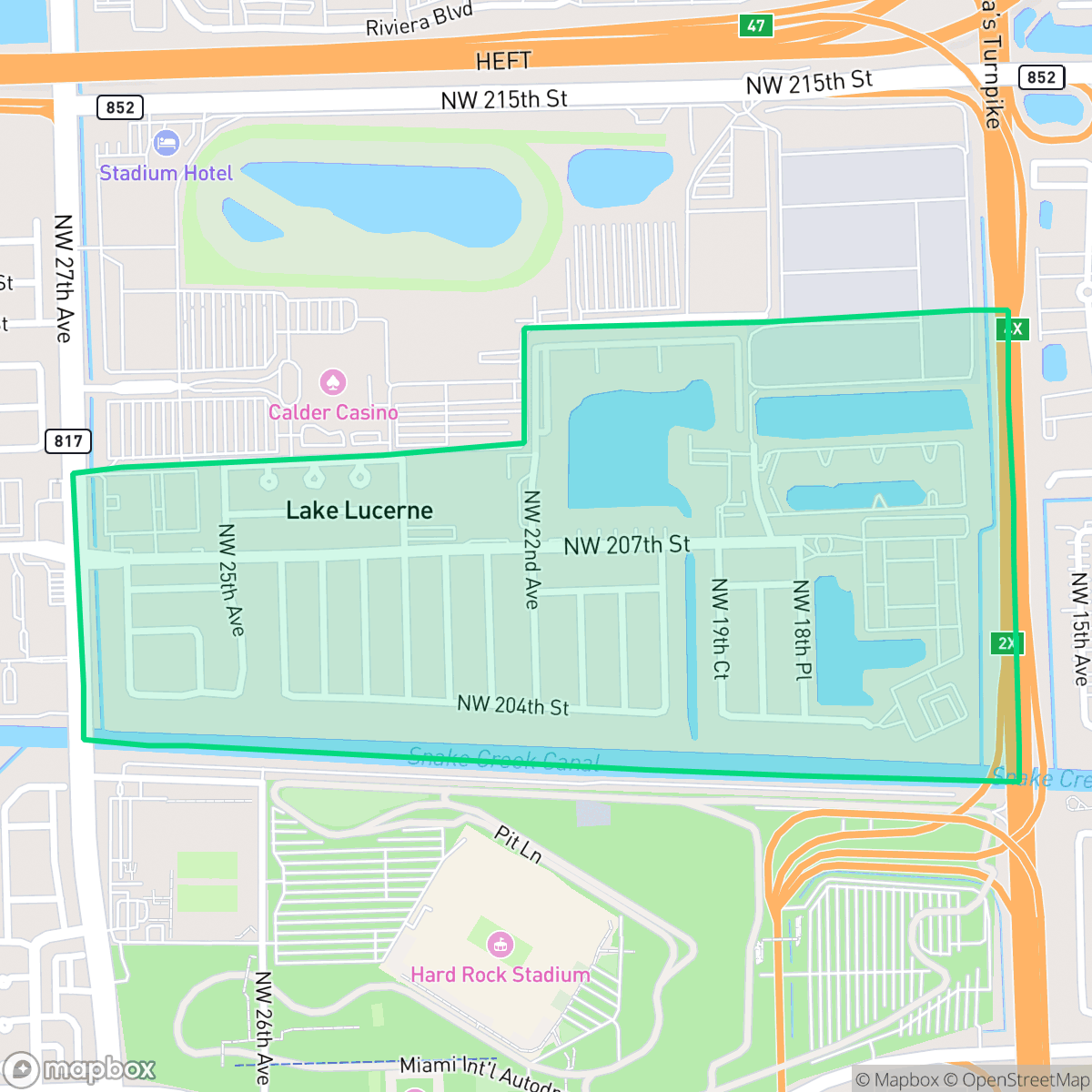
Lake Lucerne, a neighborhood within Miami Gardens, traces its origins to the post-war suburban expansion of the 1940s and 1950s. Originally a landscape of pine rockland and farmland, the area was developed into a residential community named after its central lake. The neighborhood experienced significant growth during the 1960s, characterized by mid-century single-story homes and the establishment of community pillars like Lake Lucerne Park. Historically part of an unincorporated area of Miami-Dade County, the neighborhood became a foundational section of the City of Miami Gardens upon its 2003 incorporation. Today, Lake Lucerne is recognized for its cultural diversity, with a significant population of Haitian, Arab, and Caribbean heritage, and its proximity to major landmarks like Hard Rock Stadium, which sits on land formerly designated as part of the Lake Lucerne census-designated place.
Lake Lucerne features a mix of single-family homes and multi-family complexes, creating a suburban aesthetic that remains consistent with the broader region. While the area offers a calm, residential environment, it is situated near light industrial zones that introduce some heavy vehicle traffic. Proximity to major transit corridors and the nearby Hard Rock Stadium provides regional connectivity, though the neighborhood maintains a distinct, low-key character according to iHuus data.
Prospective residents should account for specific environmental factors, including a high susceptibility to flooding and significant noise levels from nearby flight paths. While the community provides moderate pet-friendly amenities like local parks and canal-side paths, the lack of consistent sidewalk infrastructure can limit walkability. The area is best suited for those seeking a quiet, culturally diverse environment who are prepared to navigate the specific insurance and acoustic challenges inherent to this part of Miami-Dade County.
Neighborhood Scores Across 15 Qualities
Residential spacing varies between dense townhome blocks and more open suburban layouts with fenced yards. This level of density is slightly lower than the Miami Gardens average, according to iHuus data.
Residential streets often lack sidewalks, though low traffic volumes on certain grids make walking possible. This level of walkability is slightly below the Miami Gardens average, particularly as a major highway interchange disrupts continuous pedestrian routes.
Modest single-family homes and multi-family complexes feature uniform, boxy rooflines and small yards. This visual character is consistent with the broader Miami Gardens area.
Access to walking space is provided by continuous green canal banks and a public park with courts. While greenery within residential complexes is moderate, proximity to major roads can limit continuous roaming areas, though the neighborhood remains slightly more pet-friendly than the Miami Gardens average.
Residential layouts vary between dense apartment complexes and single-family blocks near large commercial structures. This mix of suburban development and open space aligns with the city average for the area.
Primarily residential in nature, this area offers a calm atmosphere with sparse commercial activity. According to iHuus data, the level of local vibrancy and access to points of interest is lower than the Miami Gardens average.
Frequent aircraft noise from nearby airport runways significantly impacts acoustic comfort. This level of disturbance is considerably higher than the Miami Gardens city average, according to iHuus data.
Air quality levels in Lake Lucerne typically fluctuate between acceptable and unhealthy conditions. According to iHuus data, the air quality remains consistent with the city average for Miami Gardens.
Light industrial and commercial facilities are interspersed with residential areas, resulting in a slightly higher presence of logistics-related traffic than the city average. According to iHuus data, certain sections near the northeast corner feature large warehouses and visible truck docking bays.
Health insurance coverage among residents is roughly in line with the Miami Gardens average. According to iHuus data, a portion of the population remains uninsured.
Voting patterns and census indicators reflect a strongly liberal political leaning that is even more pronounced than the Miami Gardens city average.
Residents live alongside a varied mix of young adults, families, and seniors. According to iHuus data, the age distribution is slightly more concentrated toward specific age brackets compared to the broader city average.
Property sits within a designated floodplain, which means residents should anticipate much higher flood risks than the Miami Gardens average. According to iHuus data, obtaining flood insurance is typically a necessity for homes in this area.
Address-Level Insights for Lake Lucerne


iHuus Neighborhood Intelligence Insights
Get address-level neighborhood insights for Lake Lucerne
- Street-level scores — see how individual blocks compare, not just neighborhood averages
- Micro-zone boundaries — identify quiet pockets, flood boundaries, and walkable clusters before you visit
- 15 dimensions in full — walkability, noise, air quality, school quality, insurance coverage, population age profile, urban/rural index, and more
- Boundary risk alerts — know if your address sits near a block boundary where scores drop, the kind of detail no listing will ever mention
- School insights — individual school ratings and insights, not just district-level data
- Compare before you commit — side-by-side data across neighborhoods, down to block precision
No credit card required
Compare with Any Neighborhood
| Dimension | Lake Lucerne | Andover |
|---|---|---|
| 🚶 Walkabilityavg 6.78 | ||
| 🔊 Acoustic Comfortavg 2.97 | ||
| 🤫 Privacy Indexavg 5.39 | ||
| 🎨 Visual Appealavg 6 | ||
| 🐕 Dog Friendlinessavg 5 | ||
| 🗺️ Urban-Rural Indexavg 6.55 | ||
| ✨ Neighborhood Vibeavg 3.42 | ||
| 🏥 Health Insurance Coverageavg 4.78 | ||
| 🌿 Air Qualityavg 6 | ||
| 🏭 Industrial Proximityavg 6.05 | ||
| 🌊 Flood Safetyavg 4.36 | ||
| 🗳️ Ideological Leanavg 8.79 | ||
| 👥 Population Age Profileavg 4.81 | ||
| 🔥 Fire Safety | ||
| 🏫 School Quality |
Lake Lucerne Rankings
School Districts Serving Lake Lucerne
School Insights for Lake Lucerne
Below average outcomes; significant attendance and academic challenges.
School Insights
See what's really behind every school rating near Lake Lucerne
- Individual school ratings — each school's own score with outcome context, not just a district average
- Enrollment & class size data — student-to-teacher ratio and how it compares to the state average
- Full demographics breakdown — ethnicity and gender composition for every school in the enrollment zone
- Every school in the district — all schools within the enrollment boundary ranked by rating, not just the closest one
- Grade levels & benchmarks — elementary through high school, with below/above state-average flags
No credit card required