Florida Memorial University, Miami Gardens
Updated · 1,204 residents
Florida Memorial University is defined by its institutional anchor and a semi-rural residential landscape characterized by uniform tract housing. While the area offers a quiet and functional environment, residents experience significant noise from nearby transit corridors and limited access to public green spaces.
Key Highlights
About Florida Memorial University
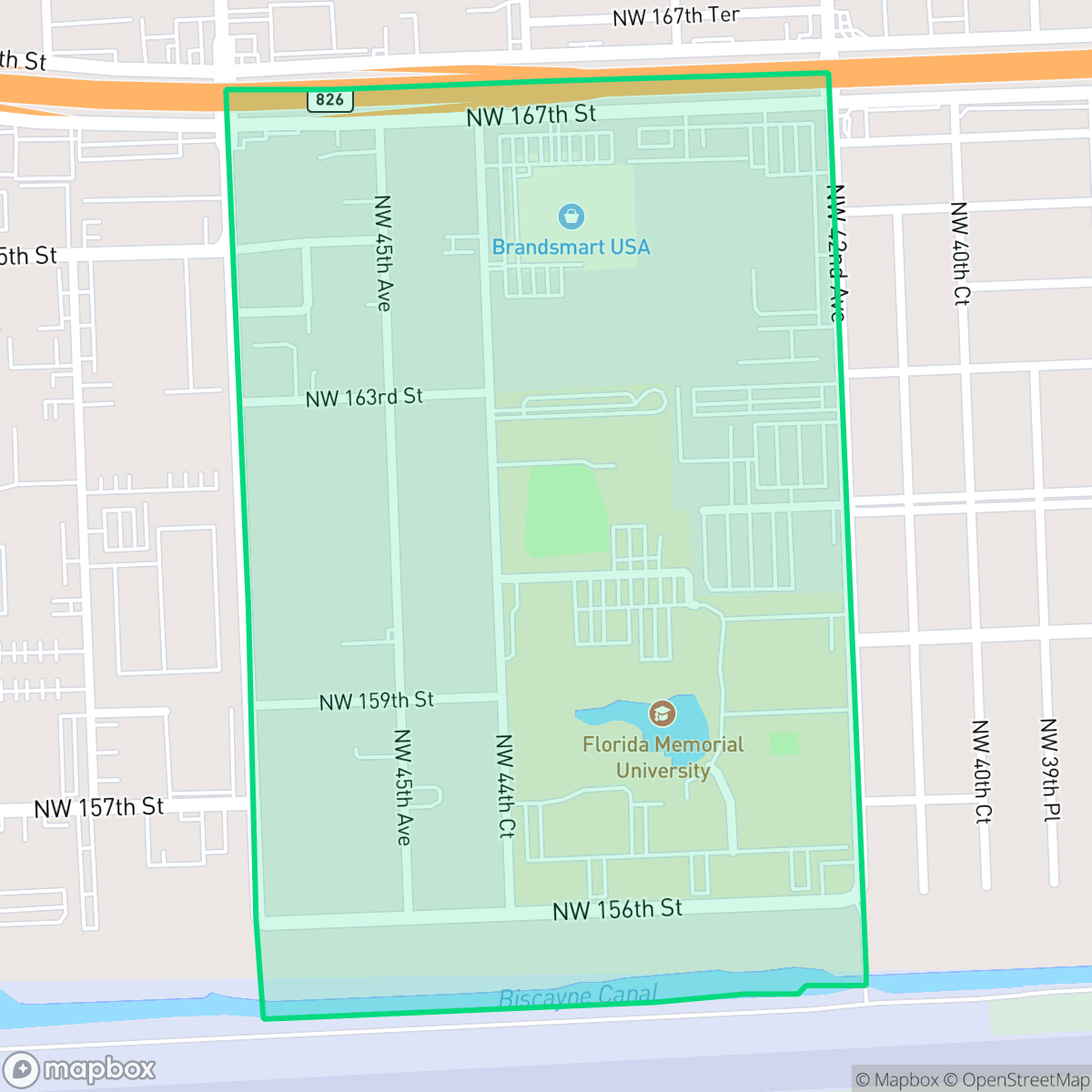
Florida Memorial University (FMU) is the defining cultural landmark of its Miami Gardens neighborhood, serving as the only Historically Black College or University (HBCU) in South Florida. Founded in 1879 in Live Oak, the institution relocated to its current 48-acre Miami Gardens campus in 1968, moving from St. Augustine to escape the racial violence of the civil rights era. The campus, developed on the site of a former airstrip, serves as a significant anchor for the city, which officially incorporated in 2003. As an institution with deep roots in post-Reconstruction education, FMU remains a vital hub for intellectual and community development, maintaining its historic mission of providing accessible education while anchoring the identity of the surrounding Miami Gardens community.
The neighborhood maintains a distinct semi-rural atmosphere, blending institutional footprints with standard residential grids. The area is marked by a high concentration of young adults, contributing to a demographic profile that is less age-diverse than the broader Miami region. Architecture is largely defined by uniform single-family homes, many of which feature private backyard swimming pools, providing a consistent visual identity across the local landscape. The presence of light commercial services and warehouse facilities adds to the area's mixed industrial character, which can occasionally result in heavy vehicle traffic.
Living here involves navigating specific trade-offs, such as persistent noise from nearby traffic and limited pet-friendly amenities due to a lack of public parks. While the streets are generally calm, the presence of highway boundaries and canals can create obstacles for pedestrians. Residents also face challenges regarding health insurance accessibility and school district variability, as the local Dade County schools manage a complex landscape of flagship programs alongside broader budget and enrollment pressures. According to iHuus data, the area offers moderate residential privacy through its consistent street layout, making it a functional choice for those prioritizing institutional proximity over high-density commercial activity.
Neighborhood Scores Across 15 Qualities
Housing density provides a moderate amount of buffer between neighbors, offering slightly more separation than the average area in Miami Gardens. According to iHuus data, buildings are arranged in a consistent grid with varying degrees of spacing between structures.
Low traffic streets provide a calm environment for walking, although highway proximity and canal boundaries act as significant pedestrian barriers. According to iHuus data, walkability in this area is slightly below the Miami Gardens average due to a lack of continuous sidewalks throughout all residential blocks.
Standard single-family tract housing with uniform rooflines and small yards defines the local landscape. Many properties include private backyard swimming pools, making the visual character consistent with the city average.
Minimal public green space and narrow street-side grass strips make off-leash exercise difficult. Residential areas primarily feature fenced yards with few accessible parks, making this area less dog friendly than the Miami Gardens average.
Open land and scattered structures provide a semi-rural atmosphere that matches the city average. According to iHuus data, the area features a mix of dense suburban residential grids and large institutional footprints.
Local activity is subdued and primarily centered around institutional and residential needs. This area offers slightly less commercial energy than the Miami Gardens average, with most amenities focused on essential services and sporadic dining options.
Persistent sounds from nearby transit corridors and heavy traffic are common in this area. According to iHuus data, the acoustic environment is significantly louder than the Miami Gardens city average.
Air conditions in this area present a mix of acceptable and unhealthy days, which may pose occasional concerns for sensitive groups. This level of air quality is consistent with the average found throughout Miami.
A blend of light commercial services and larger warehouse facilities brings occasional heavy vehicle traffic and utility odors to the area. This level of industrial proximity is slightly higher than the Miami Gardens average, according to iHuus data.
Health insurance coverage among residents is lower than the Miami average. According to iHuus data, a minority of the local population maintains active medical coverage.
Political leanings in this area are relatively balanced, showing significantly less ideological uniformity than the broader Miami area.
A high concentration of young adults defines the demographic landscape, creating a less age-diverse environment than seen in much of Miami. According to iHuus data, there is a notable lack of older residents and families compared to the city average.
Flood risk in this area is notably lower than the Miami Gardens average, though some residual risk remains due to proximity to a 500-year floodplain. According to iHuus data, properties are situated within an area that experiences infrequent flooding events.
Address-Level Insights for Florida Memorial University


iHuus Neighborhood Intelligence Insights
Get address-level neighborhood insights for Florida Memorial University
- Street-level scores — see how individual blocks compare, not just neighborhood averages
- Micro-zone boundaries — identify quiet pockets, flood boundaries, and walkable clusters before you visit
- 15 dimensions in full — walkability, noise, air quality, school quality, insurance coverage, population age profile, urban/rural index, and more
- Boundary risk alerts — know if your address sits near a block boundary where scores drop, the kind of detail no listing will ever mention
- School insights — individual school ratings and insights, not just district-level data
- Compare before you commit — side-by-side data across neighborhoods, down to block precision
No credit card required
Compare with Any Neighborhood
| Dimension | Florida Memorial University | Andover |
|---|---|---|
| 🚶 Walkabilityavg 6.78 | ||
| 🔊 Acoustic Comfortavg 2.97 | ||
| 🤫 Privacy Indexavg 5.39 | ||
| 🎨 Visual Appealavg 6 | ||
| 🐕 Dog Friendlinessavg 5 | ||
| 🗺️ Urban-Rural Indexavg 6.55 | ||
| ✨ Neighborhood Vibeavg 3.42 | ||
| 🏥 Health Insurance Coverageavg 4.78 | ||
| 🌿 Air Qualityavg 6 | ||
| 🏭 Industrial Proximityavg 6.05 | ||
| 🌊 Flood Safetyavg 4.36 | ||
| 🗳️ Ideological Leanavg 8.79 | ||
| 👥 Population Age Profileavg 4.81 | ||
| 🔥 Fire Safety | ||
| 🏫 School Quality |
Florida Memorial University Rankings
School Districts Serving Florida Memorial University
School Insights for Florida Memorial University
Below average outcomes; significant attendance and academic challenges.
School Insights
See what's really behind every school rating near Florida Memorial University
- Individual school ratings — each school's own score with outcome context, not just a district average
- Enrollment & class size data — student-to-teacher ratio and how it compares to the state average
- Full demographics breakdown — ethnicity and gender composition for every school in the enrollment zone
- Every school in the district — all schools within the enrollment boundary ranked by rating, not just the closest one
- Grade levels & benchmarks — elementary through high school, with below/above state-average flags
No credit card required