Richmond Heights/East Richmond, Richmond
Updated · 8,359 residents
Richmond Heights, also known as East Richmond, is a quiet, suburban neighborhood defined by its hilly terrain and mid-century residential architecture. It offers high walkability and excellent air quality, though residents should anticipate consistent noise from nearby highway traffic.
Key Highlights
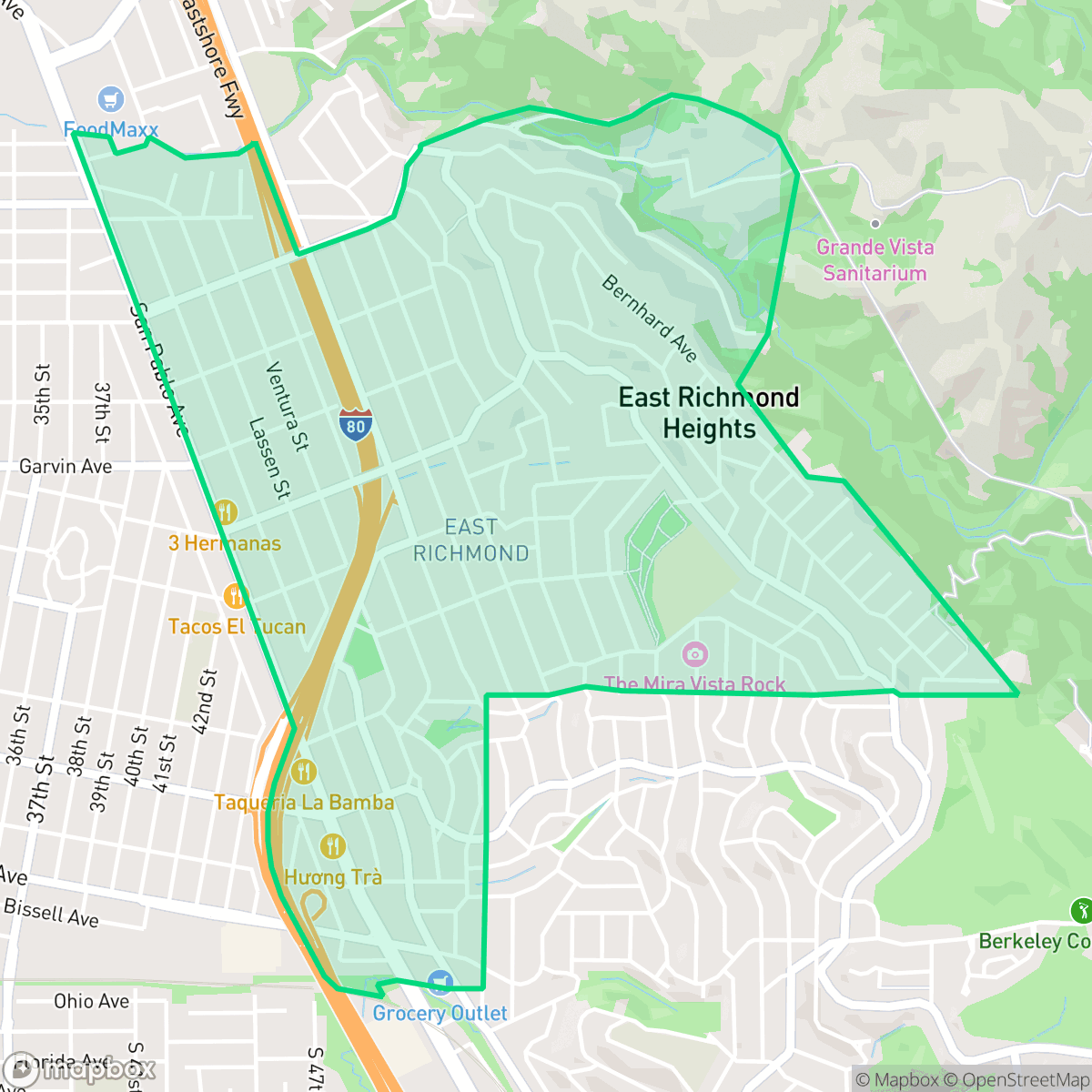
About Richmond Heights/East Richmond
Richmond Heights, historically known as East Richmond or Mira Vista, is an eastern Richmond neighborhood nestled along the Berkeley Hills. The area features a mix of mid-century residential architecture and notable local landmarks. A key architectural highlight is the Mira Vista School, designed in 1951 by renowned architect John Carl Warnecke to seamlessly "roll down the hillside," earning national acclaim as a pioneer of contextual architecture. The neighborhood is bounded by natural and historic spaces, including the Great Depression-era stonework of Alvarado Park and the scenic Wildcat Canyon. It is also home to the Gyuto Foundation, a Tibetan Buddhist Monastery and monastery-run "Path to Enlightenment" trail on Bernhard Avenue, and a community farm developed on a former brownfield site near Humboldt Park by Urban Tilth.
The area is defined by its dense suburban layout, featuring single-family homes on tight lots that foster a close-knit residential atmosphere. It provides a peaceful, primarily residential environment with minimal industrial activity, making it a stable choice for those seeking a quiet community. According to iHuus data, the neighborhood benefits from high rates of health insurance coverage and a strong sense of community, supported by local amenities like neighborhood parks and accessible pedestrian infrastructure.
Prospective residents should weigh the benefits of a walkable, green environment against the acoustic impact of the adjacent highway. While the neighborhood enjoys high walkability, the surrounding school district faces significant academic and financial challenges, though Mira Vista Elementary remains a local outlier with a higher performance rating. The area is best suited for individuals who prioritize a suburban lifestyle with easy access to regional transit routes and outdoor recreation in the nearby hills.
Neighborhood Scores Across 15 Qualities
Housing units feature mixed spacing with some neighbors positioned quite close together. According to iHuus data, this level of density is slightly higher than the Richmond average.
Extensive sidewalk networks and dedicated pedestrian bridges over major highways make navigating the area on foot efficient. This level of connectivity is largely consistent with the rest of Richmond.
Residential views range from large homes near golf courses to standard tract housing. According to iHuus data, the overall visual quality in this area sits slightly above the Richmond average.
Access to greenery for pets ranges from large golf course borders and neighborhood parks to more limited sidewalk verges. According to iHuus data, the availability of public dog walking space is roughly in line with the Richmond city average.
Residential layouts feature a dense suburban fabric of single-family homes and multi-story complexes, representing a slightly more developed environment than the Richmond average. This mix of residential grids and large commercial blocks creates a more structured urban feel compared to the more open, semi-rural areas found elsewhere in the city.
Local activity levels are slightly higher than the Richmond average, characterized by a mix of quiet residential streets and pockets of diverse dining and social hubs. While some areas offer a calm atmosphere near parks, the neighborhood's layout remains largely car-dependent.
Proximity to major freeways and railroad tracks results in persistent ambient noise. This level of acoustic disturbance is slightly higher than the Richmond average, according to iHuus data.
Air quality remains consistently high with rare instances of elevated readings. According to iHuus data, the air in this area is slightly cleaner than the Richmond average.
Residential streets and green spaces dominate the area, offering much less industrial activity than the Richmond average. While some large retail warehouses and freeway-related noise exist near certain borders, the neighborhood remains primarily composed of quiet residential and light commercial zones.
Health insurance access is exceptionally high among residents, significantly exceeding the Richmond average according to iHuus data.
Voting patterns and census indicators show a highly liberal political leaning that is consistent with the rest of Richmond. According to iHuus data, this area reflects the same political profile seen across the broader city.
Residents inhabit a demographic landscape with a balanced spread of young adults, families, and older individuals. This age distribution is slightly more varied than the average seen across Richmond.
Flood risk is notably higher than the Richmond average because portions of this area fall within a designated 100-year floodplain. Residents should be aware that flood insurance is typically required for properties in this zone according to iHuus data.
Fire safety conditions in this area are notably lower than the Richmond average according to iHuus data. Proximity to flammable vegetation and local infrastructure presents a significant risk for residents.
Address-Level Insights for Richmond Heights/East Richmond


iHuus Neighborhood Intelligence Insights
Get address-level neighborhood insights for Richmond Heights/East Richmond
- Street-level scores — see how individual blocks compare, not just neighborhood averages
- Micro-zone boundaries — identify quiet pockets, flood boundaries, and walkable clusters before you visit
- 15 dimensions in full — walkability, noise, air quality, school quality, insurance coverage, population age profile, urban/rural index, and more
- Boundary risk alerts — know if your address sits near a block boundary where scores drop, the kind of detail no listing will ever mention
- School insights — individual school ratings and insights, not just district-level data
- Compare before you commit — side-by-side data across neighborhoods, down to block precision
No credit card required
Compare with Any Neighborhood
| Dimension | Richmond Heights/East Richmond | Atchison Village |
|---|---|---|
| 🚶 Walkabilityavg 8.38 | ||
| 🔊 Acoustic Comfortavg 2.96 | ||
| 🤫 Privacy Indexavg 4.19 | ||
| 🎨 Visual Appealavg 5.97 | ||
| 🐕 Dog Friendlinessavg 6.4 | ||
| 🗺️ Urban-Rural Indexavg 6.62 | ||
| ✨ Neighborhood Vibeavg 4.2 | ||
| 🏥 Health Insurance Coverageavg 7.31 | ||
| 🌿 Air Qualityavg 8.35 | ||
| 🏭 Industrial Proximityavg 7.37 | ||
| 🌊 Flood Safetyavg 2.2 | ||
| 🗳️ Ideological Leanavg 9.87 | ||
| 👥 Population Age Profileavg 4.89 | ||
| 🔥 Fire Safetyavg 0.24 | ||
| 🏫 School Quality |
Richmond Heights/East Richmond Rankings
School Districts Serving Richmond Heights/East Richmond
School Insights for Richmond Heights/East Richmond
Below average outcomes; significant attendance and academic challenges.
School Insights
See what's really behind every school rating near Richmond Heights/East Richmond
- Individual school ratings — each school's own score with outcome context, not just a district average
- Enrollment & class size data — student-to-teacher ratio and how it compares to the state average
- Full demographics breakdown — ethnicity and gender composition for every school in the enrollment zone
- Every school in the district — all schools within the enrollment boundary ranked by rating, not just the closest one
- Grade levels & benchmarks — elementary through high school, with below/above state-average flags
No credit card required