Richmond Annex, Richmond
Updated · 4,514 residents
Richmond Annex is a highly walkable residential enclave defined by its consistent grid layout and proximity to the Pacific East Mall. While the neighborhood offers excellent air quality and a lack of industrial presence, residents should expect notable noise levels from highway traffic and limited privacy due to the high density of its bungalow-style housing.
Key Highlights
About Richmond Annex
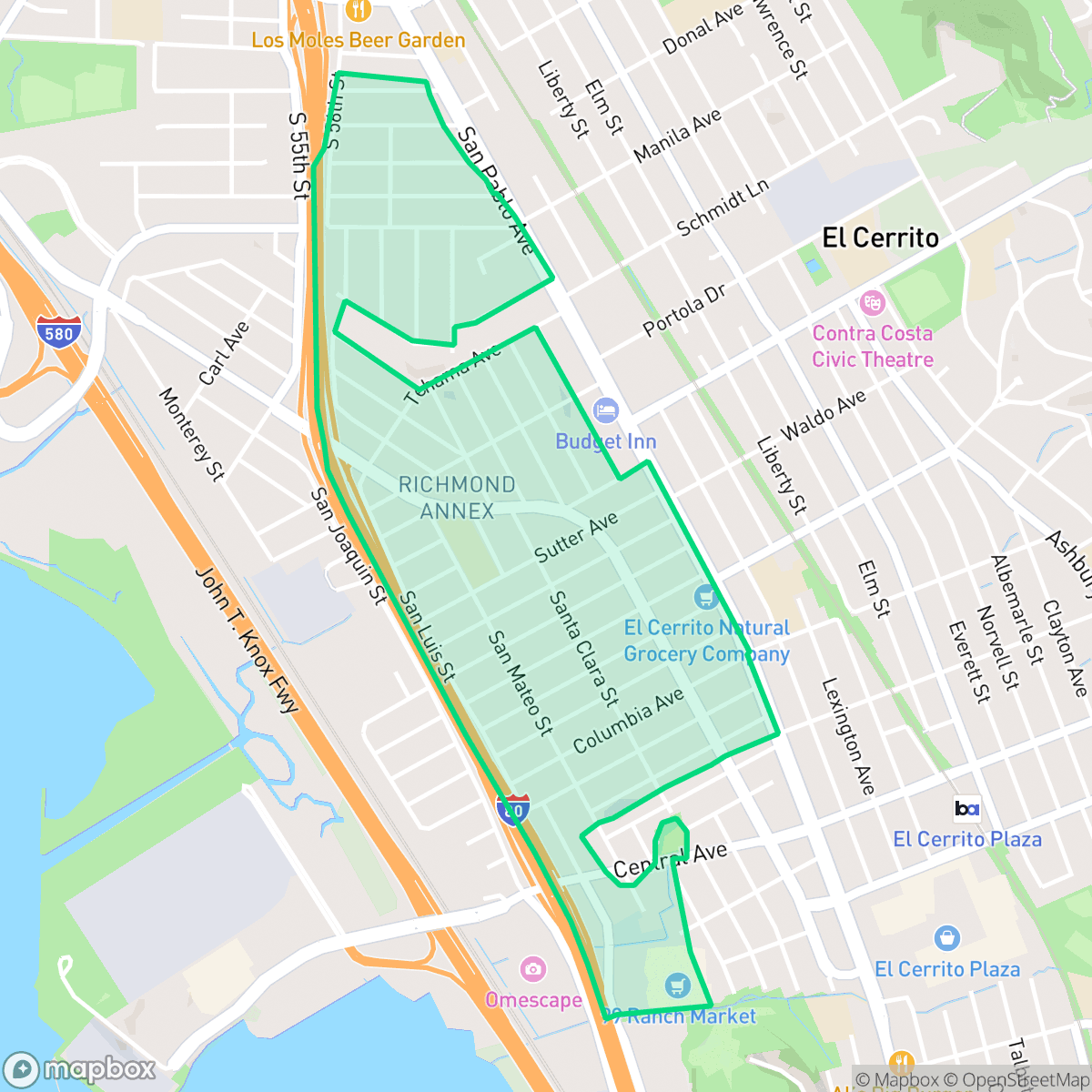
Once farmed by the Conlon Brothers and owned by landowner William Meyer in the late 19th century, the Richmond Annex officially joined Richmond on September 26, 1926, following a dramatic 13–12 vote to annex into Richmond rather than neighboring El Cerrito. Today, "The Annex" is a distinct, working-class residential enclave of bungalows, physically separated from the rest of Richmond by Interstate 80. Its main thoroughfare, Carlson Boulevard, connects the neighborhood's cozy residential streets. Notable local landmarks include the Richmond Annex Senior Center—housed in a historic 1937 former firehouse—and the Pacific East Mall, a vibrant retail hub featuring the East Bay's largest concentration of Asian businesses.
The area functions as a quiet residential pocket characterized by its consistent street grid and high walkability. It maintains a distinct identity through its mix of modest, uniform housing and local commercial hubs like the Pacific East Mall, which hosts a significant concentration of Asian businesses. Residents benefit from high air quality and a lack of nearby heavy industrial facilities, making it a clean environment for those who prioritize accessibility to local services and retail.
Prospective residents should consider the trade-offs inherent in the neighborhood's layout. According to iHuus data, the area experiences elevated noise levels primarily due to road traffic, which may impact acoustic comfort. The housing stock consists of tightly packed homes with small yards, resulting in limited private outdoor space and a lower privacy index. Furthermore, families should be aware that the local school district faces significant academic and financial challenges, which may influence long-term educational planning for those moving to the area.
Neighborhood Scores Across 15 Qualities
Residential structures are positioned closely together with minimal separation between property lines. This density is slightly higher than the Richmond average, resulting in less personal buffer space between neighbors.
Comprehensive sidewalk networks and frequent crosswalks make navigating the area on foot easy, providing better pedestrian connectivity than the Richmond average. While the central highway presents a physical barrier, the residential streets and parkland paths offer a consistent grid for walkers.
Standard tract housing and mid-sized apartment complexes characterize the area, featuring consistent rooflines and small yards. This visual landscape is largely similar to the city average.
Abundant trail space and a large central forest park provide excellent opportunities for walking dogs; however, the neighborhood remains roughly average for the city in terms of overall dog friendliness.
Residential grids transition into industrial and coastal zones, offering a blend of housing and open space that is slightly less urbanized than the Richmond average according to iHuus data.
A mix of residential streets and light industrial zones creates a moderately active atmosphere that is more lively than the Richmond average. While diverse dining and small commercial units are present, much of the neighborhood maintains a calm, suburban feel near major transit corridors.
Frequent aircraft noise from the nearby airport runway and proximity to heavy rail lines result in very low acoustic comfort. According to iHuus data, noise levels here are significantly higher than the Richmond average.
Air quality in this area is exceptionally clear and significantly cleaner than the Richmond average. According to iHuus data, residents can expect minimal exposure to pollutants and very low health concerns regarding airborne particulates.
Residential and light commercial uses predominate the area, though proximity to major highway infrastructure and nearby logistics hubs can introduce noise. While there is no heavy industrial presence, some areas remain under EPA monitoring due to historical site remediation.
Health insurance enrollment is notably higher than the Richmond average, according to iHuus data. This level of coverage suggests greater access to medical services for area residents.
Voting patterns and census indicators show a very strong liberal lean, which is slightly more pronounced than the city average according to iHuus data.
Residents live alongside a balanced mix of young adults, families, and older populations. This demographic distribution is largely consistent with the broader Richmond area.
Properties in this area are situated within a recognized floodplain, which may necessitate flood insurance. This level of risk is slightly higher than the average for Richmond.
Address-Level Insights for Richmond Annex


iHuus Neighborhood Intelligence Insights
Get address-level neighborhood insights for Richmond Annex
- Street-level scores — see how individual blocks compare, not just neighborhood averages
- Micro-zone boundaries — identify quiet pockets, flood boundaries, and walkable clusters before you visit
- 15 dimensions in full — walkability, noise, air quality, school quality, insurance coverage, population age profile, urban/rural index, and more
- Boundary risk alerts — know if your address sits near a block boundary where scores drop, the kind of detail no listing will ever mention
- School insights — individual school ratings and insights, not just district-level data
- Compare before you commit — side-by-side data across neighborhoods, down to block precision
No credit card required
Compare with Any Neighborhood
| Dimension | Richmond Annex | Atchison Village |
|---|---|---|
| 🚶 Walkabilityavg 8.38 | ||
| 🔊 Acoustic Comfortavg 2.96 | ||
| 🤫 Privacy Indexavg 4.19 | ||
| 🎨 Visual Appealavg 5.97 | ||
| 🐕 Dog Friendlinessavg 6.4 | ||
| 🗺️ Urban-Rural Indexavg 6.62 | ||
| ✨ Neighborhood Vibeavg 4.2 | ||
| 🏥 Health Insurance Coverageavg 7.31 | ||
| 🌿 Air Qualityavg 8.35 | ||
| 🏭 Industrial Proximityavg 7.37 | ||
| 🌊 Flood Safetyavg 2.2 | ||
| 🗳️ Ideological Leanavg 9.87 | ||
| 👥 Population Age Profileavg 4.89 | ||
| 🔥 Fire Safetyavg 0.24 | ||
| 🏫 School Quality |
Richmond Annex Rankings
School Districts Serving Richmond Annex
School Insights for Richmond Annex
Below average outcomes; significant attendance and academic challenges.
School Insights
See what's really behind every school rating near Richmond Annex
- Individual school ratings — each school's own score with outcome context, not just a district average
- Enrollment & class size data — student-to-teacher ratio and how it compares to the state average
- Full demographics breakdown — ethnicity and gender composition for every school in the enrollment zone
- Every school in the district — all schools within the enrollment boundary ranked by rating, not just the closest one
- Grade levels & benchmarks — elementary through high school, with below/above state-average flags
No credit card required