Point Richmond, Richmond
Updated · 2,117 residents
Point Richmond is a scenic, historic village known for its distinct architectural character and proximity to the San Francisco Bay. While it offers a quiet, visually appealing environment, residents experience a car-dependent lifestyle with limited local services and notable proximity to industrial zones.
Key Highlights
About Point Richmond
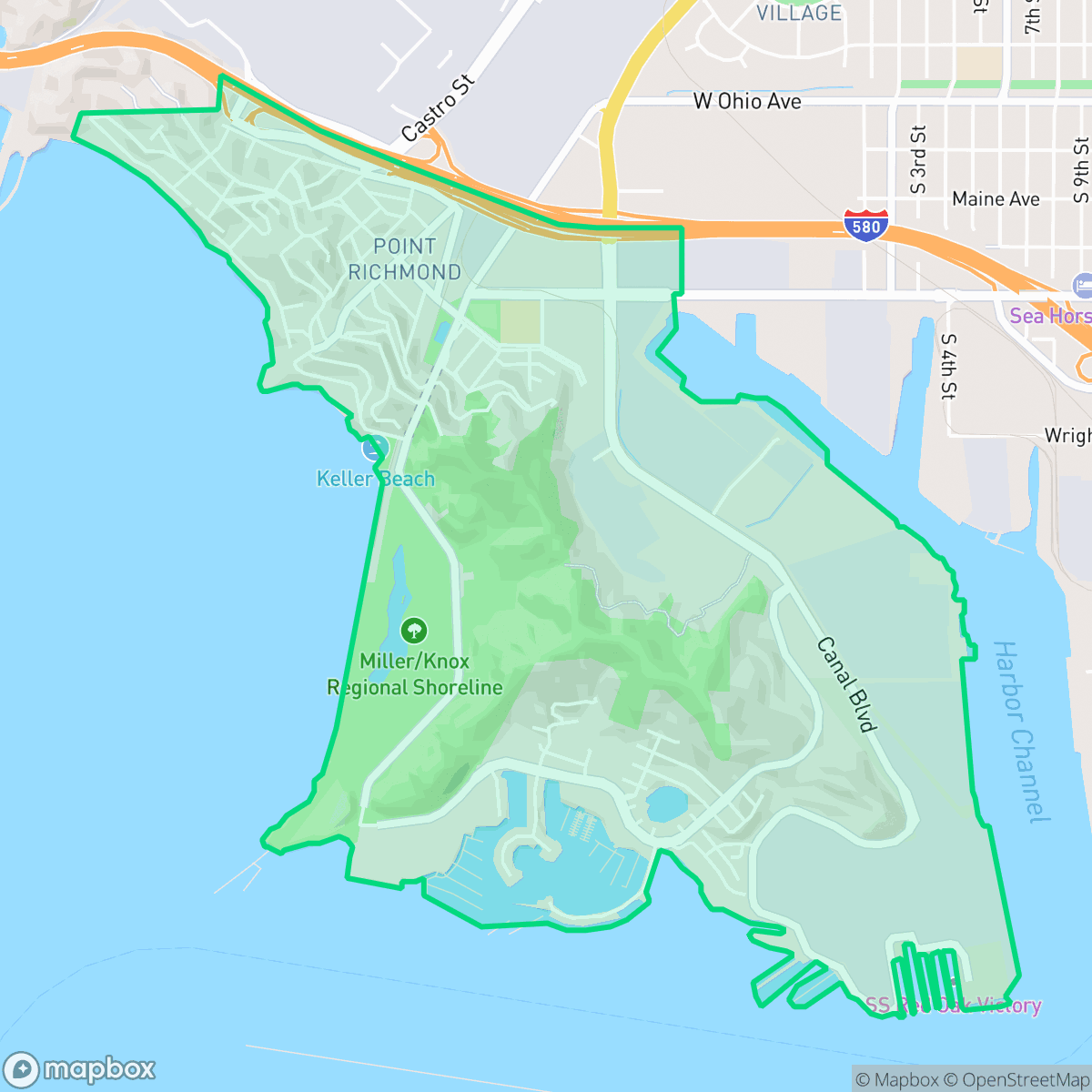
Established in the late 1890s, Point Richmond developed as a bustling boomtown after Augustin Macdonald identified Ferry Point as the western terminus for the Santa Fe Railroad. The neighborhood served as Richmond’s original downtown, fueled by the railroad and the adjacent Standard Oil refinery. Divided by a ridge into "town" and "bay" sides, the neighborhood retains its distinct, pedestrian-friendly "village" character. The Point Richmond Historic District, listed on the National Register of Historic Places, preserves over 300 contributing structures built between 1900 and 1920, showcasing architectural styles like Queen Anne cottages, Neo-Classic row houses, and Craftsman bungalows. Notable local landmarks defining the neighborhood’s identity include the historic Hotel Mac, the 1926 Municipal Natatorium (known as "The Plunge"), Keller Beach, and the scenic trails of Nicholl Knob.
The neighborhood functions as a quiet, coastal enclave that balances residential pockets with significant industrial infrastructure. It is characterized by a serene atmosphere and high visual appeal, featuring expansive green spaces and coastal access points like Keller Beach. Despite its peaceful aesthetic, the area is largely car-dependent, and daily life is influenced by the nearby presence of heavy industrial facilities and logistics hubs. According to recent data, the area maintains a high level of health insurance coverage and a strong sense of community, though residents should be aware of the environmental and safety considerations associated with its industrial surroundings.
Living in this area involves distinct trade-offs, particularly regarding its infrastructure and public services. While the neighborhood offers a reprieve from the density of surrounding urban centers, it lacks the high walkability found in other parts of the city. Prospective residents may find the quiet, suburban-industrial blend suitable, provided they are comfortable with the limited local business density and the ongoing environmental monitoring of nearby industrial sites. The local school district faces significant academic and financial challenges, which is a factor for families to consider when evaluating the area.
Neighborhood Scores Across 15 Qualities
Residential spacing is varied, offering some buffer between neighbors that is roughly consistent with the Richmond average. According to iHuus data, the area features mixed density patterns.
Low sidewalk availability makes navigating the area difficult for pedestrians; however, the residential streets remain calm and suitable for walking. This level of walkability is notably lower than the Richmond city average, according to iHuus data.
Larger residences and frequent upscale amenities contribute to an aesthetic that is more visually appealing than the Richmond average, according to iHuus data.
Connected green spaces and wide paths provide safe, low-traffic areas for walking pets. According to iHuus data, the availability of these amenities is roughly in line with the Richmond average.
Residential streets and green spaces exist in roughly equal measure with large-scale industrial and maritime infrastructure. This balance of built environment and open space is slightly less dense than the Richmond city average, according to iHuus data.
Limited local business activity and a heavy industrial presence create a much more subdued atmosphere than the Richmond average. Residents can expect a quiet, car-dependent environment with very few social destinations or walkable services nearby.
Steady hums from nearby busy streets provide a consistent level of ambient noise. According to iHuus data, acoustic comfort in this area is notably higher than the Richmond city average.
Air quality remains consistently good with infrequent instances of elevated readings, though it sits slightly below the Richmond city average according to iHuus data.
Industrial and commercial activity is notably lower here than in the rest of Richmond, though the area remains subject to the influence of a nearby EPA Superfund site. Residents may encounter a blend of residential pockets and active maritime or fuel infrastructure near the waterfront.
Health insurance enrollment among residents is notably higher than the Richmond city average, according to iHuus data.
Voting patterns and census indicators show a deeply liberal political landscape that is consistent with the broader Richmond area. According to iHuus data, the ideological leaning of this neighborhood aligns closely with the city average.
A balanced mix of young adults, families, and older residents characterizes the area. According to iHuus data, this demographic variety is more widespread than the average found across Richmond.
Frequent flooding is a concern as portions of the area sit within a designated floodplain. According to iHuus data, the risk level in this neighborhood is slightly higher than the Richmond average.
Address-Level Insights for Point Richmond


iHuus Neighborhood Intelligence Insights
Get address-level neighborhood insights for Point Richmond
- Street-level scores — see how individual blocks compare, not just neighborhood averages
- Micro-zone boundaries — identify quiet pockets, flood boundaries, and walkable clusters before you visit
- 15 dimensions in full — walkability, noise, air quality, school quality, insurance coverage, population age profile, urban/rural index, and more
- Boundary risk alerts — know if your address sits near a block boundary where scores drop, the kind of detail no listing will ever mention
- School insights — individual school ratings and insights, not just district-level data
- Compare before you commit — side-by-side data across neighborhoods, down to block precision
No credit card required
Compare with Any Neighborhood
| Dimension | Point Richmond | Atchison Village |
|---|---|---|
| 🚶 Walkabilityavg 8.38 | ||
| 🔊 Acoustic Comfortavg 2.96 | ||
| 🤫 Privacy Indexavg 4.19 | ||
| 🎨 Visual Appealavg 5.97 | ||
| 🐕 Dog Friendlinessavg 6.4 | ||
| 🗺️ Urban-Rural Indexavg 6.62 | ||
| ✨ Neighborhood Vibeavg 4.2 | ||
| 🏥 Health Insurance Coverageavg 7.31 | ||
| 🌿 Air Qualityavg 8.35 | ||
| 🏭 Industrial Proximityavg 7.37 | ||
| 🌊 Flood Safetyavg 2.2 | ||
| 🗳️ Ideological Leanavg 9.87 | ||
| 👥 Population Age Profileavg 4.89 | ||
| 🔥 Fire Safetyavg 0.24 | ||
| 🏫 School Quality |
Point Richmond Rankings
School Districts Serving Point Richmond
School Insights for Point Richmond
Below average outcomes; significant attendance and academic challenges.
School Insights
See what's really behind every school rating near Point Richmond
- Individual school ratings — each school's own score with outcome context, not just a district average
- Enrollment & class size data — student-to-teacher ratio and how it compares to the state average
- Full demographics breakdown — ethnicity and gender composition for every school in the enrollment zone
- Every school in the district — all schools within the enrollment boundary ranked by rating, not just the closest one
- Grade levels & benchmarks — elementary through high school, with below/above state-average flags
No credit card required