Park Plaza, Richmond
Updated · 3,056 residents
Park Plaza is a highly walkable community in Richmond that balances suburban residential life with access to expansive green spaces and local amenities. While residents benefit from excellent air quality and convenient pedestrian infrastructure, the area features closely spaced housing and elevated noise levels from nearby highway and rail corridors.
Key Highlights
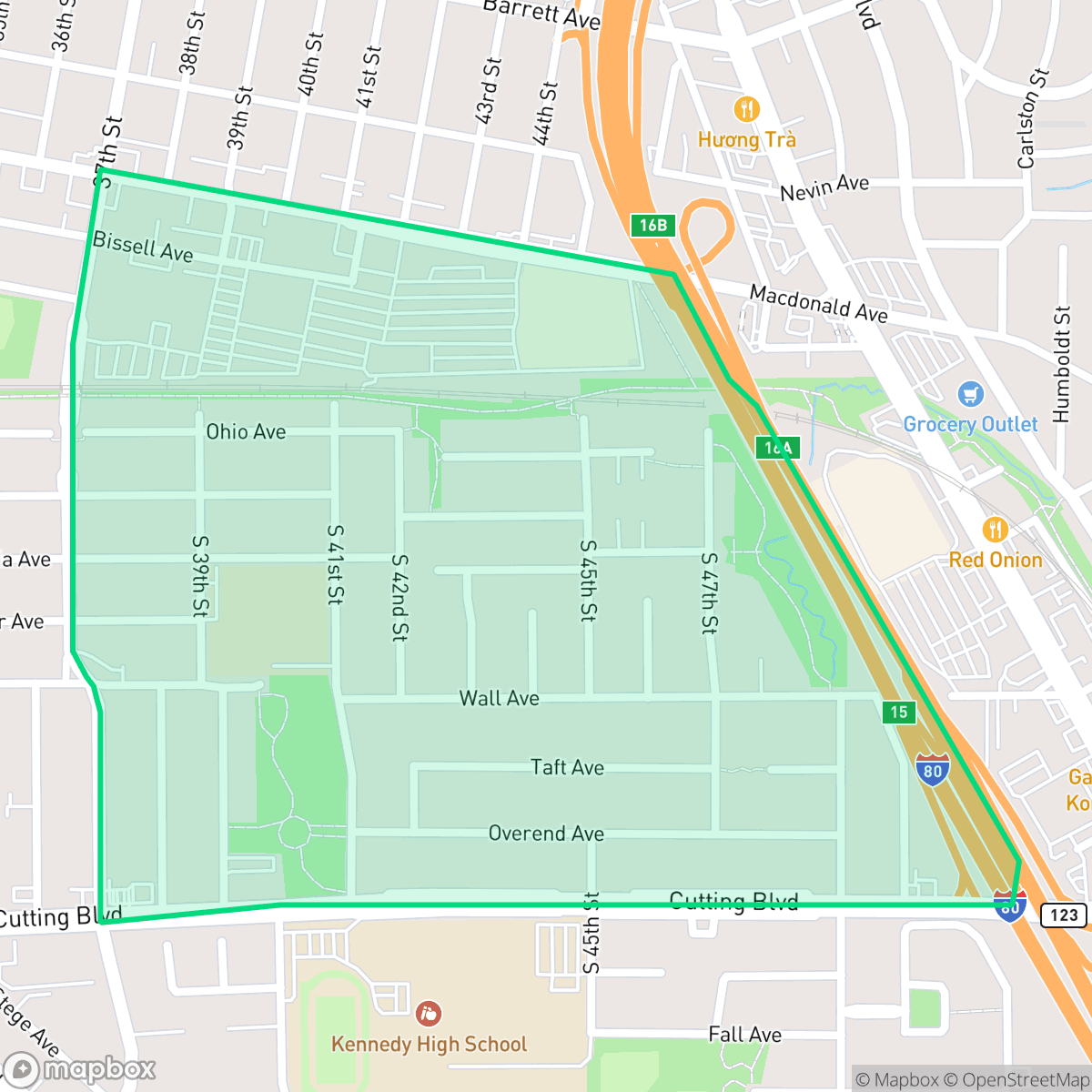
About Park Plaza
The Park Plaza neighborhood of Richmond, California, is deeply tied to the history of Japanese-American floriculture. Beginning in 1906, immigrant families, including the Sakai, Oishi, and Endo families, established and operated thriving commercial flower nurseries near 47th Street and Florida Avenue. Despite the forced internment of Japanese Americans during World War II, these families managed to preserve their nurseries and returned to run them for decades. In 2006, the city acquired the 14-acre nursery site to remediate the toxic brownfield, transforming it into the Miraflores housing development. This project features the Miraflores Senior Apartments, completed in 2018, and the Miraflores Greenbelt, which daylights Baxter Creek and connects to the Richmond Greenway. To honor this local heritage, several historic nursery structures, including the Sakai and Oishi family homes, a greenhouse, and a water tower, are preserved within the development.
The neighborhood is defined by a consistent, highly walkable grid that connects residents to local retail centers and recreational hubs. According to iHuus data, the area offers high air quality and strong dog-friendliness, supported by a large central park that provides essential outdoor space for the community. The architectural landscape is composed of standard tract housing, creating a dense suburban environment where homes are situated in close proximity to one another. Prospective residents should note that the area maintains a moderate level of activity, particularly near local social hubs and retail corridors.
Living in this area involves specific trade-offs, particularly regarding acoustic comfort. The neighborhood experiences significant noise from adjacent highway traffic and rail lines, which is a notable factor for those sensitive to sound. Furthermore, the local school district, West Contra Costa Unified, faces ongoing fiscal and academic challenges that may influence families with school-aged children. The area is best suited for those who prioritize pedestrian accessibility and proximity to urban amenities over quiet seclusion or expansive private yard space.
Neighborhood Scores Across 15 Qualities
Residential lots feature high density with houses positioned very near one another on many blocks. This level of neighbor proximity is roughly in line with the average for Richmond.
Pedestrian travel is easy throughout the residential area due to a continuous sidewalk network and a consistent street grid. This level of walkability is notably higher than the average for Richmond.
Standard tract homes with boxy rooflines and small yards characterize the landscape. This level of visual variety is consistent with the average for Richmond.
Large central parks and school sports fields offer significant space for dog walking; this level of pet accessibility is consistent with the city average.
Residential areas feature a dense suburban fabric with a mix of single-family homes and large retail centers. This level of development is largely in line with the typical landscape found across Richmond.
Suburban streets and green spaces provide a balance of quiet residential blocks and active social hubs with diverse dining options. This level of activity and amenity access is notably higher than the Richmond city average, according to iHuus data.
Frequent noise from nearby railroad tracks and heavy freeway traffic characterizes the area. According to iHuus data, acoustic comfort is lower than the Richmond city average.
Air quality remains consistently high with minimal health concerns for residents. According to iHuus data, levels in Park Plaza are better than the Richmond city average.
Residential and institutional spaces dominate the area with very little heavy industry visible. While some residents may experience noise from adjacent highways and rail corridors, the presence of large-scale industrial plants is notably lower than the Richmond average, according to iHuus data.
Health insurance access is relatively high for residents here, trending slightly above the Richmond city average according to iHuus data.
Voting patterns and census indicators show a deeply liberal political leaning that is consistent with the broader Richmond area, according to iHuus data.
A diverse range of age groups, including young adults, families, and seniors, resides here. This demographic distribution is consistent with the average seen across Richmond.
Property within this area is situated inside a recognized flood zone, making flood insurance likely a necessity for residents. This risk level is notably higher than the average found across Richmond.
Address-Level Insights for Park Plaza


iHuus Neighborhood Intelligence Insights
Get address-level neighborhood insights for Park Plaza
- Street-level scores — see how individual blocks compare, not just neighborhood averages
- Micro-zone boundaries — identify quiet pockets, flood boundaries, and walkable clusters before you visit
- 15 dimensions in full — walkability, noise, air quality, school quality, insurance coverage, population age profile, urban/rural index, and more
- Boundary risk alerts — know if your address sits near a block boundary where scores drop, the kind of detail no listing will ever mention
- School insights — individual school ratings and insights, not just district-level data
- Compare before you commit — side-by-side data across neighborhoods, down to block precision
No credit card required
Compare with Any Neighborhood
| Dimension | Park Plaza | Atchison Village |
|---|---|---|
| 🚶 Walkabilityavg 8.38 | ||
| 🔊 Acoustic Comfortavg 2.96 | ||
| 🤫 Privacy Indexavg 4.19 | ||
| 🎨 Visual Appealavg 5.97 | ||
| 🐕 Dog Friendlinessavg 6.4 | ||
| 🗺️ Urban-Rural Indexavg 6.62 | ||
| ✨ Neighborhood Vibeavg 4.2 | ||
| 🏥 Health Insurance Coverageavg 7.31 | ||
| 🌿 Air Qualityavg 8.35 | ||
| 🏭 Industrial Proximityavg 7.37 | ||
| 🌊 Flood Safetyavg 2.2 | ||
| 🗳️ Ideological Leanavg 9.87 | ||
| 👥 Population Age Profileavg 4.89 | ||
| 🔥 Fire Safetyavg 0.24 | ||
| 🏫 School Quality |
Park Plaza Rankings
School Districts Serving Park Plaza
School Insights for Park Plaza
Below average outcomes; significant attendance and academic challenges.
School Insights
See what's really behind every school rating near Park Plaza
- Individual school ratings — each school's own score with outcome context, not just a district average
- Enrollment & class size data — student-to-teacher ratio and how it compares to the state average
- Full demographics breakdown — ethnicity and gender composition for every school in the enrollment zone
- Every school in the district — all schools within the enrollment boundary ranked by rating, not just the closest one
- Grade levels & benchmarks — elementary through high school, with below/above state-average flags
No credit card required