Panhandle Annex, Richmond
Updated · 607 residents
Panhandle Annex is a compact, dense residential neighborhood in Richmond defined by its proximity to Booker T. Anderson Jr. Park and a consistent grid of suburban homes. While the area offers excellent air quality and strong health insurance coverage, residents experience significant noise from nearby highway traffic and should be aware of local flood and fire risk profiles.
Key Highlights
About Panhandle Annex
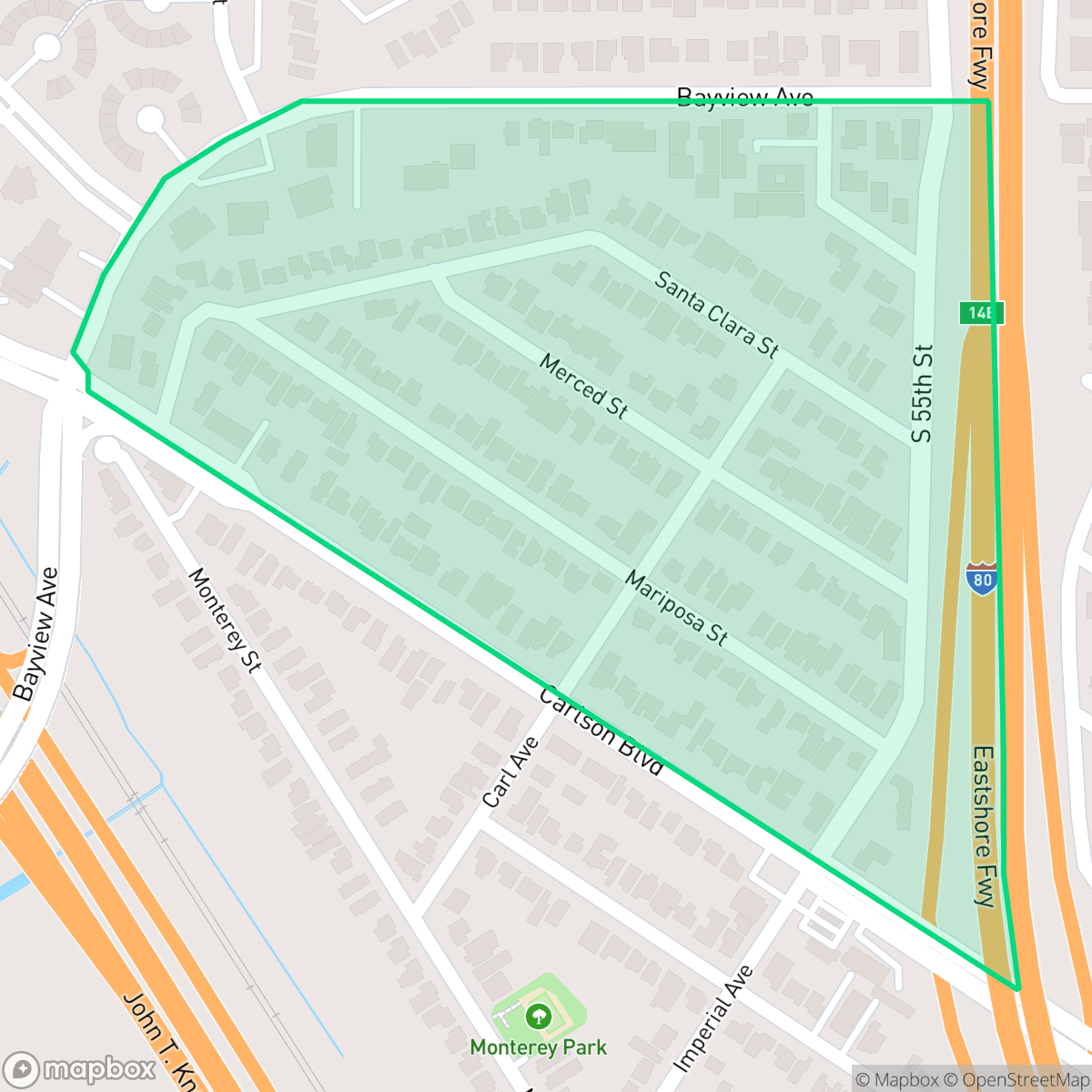
Located in southeast Richmond, California, the small residential neighborhood of Panhandle Annex has a unique history dating back to the late 19th century. In the 1890s, the land was home to the Stege Frog Farm, which raised California red-legged frogs for San Francisco restaurants. Today, the neighborhood's cultural and recreational heart is Booker T. Anderson Jr. Park and community center, named after the prominent local civil rights leader, city councilmember, and former mayor. This tight-knit community of approximately 225 homes is also defined by the "Panhandle Annex Mural" on South 55th Street. Created in 2022 by artist Regina Gilligan and local volunteers, this landmark public artwork commemorates the area's native ecology, its Ohlone heritage, and a now-underground local creek.
The neighborhood functions as a quiet, tightly packed residential enclave characterized by standard tract housing and a walkable street grid. Its central feature is the community-focused park space, which provides essential outdoor recreation for local families. According to iHuus data, the area maintains a notably progressive ideological leaning and high rates of health insurance coverage, reflecting a stable, if modest, community demographic. Living here involves specific trade-offs, particularly regarding environmental noise. The proximity to major transit corridors results in a high volume of road traffic, which significantly impacts acoustic comfort. Prospective residents should also consider the district's school performance, as the local school system faces ongoing financial and academic challenges. While the neighborhood offers excellent air quality, the high vulnerability to flood and fire hazards remains a critical factor for long-term planning and insurance considerations.
Neighborhood Scores Across 15 Qualities
Residential spacing is slightly more dense than the Richmond average, featuring a mix of detached homes and multi-family complexes with shared walls. Some areas feature houses positioned closely together, which may limit visual buffers between neighbors.
Pedestrian infrastructure includes a consistent sidewalk grid and safe crossings, though the central highway acts as a significant physical barrier. This level of walkability is slightly lower than the Richmond average according to iHuus data.
Typical tract housing characterizes this area, featuring modest lots and simple rooflines. The visual landscape is consistent with the broader Richmond area, offering tidy yards without significant luxury amenities.
Connected green spaces and a large park with ball fields offer ample room for pet walking. According to iHuus data, the availability of wide paths and continuous sidewalks is higher than the Richmond average.
Residential street grids and green spaces are balanced with significant industrial zones and highway infrastructure. This area feels more urbanized than the Richmond average due to the density of multi-unit housing and commercial corridors.
Limited social activity and sparse retail density result in a much more subdued atmosphere than the Richmond average. Most areas are characterized by quiet, industrial, or residential blocks where daily errands often require a vehicle.
Frequent aircraft noise from the nearby airport runway and heavy rail activity creates a high level of acoustic disturbance. According to iHuus data, the noise levels in this area are significantly higher than the Richmond average.
Air quality in this area is exceptionally high and remains significantly cleaner than the Richmond average. Residents can expect minimal exposure to pollutants based on iHuus sensor data.
Large logistics hubs and light industrial blocks are located near residential areas, resulting in a higher concentration of industrial activity than the Richmond average. Residents may encounter noise from nearby highway traffic and semi-truck operations, as well as ongoing environmental monitoring from a former Superfund site.
Health insurance accessibility is strong in this area, with coverage rates notably higher than the Richmond city average according to iHuus data.
Voting patterns and census indicators in this area show a predominantly liberal leaning, which is very similar to the broader Richmond area according to iHuus data.
Residents live alongside a balanced mix of young adults, families, and older populations. This age distribution is consistent with the broader Richmond area according to iHuus data.
Property locations within the 100-year floodplain are more frequent here than in the rest of Richmond. Residents should anticipate that flood insurance will likely be a requirement for most dwellings according to iHuus data.
Address-Level Insights for Panhandle Annex


iHuus Neighborhood Intelligence Insights
Get address-level neighborhood insights for Panhandle Annex
- Street-level scores — see how individual blocks compare, not just neighborhood averages
- Micro-zone boundaries — identify quiet pockets, flood boundaries, and walkable clusters before you visit
- 15 dimensions in full — walkability, noise, air quality, school quality, insurance coverage, population age profile, urban/rural index, and more
- Boundary risk alerts — know if your address sits near a block boundary where scores drop, the kind of detail no listing will ever mention
- School insights — individual school ratings and insights, not just district-level data
- Compare before you commit — side-by-side data across neighborhoods, down to block precision
No credit card required
Compare with Any Neighborhood
| Dimension | Panhandle Annex | Atchison Village |
|---|---|---|
| 🚶 Walkabilityavg 8.38 | ||
| 🔊 Acoustic Comfortavg 2.96 | ||
| 🤫 Privacy Indexavg 4.19 | ||
| 🎨 Visual Appealavg 5.97 | ||
| 🐕 Dog Friendlinessavg 6.4 | ||
| 🗺️ Urban-Rural Indexavg 6.62 | ||
| ✨ Neighborhood Vibeavg 4.2 | ||
| 🏥 Health Insurance Coverageavg 7.31 | ||
| 🌿 Air Qualityavg 8.35 | ||
| 🏭 Industrial Proximityavg 7.37 | ||
| 🌊 Flood Safetyavg 2.2 | ||
| 🗳️ Ideological Leanavg 9.87 | ||
| 👥 Population Age Profileavg 4.89 | ||
| 🔥 Fire Safetyavg 0.24 | ||
| 🏫 School Quality |
Panhandle Annex Rankings
School Districts Serving Panhandle Annex
School Insights for Panhandle Annex
Below average outcomes; significant attendance and academic challenges.
School Insights
See what's really behind every school rating near Panhandle Annex
- Individual school ratings — each school's own score with outcome context, not just a district average
- Enrollment & class size data — student-to-teacher ratio and how it compares to the state average
- Full demographics breakdown — ethnicity and gender composition for every school in the enrollment zone
- Every school in the district — all schools within the enrollment boundary ranked by rating, not just the closest one
- Grade levels & benchmarks — elementary through high school, with below/above state-average flags
No credit card required