North and East, Richmond
Updated · 16,018 residents
North and East is a highly walkable residential area in Richmond, CA, defined by its dense grid of mid-20th-century homes and active community involvement. While the neighborhood offers excellent access to local dining and urban amenities, residents should note the limited private green space and elevated noise levels from nearby road traffic.
Key Highlights
About North and East
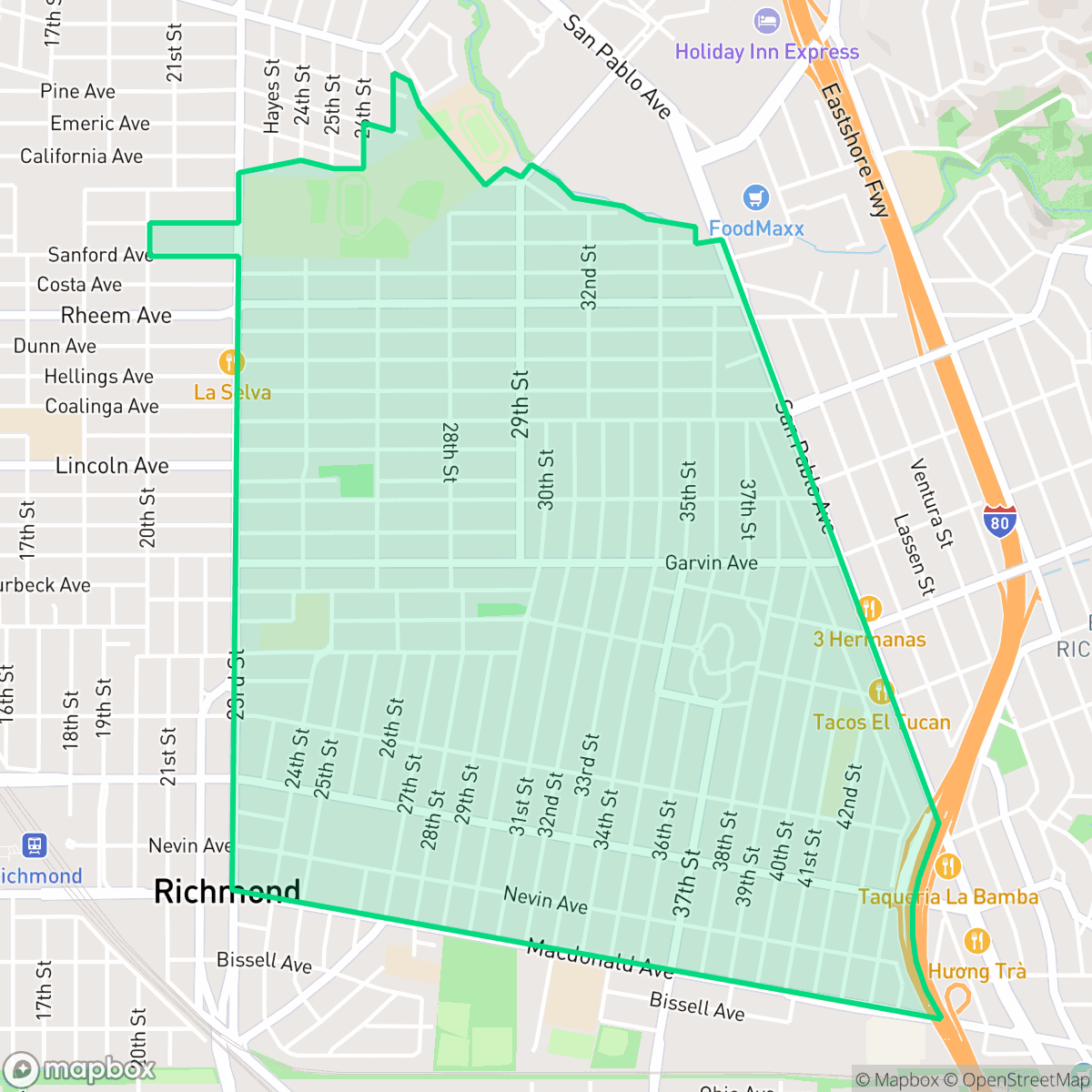
Initially developed over a century ago as Grand View Terrace, Richmond's North and East neighborhood was designed by the same development team behind North Berkeley’s Marin Circle. The area featured matching signature hallmarks, including boundary-marking pillars, prominent pink sidewalks, and a historic fountain on Clinton Hill (at Mesa Way, Clinton Avenue, and 36th Street) that served as the community's early centerpiece. Today, North and East is a well-established, tree-lined residential neighborhood known for its active neighborhood council and strong community spirit. Its housing stock largely dates to the mid-20th century, with architectural styles ranging from Spanish Mediterranean to classic Tudors. Notable local landmarks anchoring the neighborhood include Salesian College Preparatory on its northern edge and the Macdonald 80 Shopping Center to the south.
The neighborhood features a dense residential fabric with homes positioned closely together, prioritizing a compact, grid-based layout that facilitates high walkability. Residents benefit from a lively social scene, with various local restaurants and cafes situated throughout the area. According to iHuus data, the community maintains high levels of health insurance coverage and a strong, consistent ideological alignment among its residents.
Prospective residents should consider the trade-offs of this urban-suburban environment. The area experiences notable noise from road traffic, and the limited availability of public green space may present challenges for pet owners. While the broader school district faces significant academic and financial pressures, the neighborhood remains anchored by local institutions such as Manzanita Middle School, which performs well above the district average.
Neighborhood Scores Across 15 Qualities
Residential structures are tightly packed with minimal separation between houses. According to iHuus data, this lack of distance between homes is notably lower than the Richmond city average.
Extensive sidewalk networks and clear pedestrian crossings provide much easier navigation on foot than the Richmond average. Residents can rely on a consistent grid of continuous walkways and marked crosswalks throughout both residential and commercial blocks.
Uniform rooflines and small yards define this area, which presents a slightly less varied landscape than the Richmond average. Residential lots are densely packed with few private luxury amenities or large green spaces visible.
Public park access and sidewalk verges are sparse in this area, making it less dog friendly than the rest of Richmond. Most accessible green space is restricted to private backyards or fenced school fields according to iHuus data.
Residential streets and green spaces exist in roughly equal measure, though the area is slightly less suburban than the Richmond average. This landscape consists of a mix of single-family homes, low-rise apartments, and commercial lots.
Local dining and social hubs are notably more concentrated here than in the rest of Richmond. While some areas offer lively urban blocks with diverse eateries, other parts consist of calmer suburban streets near highway features.
Frequent auditory disturbances from nearby railroad tracks and heavy freeway traffic characterize this area. According to iHuus data, acoustic comfort in this neighborhood is slightly below the Richmond city average.
Air quality remains high with rare instances of elevated readings, sitting slightly below the Richmond average according to iHuus data.
Largely residential and institutional, this area features fewer heavy industrial sites than the Richmond average. While some sections border large warehouses and a railway corridor, most of the neighborhood lacks significant industrial or hazardous plants.
Health insurance accessibility is higher in this area than the Richmond average, according to iHuus data. This indicates a greater proportion of the local population possesses medical coverage.
Voting patterns and census indicators reflect a deeply liberal political landscape that aligns with the broader Richmond average.
A balanced distribution of young adults, families, and older residents characterizes the area. According to iHuus data, this demographic spread is very similar to the broader Richmond average.
Significant flood risk exists because portions of this area sit within a designated floodplain. According to iHuus data, this risk level is higher than the average for Richmond.
Address-Level Insights for North and East


iHuus Neighborhood Intelligence Insights
Get address-level neighborhood insights for North and East
- Street-level scores — see how individual blocks compare, not just neighborhood averages
- Micro-zone boundaries — identify quiet pockets, flood boundaries, and walkable clusters before you visit
- 15 dimensions in full — walkability, noise, air quality, school quality, insurance coverage, population age profile, urban/rural index, and more
- Boundary risk alerts — know if your address sits near a block boundary where scores drop, the kind of detail no listing will ever mention
- School insights — individual school ratings and insights, not just district-level data
- Compare before you commit — side-by-side data across neighborhoods, down to block precision
No credit card required
Compare with Any Neighborhood
| Dimension | North and East | Atchison Village |
|---|---|---|
| 🚶 Walkabilityavg 8.38 | ||
| 🔊 Acoustic Comfortavg 2.96 | ||
| 🤫 Privacy Indexavg 4.19 | ||
| 🎨 Visual Appealavg 5.97 | ||
| 🐕 Dog Friendlinessavg 6.4 | ||
| 🗺️ Urban-Rural Indexavg 6.62 | ||
| ✨ Neighborhood Vibeavg 4.2 | ||
| 🏥 Health Insurance Coverageavg 7.31 | ||
| 🌿 Air Qualityavg 8.35 | ||
| 🏭 Industrial Proximityavg 7.37 | ||
| 🌊 Flood Safetyavg 2.2 | ||
| 🗳️ Ideological Leanavg 9.87 | ||
| 👥 Population Age Profileavg 4.89 | ||
| 🔥 Fire Safetyavg 0.24 | ||
| 🏫 School Quality |
North and East Rankings
School Districts Serving North and East
School Insights for North and East
Below average outcomes; significant attendance and academic challenges.
School Insights
See what's really behind every school rating near North and East
- Individual school ratings — each school's own score with outcome context, not just a district average
- Enrollment & class size data — student-to-teacher ratio and how it compares to the state average
- Full demographics breakdown — ethnicity and gender composition for every school in the enrollment zone
- Every school in the district — all schools within the enrollment boundary ranked by rating, not just the closest one
- Grade levels & benchmarks — elementary through high school, with below/above state-average flags
No credit card required