Marina Bay, Richmond
Updated · 3,256 residents
Marina Bay is a waterfront enclave defined by its 850-berth yacht harbor and direct access to the San Francisco Bay Trail. The area offers high air quality and a quiet residential atmosphere, though residents face moderate noise from nearby transit and limited local dining options.
Key Highlights
About Marina Bay
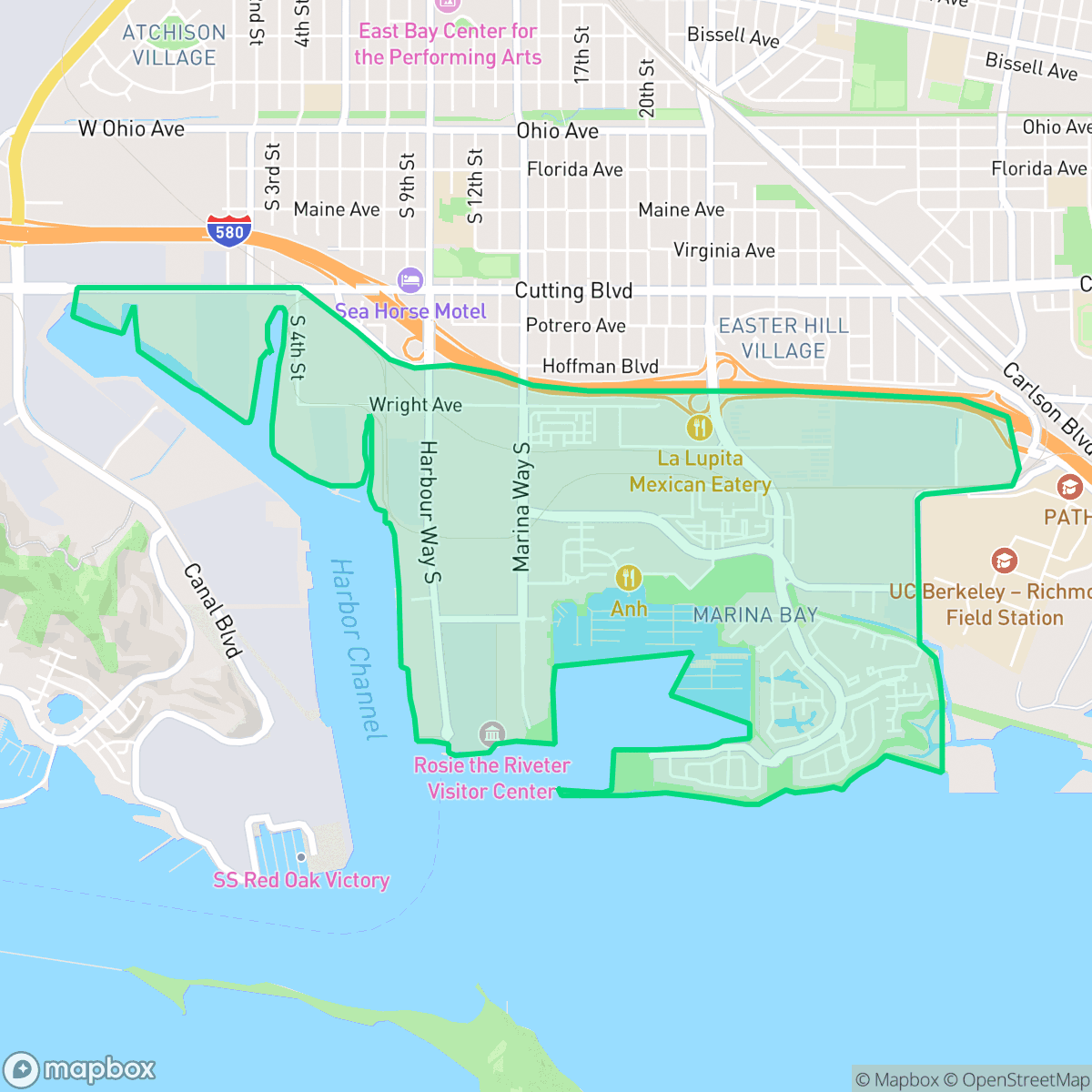
Marina Bay is a 350-acre master-planned waterfront community in Richmond, California, built on the historic site of Kaiser Shipyard #2. During World War II, thousands of workers—including many pioneering women—constructed Liberty ships in these deepwater basins. Following decades of post-war industrial decline, the Richmond Redevelopment Agency initiated the Harbor Redevelopment Project in the mid-1970s, transforming the defunct shipyards into a nautical-themed residential and commercial neighborhood by the mid-1980s. Today, Marina Bay is anchored by an 850-berth yacht harbor and the San Francisco Bay Trail. It is also home to the Rosie the Riveter/World War II Home Front National Historical Park, which features a memorial pathway designed to match the length of a Liberty ship's keel, honoring the neighborhood's vital wartime labor history.
This neighborhood functions as an industrial-suburban hybrid where modern residential blocks sit alongside large-scale warehouses and logistics infrastructure. The landscape is characterized by a sparse, quiet environment with pockets of greenery and unconventional local eateries. According to iHuus data, the area maintains a distinct identity through its blend of maritime heritage and contemporary living, providing a serene backdrop for those who value proximity to the water over traditional high-density urban convenience. Potential residents should consider several trade-offs, including moderate walkability and the presence of a nearby EPA Superfund site. While the neighborhood provides a unique aesthetic, the surrounding school district faces significant academic and financial challenges. The area is best suited for individuals or families who prioritize waterfront access and a quieter pace of life, provided they are comfortable with the logistical realities of an industrial-adjacent location.
Neighborhood Scores Across 15 Qualities
Residential spacing varies throughout the area, with some high density pockets featuring houses positioned closely together. According to iHuus data, the level of separation between neighbors is slightly higher than the Richmond city average.
Residential streets feature a well-defined grid with sidewalks and marked crossings, though overall accessibility is slightly lower than the Richmond average. Most local trips are manageable on foot due to the structured street layout.
Uniform tract housing with small yards and simple rooflines defines the area. This level of visual variety is typical for the Richmond area, according to iHuus data.
Continuous sidewalks and a large park area in the northwest provide safe, connected routes for pets. According to iHuus data, the availability of green space and traffic-free paths is on par with the rest of Richmond.
Large-scale industrial infrastructure and port facilities are interspersed with residential pockets and open green spaces. This landscape reflects a level of urban-to-rural transition that is consistent with the broader Richmond area, according to iHuus data.
Low density and heavy industrial presence create a very quiet atmosphere, though the area lacks the commercial activity found in more active parts of Richmond. Residents will find few local businesses or social hubs within walking distance, making the neighborhood primarily car-dependent.
Frequent noise from nearby railroad tracks and major freeways is a persistent feature of this area. This level of acoustic disturbance is consistent with the city average.
Air quality in this area is consistently excellent and remains above the Richmond average. Residents can expect minimal health concerns related to atmospheric pollutants according to iHuus data.
Industrial activity is notably lower here than in the rest of Richmond, offering a reprieve from heavy freight corridors and large-scale warehouses. However, residents should be aware that a nearby EPA Superfund site exists with potential for soil and water contamination, according to iHuus data.
Health insurance enrollment among residents is relatively high, though slightly below the Richmond city average according to iHuus data.
Voting patterns and census indicators reflect a highly liberal political environment that is consistent with the rest of Richmond. According to iHuus data, the area exhibits a political leaning very similar to the city average.
Residents live alongside a balanced mix of young professionals, families, and seniors. This age distribution is slightly more varied than the average found across Richmond.
Flood risk in this area is notably higher than the Richmond average. According to iHuus data, the lack of a detailed federal study means residents should remain aware of potential uncertainty regarding water levels during extreme weather events.
Address-Level Insights for Marina Bay


iHuus Neighborhood Intelligence Insights
Get address-level neighborhood insights for Marina Bay
- Street-level scores — see how individual blocks compare, not just neighborhood averages
- Micro-zone boundaries — identify quiet pockets, flood boundaries, and walkable clusters before you visit
- 15 dimensions in full — walkability, noise, air quality, school quality, insurance coverage, population age profile, urban/rural index, and more
- Boundary risk alerts — know if your address sits near a block boundary where scores drop, the kind of detail no listing will ever mention
- School insights — individual school ratings and insights, not just district-level data
- Compare before you commit — side-by-side data across neighborhoods, down to block precision
No credit card required
Compare with Any Neighborhood
| Dimension | Marina Bay | Atchison Village |
|---|---|---|
| 🚶 Walkabilityavg 8.38 | ||
| 🔊 Acoustic Comfortavg 2.96 | ||
| 🤫 Privacy Indexavg 4.19 | ||
| 🎨 Visual Appealavg 5.97 | ||
| 🐕 Dog Friendlinessavg 6.4 | ||
| 🗺️ Urban-Rural Indexavg 6.62 | ||
| ✨ Neighborhood Vibeavg 4.2 | ||
| 🏥 Health Insurance Coverageavg 7.31 | ||
| 🌿 Air Qualityavg 8.35 | ||
| 🏭 Industrial Proximityavg 7.37 | ||
| 🌊 Flood Safetyavg 2.2 | ||
| 🗳️ Ideological Leanavg 9.87 | ||
| 👥 Population Age Profileavg 4.89 | ||
| 🔥 Fire Safetyavg 0.24 | ||
| 🏫 School Quality |
Marina Bay Rankings
School Districts Serving Marina Bay
School Insights for Marina Bay
Below average outcomes; significant attendance and academic challenges.
School Insights
See what's really behind every school rating near Marina Bay
- Individual school ratings — each school's own score with outcome context, not just a district average
- Enrollment & class size data — student-to-teacher ratio and how it compares to the state average
- Full demographics breakdown — ethnicity and gender composition for every school in the enrollment zone
- Every school in the district — all schools within the enrollment boundary ranked by rating, not just the closest one
- Grade levels & benchmarks — elementary through high school, with below/above state-average flags
No credit card required