Laurel Park, Richmond
Updated · 1,429 residents
Laurel Park is a highly walkable neighborhood in Richmond characterized by its uniform 1960s tract housing and strong sense of civic engagement. Residents benefit from excellent air quality and ready access to public green spaces, though the area experiences notable noise levels from nearby road traffic.
Key Highlights
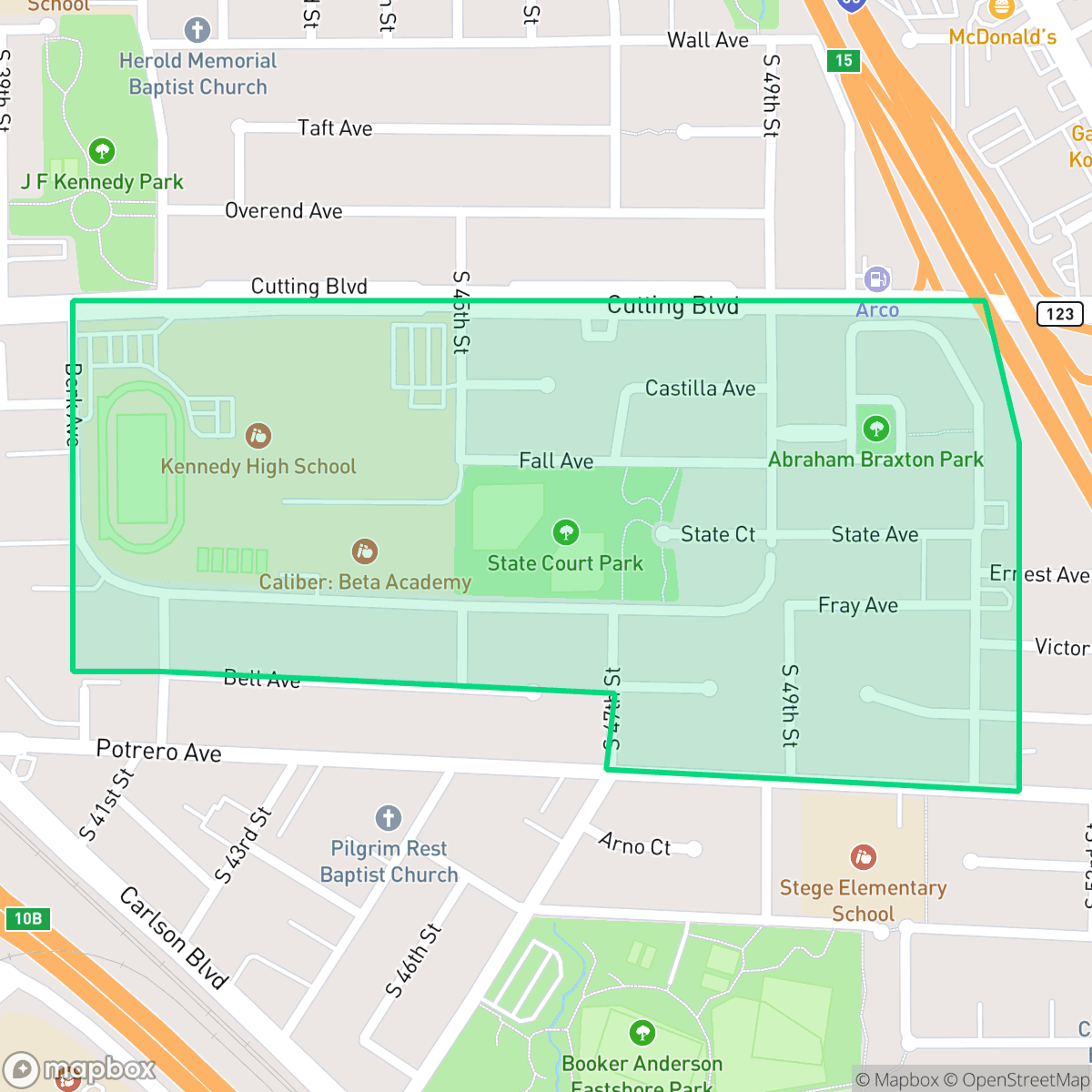
About Laurel Park
Laurel Park, located in southeast Richmond, California, was developed in the 1960s as a residential neighborhood of single-family homes. The tract was intentionally designed with five or six distinct architectural styles to foster a racially and economically diverse community. A cornerstone of local civic life is Abraham Braxton Park, named after the late husband of Myrtle Braxton, a legendary community advocate who has served as the Laurel Park Neighborhood Council president since 1987. The neighborhood has also been home to other prominent local figures, including municipal leader Ahmad Anderson. Over the decades, the Laurel Park Neighborhood Council has successfully championed key infrastructure and safety improvements, such as the Cutting Boulevard protective wall, cementing a strong legacy of grassroots activism and community pride.
The neighborhood functions as a dense, residential enclave where a consistent street grid supports easy pedestrian movement throughout the entire area. It maintains a distinct suburban aesthetic rooted in its mid-century architectural development, free from heavy industrial activity or large-scale warehousing. The community is defined by its institutional presence and a long-standing tradition of grassroots activism that continues to shape the local environment. According to iHuus data, the area stands out for its lack of industrial proximity and high-quality air, making it a purely residential destination for those who value neighborhood-level connectivity.
Prospective residents should weigh these benefits against significant livability trade-offs, particularly regarding acoustic comfort and environmental risks. The area experiences elevated noise levels primarily due to road traffic and faces substantial challenges regarding flood and fire safety. Furthermore, the local schools within the West Contra Costa Unified School District currently struggle with academic and financial instability. This neighborhood is best suited for individuals who prioritize walkability and community-driven social environments over absolute quiet or proximity to top-rated educational institutions.
Neighborhood Scores Across 15 Qualities
Residential lots often feature shared property lines and houses spaced closely together. This density of housing is roughly in line with the Richmond average, according to iHuus data.
Pedestrian-friendly street grids with continuous sidewalks and frequent crossings characterize the area. This level of connectivity is notably higher than the Richmond average, according to iHuus data.
Standard tract housing features consistent rooflines and small yards. This residential landscape is typical for the city.
Abundant green spaces and large public parks with walking paths make this area more dog friendly than the Richmond average. Access to central park grounds and school sports fields provides plenty of space for pets to exercise safely.
Residential blocks featuring single-family homes sit alongside large-scale industrial warehouses and infrastructure. This layout is largely consistent with the broader Richmond area.
Local activity levels are slightly higher than the Richmond average, characterized by a mix of quiet residential streets and suburban pockets with accessible service hubs. While some areas near the highway remain industrial and low-traffic, other blocks provide a balanced level of activity for daily needs.
Frequent sounds from nearby railroad tracks and freeway traffic characterize this area. According to iHuus data, acoustic comfort in Laurel Park is lower than the Richmond city average.
Air quality is consistently high with minimal health concerns. This level of air purity is notably better than the average found throughout Richmond, according to iHuus data.
Residential living dominates the area with very little heavy industry nearby, making it more tranquil than the Richmond average. According to iHuus data, the neighborhood remains primarily residential and institutional without large scale warehousing or heavy manufacturing.
Health insurance access among residents is slightly higher than the Richmond average, according to iHuus data.
Voting patterns and census indicators show a deeply liberal leaning that is slightly more pronounced than the Richmond city average.
Residents live alongside a balanced demographic of young professionals, families, and seniors. This age distribution is largely consistent with the broader Richmond area according to iHuus data.
Address-Level Insights for Laurel Park


iHuus Neighborhood Intelligence Insights
Get address-level neighborhood insights for Laurel Park
- Street-level scores — see how individual blocks compare, not just neighborhood averages
- Micro-zone boundaries — identify quiet pockets, flood boundaries, and walkable clusters before you visit
- 15 dimensions in full — walkability, noise, air quality, school quality, insurance coverage, population age profile, urban/rural index, and more
- Boundary risk alerts — know if your address sits near a block boundary where scores drop, the kind of detail no listing will ever mention
- School insights — individual school ratings and insights, not just district-level data
- Compare before you commit — side-by-side data across neighborhoods, down to block precision
No credit card required
Compare with Any Neighborhood
| Dimension | Laurel Park | Atchison Village |
|---|---|---|
| 🚶 Walkabilityavg 8.38 | ||
| 🔊 Acoustic Comfortavg 2.96 | ||
| 🤫 Privacy Indexavg 4.19 | ||
| 🎨 Visual Appealavg 5.97 | ||
| 🐕 Dog Friendlinessavg 6.4 | ||
| 🗺️ Urban-Rural Indexavg 6.62 | ||
| ✨ Neighborhood Vibeavg 4.2 | ||
| 🏥 Health Insurance Coverageavg 7.31 | ||
| 🌿 Air Qualityavg 8.35 | ||
| 🏭 Industrial Proximityavg 7.37 | ||
| 🌊 Flood Safetyavg 2.2 | ||
| 🗳️ Ideological Leanavg 9.87 | ||
| 👥 Population Age Profileavg 4.89 | ||
| 🔥 Fire Safetyavg 0.24 | ||
| 🏫 School Quality |
Laurel Park Rankings
School Districts Serving Laurel Park
School Insights for Laurel Park
Below average outcomes; significant attendance and academic challenges.
School Insights
See what's really behind every school rating near Laurel Park
- Individual school ratings — each school's own score with outcome context, not just a district average
- Enrollment & class size data — student-to-teacher ratio and how it compares to the state average
- Full demographics breakdown — ethnicity and gender composition for every school in the enrollment zone
- Every school in the district — all schools within the enrollment boundary ranked by rating, not just the closest one
- Grade levels & benchmarks — elementary through high school, with below/above state-average flags
No credit card required