Cortez/Stege, Richmond
Updated · 3,638 residents
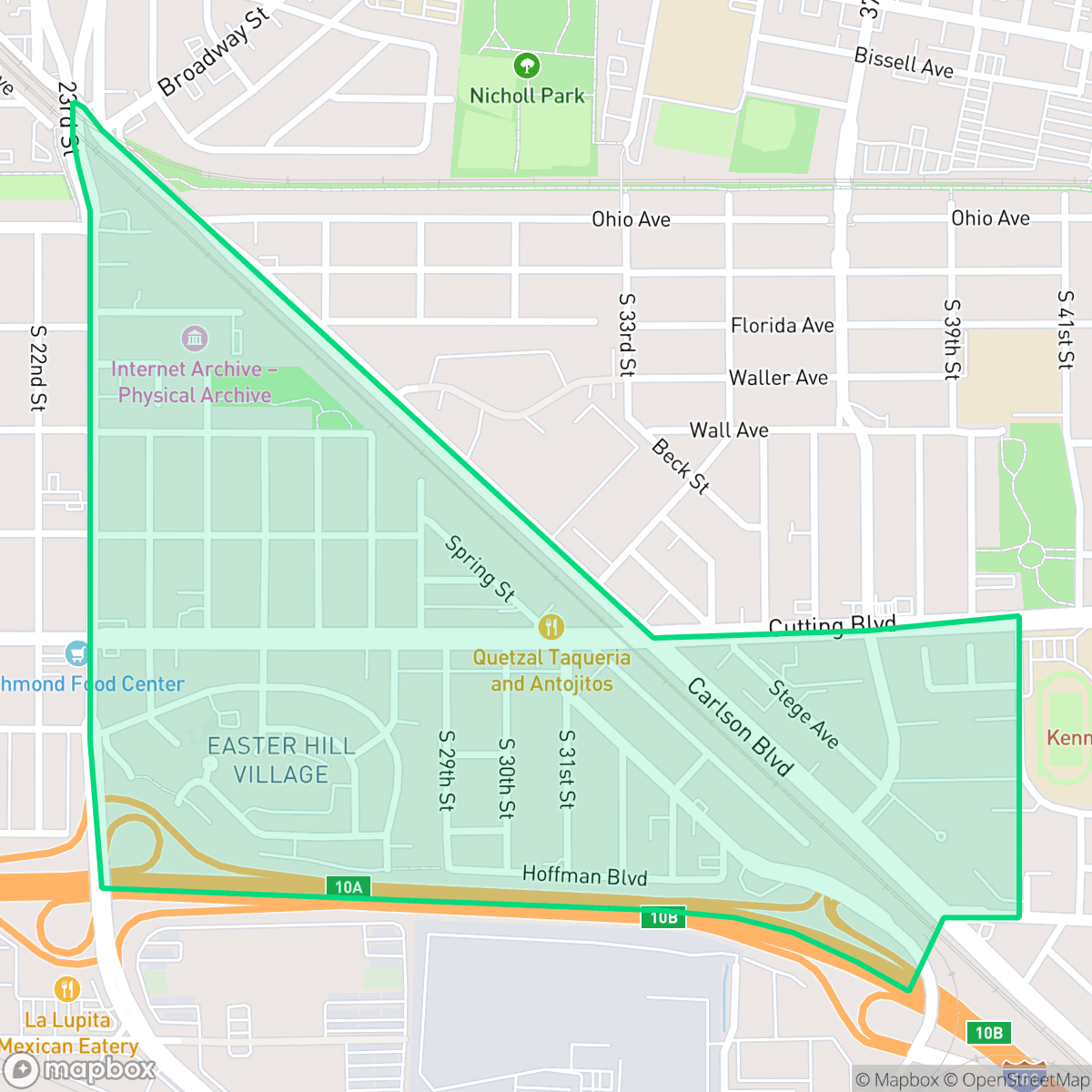
Cortez/Stege is a highly walkable neighborhood defined by its dense, grid-based residential layout and proximity to local parks. While residents enjoy consistently good air quality, the area is characterized by significant industrial activity and noticeable noise from nearby transit corridors.
Key Highlights
About Cortez/Stege
The Cortez/Stege neighborhood in Richmond, California, is rooted in the history of the unincorporated town of Stege, founded in 1876 by Richard Stege. Originally an agricultural community, Stege was famously home to a large-scale frog ranch operated by Richard Stege, who shipped thousands of frogs annually. By the late 19th and early 20th centuries, the area transitioned into an industrial hub featuring chemical and explosives manufacturing plants. The town maintained a distinct identity with its own railroad depot until it was annexed by the City of Richmond in 1912. The name persists today through local landmarks like Stege Avenue, Stege Elementary School, and the long-standing Stege Sanitary District, which was established in 1913 to provide regional utility services. The neighborhood’s development reflects Richmond’s broader evolution from rural ranch land to an industrial center.
The neighborhood functions as a dense, transit-adjacent residential pocket within Richmond. Its well-defined grid system makes it exceptionally easy for pedestrians to navigate, providing reliable access to local green spaces and walking paths that support a pet-friendly lifestyle. Despite its quiet suburban atmosphere, the landscape is heavily influenced by surrounding industrial zones and major rail corridors, which contribute to elevated noise levels throughout the day.
Prospective residents should be aware that the area sits within a high-risk floodplain, which often necessitates flood insurance for homeowners. The local housing stock is tightly packed, offering limited privacy between structures. While the community benefits from high air quality, it faces challenges regarding public health insurance access and relies on the West Contra Costa Unified School District, which currently experiences significant academic and financial instability. The area is best suited for those who prioritize walkability and access to regional transit over a secluded living environment.
Neighborhood Scores Across 15 Qualities
Homes and structures are positioned in close proximity with very little separation between buildings. This density is notably higher than the Richmond average, as indicated by iHuus data.
Pedestrian travel is easy due to a well-defined grid with dedicated sidewalks on both sides of most streets and frequent marked crossings. This level of walkability is notably higher than the Richmond average.
Uniform tract housing and dense apartment complexes define the visual landscape. This level of visual variety is consistent with the rest of Richmond.
Large central parks and connected walking paths offer reliable space for pets. According to iHuus data, this level of dog friendliness is roughly in line with the rest of Richmond.
Residential blocks feature a blend of suburban housing and large scale industrial or commercial zones, closely mirroring the general density found throughout Richmond.
Low-density industrial and warehouse zones define the landscape, resulting in a level of activity that is consistent with the city average. While some local dining and park spaces exist, the area lacks a dense commercial core for frequent pedestrian interaction.
Frequent noise from nearby railroad tracks and major freeways characterizes the area. According to iHuus data, acoustic comfort is significantly lower than the Richmond city average.
Air quality remains consistently good with rare instances of elevated readings. This level of cleanliness is slightly higher than the Richmond average, according to iHuus data.
Active commercial zones and heavy industrial facilities with significant freight traffic are much more prevalent here than in the rest of Richmond. Proximity to a major rail corridor and an EPA Superfund site may also impact local environmental and noise conditions.
Health insurance coverage is notably lower here than the Richmond average, according to iHuus data.
Voting patterns and census indicators in this area reflect a deeply liberal political leaning that is very similar to the broader Richmond community.
Residents live alongside a varied demographic of young adults, families, and seniors. According to iHuus data, the age distribution is slightly more concentrated toward specific age groups than the Richmond city average.
Property within the 100-year floodplain is subject to significant flooding risks, which is notably higher than the Richmond average. Residents should be aware that flood insurance is typically required for homes in this area according to iHuus data.
Address-Level Insights for Cortez/Stege


iHuus Neighborhood Intelligence Insights
Get address-level neighborhood insights for Cortez/Stege
- Street-level scores — see how individual blocks compare, not just neighborhood averages
- Micro-zone boundaries — identify quiet pockets, flood boundaries, and walkable clusters before you visit
- 15 dimensions in full — walkability, noise, air quality, school quality, insurance coverage, population age profile, urban/rural index, and more
- Boundary risk alerts — know if your address sits near a block boundary where scores drop, the kind of detail no listing will ever mention
- School insights — individual school ratings and insights, not just district-level data
- Compare before you commit — side-by-side data across neighborhoods, down to block precision
No credit card required
Compare with Any Neighborhood
| Dimension | Cortez/Stege | Atchison Village |
|---|---|---|
| 🚶 Walkabilityavg 8.38 | ||
| 🔊 Acoustic Comfortavg 2.96 | ||
| 🤫 Privacy Indexavg 4.19 | ||
| 🎨 Visual Appealavg 5.97 | ||
| 🐕 Dog Friendlinessavg 6.4 | ||
| 🗺️ Urban-Rural Indexavg 6.62 | ||
| ✨ Neighborhood Vibeavg 4.2 | ||
| 🏥 Health Insurance Coverageavg 7.31 | ||
| 🌿 Air Qualityavg 8.35 | ||
| 🏭 Industrial Proximityavg 7.37 | ||
| 🌊 Flood Safetyavg 2.2 | ||
| 🗳️ Ideological Leanavg 9.87 | ||
| 👥 Population Age Profileavg 4.89 | ||
| 🔥 Fire Safetyavg 0.24 | ||
| 🏫 School Quality |
Cortez/Stege Rankings
School Districts Serving Cortez/Stege
School Insights for Cortez/Stege
Below average outcomes; significant attendance and academic challenges.
School Insights
See what's really behind every school rating near Cortez/Stege
- Individual school ratings — each school's own score with outcome context, not just a district average
- Enrollment & class size data — student-to-teacher ratio and how it compares to the state average
- Full demographics breakdown — ethnicity and gender composition for every school in the enrollment zone
- Every school in the district — all schools within the enrollment boundary ranked by rating, not just the closest one
- Grade levels & benchmarks — elementary through high school, with below/above state-average flags
No credit card required