Coronado, Richmond
Updated · 3,977 residents
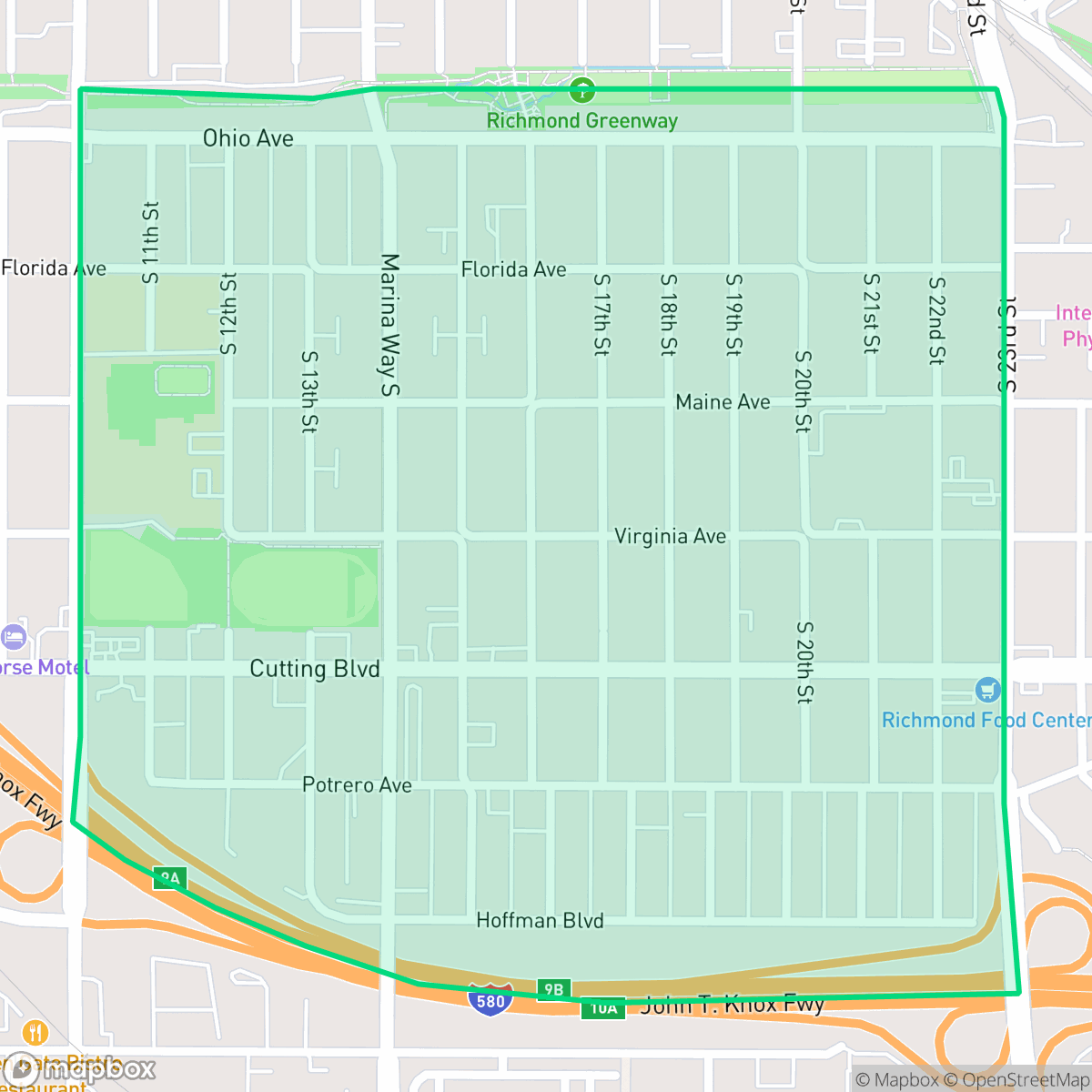
Coronado is a highly walkable, grid-based neighborhood in Richmond characterized by its dense residential layout and proximity to community landmarks. While it offers convenient access to local parks and schools, residents should anticipate significant noise levels from nearby road traffic and the influence of surrounding industrial activity.
Key Highlights
About Coronado
The Coronado neighborhood in Richmond, California, developed from the late 19th-century agricultural tract of pioneer J.R. Nystrom. During World War II, the area transformed rapidly to house thousands of defense workers employed at the nearby Kaiser Shipyards. A defining landmark is Nystrom Village, a historic 1942 defense housing complex consisting of 51 single-story duplexes arranged around central green spaces. Originally segregated for white shipyard managers, the complex was integrated after a successful civil rights challenge by the NAACP. The neighborhood also features Nystrom Elementary School, founded on land donated by Nystrom in 1908, and the historic Maritime Child Development Center, which provided childcare for wartime workers. Today, Coronado’s WWII-era architecture and home-front heritage are preserved and studied under the city’s Project PRISM initiative.
The area functions as a dense, low-density urban grid that prioritizes pedestrian access, as evidenced by its extensive sidewalk network and connected streets. Residents frequently utilize local green spaces like M L King Memorial Park and visit community centers such as Masjid Al-Noor. The neighborhood maintains a quiet, suburban atmosphere during the day, though the presence of light industrial units and major transit corridors contributes to a distinct mix of residential and commercial activity.
Prospective residents should consider specific livability trade-offs, particularly regarding acoustic comfort, as road traffic noise is notable throughout the area. While the neighborhood benefits from good air quality, its proximity to industrial zones and historical site conditions are important factors for long-term planning. The local school landscape is varied, ranging from district-managed institutions to specialized preparatory options, which may influence housing choices for families. This community is best suited for those who value high walkability and proximity to Richmond’s central amenities over complete quiet or expansive private outdoor space.
Neighborhood Scores Across 15 Qualities
Residential structures are positioned in close proximity with minimal separation between property lines. According to iHuus data, this density of housing is notably higher than the Richmond average.
Pedestrians benefit from a consistent grid featuring wide sidewalks on both sides of most streets and clearly marked crosswalks. This infrastructure provides much higher walkability than the Richmond average.
Standard tract housing and apartment complexes create a consistent visual landscape with small, tidy yards and high density. This level of visual variety is typical for the Richmond area according to iHuus data.
Walking opportunities for dogs are supported by multiple small community parks and access to a large sports field in the northwest. According to iHuus data, the availability of green space for pets is slightly below the Richmond average.
The landscape is characterized by a dense blend of industrial zones, residential grids, and commercial warehouses. According to iHuus data, this level of urban density is roughly in line with the rest of Richmond.
Primarily composed of industrial and suburban blocks, this area offers a low-energy atmosphere that is less active than the Richmond average. Most dining and retail options are spread out, requiring a car for easy access to local businesses.
Frequent noise from nearby railroad tracks and heavy freeway traffic is a notable characteristic of this area. According to iHuus data, acoustic comfort in Coronado is lower than the Richmond city average.
Air quality in this area remains mostly clean with only rare instances of elevated readings. This level of air quality is slightly below the Richmond average according to iHuus data.
Heavy industrial activity and freight corridors are notably less prevalent here than in the rest of Richmond. However, residents should be aware of the proximity to an EPA Superfund site and large-scale manufacturing facilities that may affect local soil and water quality.
Health insurance access is notably lower in Coronado than in the rest of Richmond, according to iHuus data. Residents may face more challenges accessing employer-sponsored or private medical plans compared to the city average.
Voting patterns and census indicators show a highly liberal political leaning that is slightly more pronounced than the Richmond city average.
Residents experience a varied demographic mix of young adults, families, and older individuals; according to iHuus data, this age distribution is slightly more concentrated toward certain age groups than the Richmond average.
Properties in this area are situated within a designated floodplain, which increases the likelihood of flood events and may necessitate flood insurance. According to iHuus data, the risk level in Coronado is higher than the Richmond average.
Address-Level Insights for Coronado


iHuus Neighborhood Intelligence Insights
Get address-level neighborhood insights for Coronado
- Street-level scores — see how individual blocks compare, not just neighborhood averages
- Micro-zone boundaries — identify quiet pockets, flood boundaries, and walkable clusters before you visit
- 15 dimensions in full — walkability, noise, air quality, school quality, insurance coverage, population age profile, urban/rural index, and more
- Boundary risk alerts — know if your address sits near a block boundary where scores drop, the kind of detail no listing will ever mention
- School insights — individual school ratings and insights, not just district-level data
- Compare before you commit — side-by-side data across neighborhoods, down to block precision
No credit card required
Compare with Any Neighborhood
| Dimension | Coronado | Atchison Village |
|---|---|---|
| 🚶 Walkabilityavg 8.38 | ||
| 🔊 Acoustic Comfortavg 2.96 | ||
| 🤫 Privacy Indexavg 4.19 | ||
| 🎨 Visual Appealavg 5.97 | ||
| 🐕 Dog Friendlinessavg 6.4 | ||
| 🗺️ Urban-Rural Indexavg 6.62 | ||
| ✨ Neighborhood Vibeavg 4.2 | ||
| 🏥 Health Insurance Coverageavg 7.31 | ||
| 🌿 Air Qualityavg 8.35 | ||
| 🏭 Industrial Proximityavg 7.37 | ||
| 🌊 Flood Safetyavg 2.2 | ||
| 🗳️ Ideological Leanavg 9.87 | ||
| 👥 Population Age Profileavg 4.89 | ||
| 🔥 Fire Safetyavg 0.24 | ||
| 🏫 School Quality |
Coronado Rankings
School Districts Serving Coronado
School Insights for Coronado
Below average outcomes; significant attendance and academic challenges.
School Insights
See what's really behind every school rating near Coronado
- Individual school ratings — each school's own score with outcome context, not just a district average
- Enrollment & class size data — student-to-teacher ratio and how it compares to the state average
- Full demographics breakdown — ethnicity and gender composition for every school in the enrollment zone
- Every school in the district — all schools within the enrollment boundary ranked by rating, not just the closest one
- Grade levels & benchmarks — elementary through high school, with below/above state-average flags
No credit card required