Belding/Woods, Richmond
Updated · 7,392 residents
Belding/Woods is a highly walkable, dense residential neighborhood in Richmond characterized by its grid-based layout and mid-century housing stock. Residents benefit from excellent pedestrian access and a relatively quiet acoustic environment, though the area features limited privacy due to the close proximity of neighboring homes.
Key Highlights
About Belding/Woods
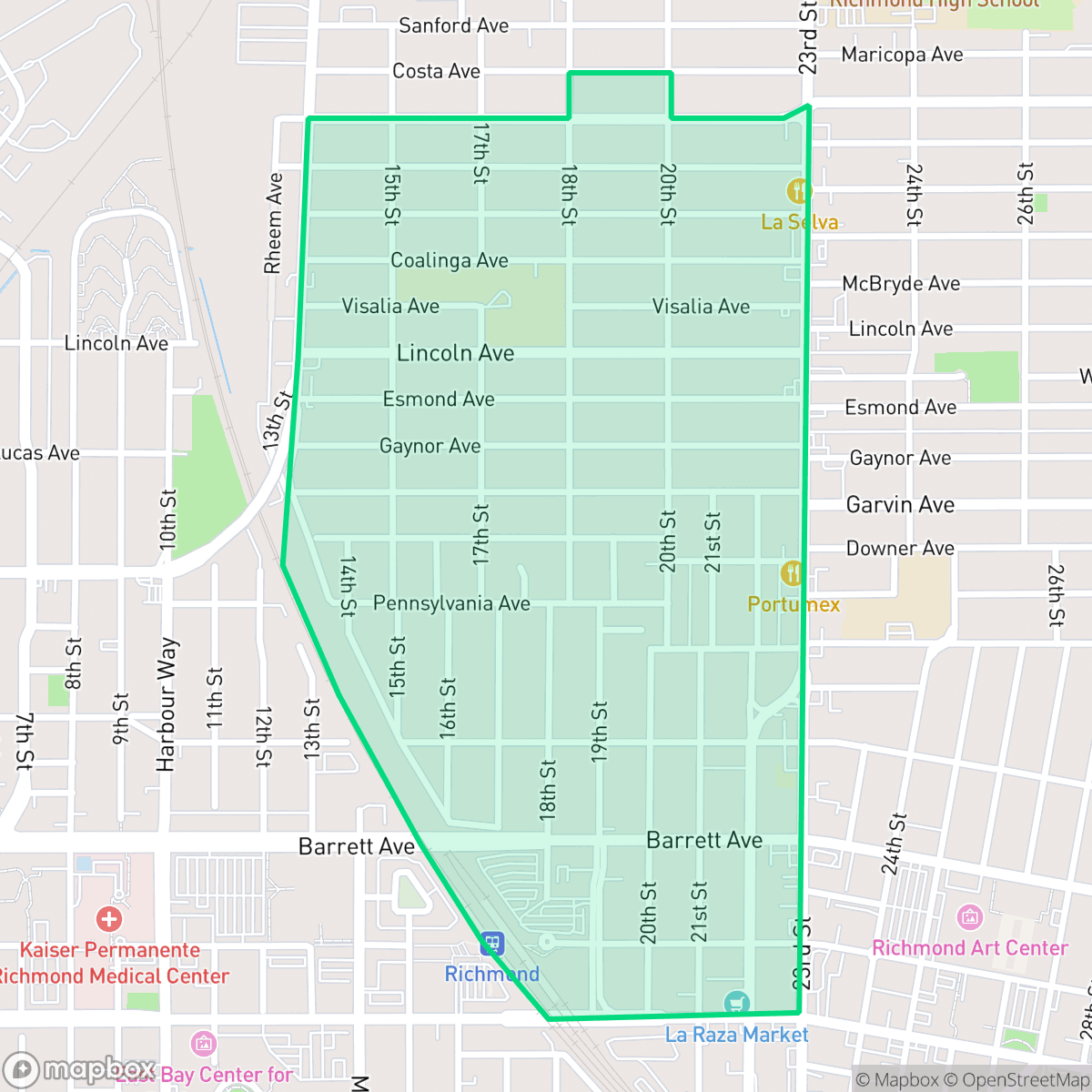
Located in the heart of Richmond, California, Belding-Woods is a densely populated, primarily residential neighborhood bounded on the east by the active 23rd Street corridor. Its well-established housing stock consists largely of mid-century single-family homes—including classic Craftsman bungalows—and small apartment buildings constructed primarily between 1940 and 1969. A central landmark and vital community gathering space is the two-acre Belding-Garcia Park at 17th Street and Coalinga Avenue. In 2013, the park’s playground was completely rebuilt in a single day through a collaborative, community-led effort involving local families and the nonprofit Pogo Park. Today, the neighborhood maintains a close-knit civic identity, championed by an active Neighborhood Council known for hosting festive annual events like "Christmas in the Streets".
The neighborhood functions as a high-density urban environment where the established street grid facilitates easy movement throughout the community. The presence of nearby transit infrastructure and industrial zones contributes to the area's specific urban character, while the architectural consistency of the mid-century homes provides a uniform visual aesthetic. According to iHuus data, the area maintains a robust walkability score, ensuring that residents have reliable access to sidewalks and crosswalks for daily commuting and local errands.
Prospective residents should note that the area prioritizes pedestrian connectivity and acoustic comfort over expansive private outdoor space. While the community offers a stable residential environment, families should consider the challenges facing the local school district, which currently experiences significant academic and financial pressures. The neighborhood is best suited for those who value transit accessibility and a central location within Richmond over the privacy typically found in suburban environments.
Neighborhood Scores Across 15 Qualities
Residential structures are tightly packed with minimal separation between houses. According to iHuus data, this level of density is notably higher than the average for Richmond.
Continuous sidewalks and well-marked crosswalks exist on nearly every street, making this area significantly more pedestrian-friendly than the Richmond average. The consistent grid layout and dedicated crossings ensure safe and easy movement throughout the neighborhood.
Standard tract housing dominates the landscape with uniform rooflines and small yards. The area features a consistent, high-density residential layout that is slightly less visually varied than the Richmond average, according to iHuus data.
Public park access and sidewalk greenery are relatively sparse compared to the Richmond average. Most available vegetation is found within private residential backyards rather than in accessible public verges.
Residential streets and green spaces exist in roughly equal measure, though the area feels slightly more urban than the Richmond average. Some pockets feature dense low-rise grids and industrial lots, while other sections consist of single-family housing and institutional facilities.
A mix of urban blocks and suburban streets offers more social activity and dining variety than the typical Richmond neighborhood. Local amenities range from diverse eateries to community parks, though some residential pockets remain quiet near industrial areas.
Frequent sounds from nearby railroad tracks and heavy freeway traffic characterize the area. According to iHuus data, acoustic comfort is slightly lower than the Richmond city average.
Air quality in this area is generally good, though it remains slightly below the Richmond city average according to iHuus data.
Residential and institutional structures dominate the landscape, though a nearby rail yard and transit facility introduce some industrial activity and noise. While the area is largely free of heavy industrial sites, some parts of the neighborhood sit near a Superfund site with potential soil and water contaminants.
Health insurance access is more prevalent here than in the rest of Richmond, according to iHuus data. Residents in this area benefit from higher rates of coverage compared to the city average.
Voting patterns and census indicators align closely with the city average, reflecting a deeply established liberal political landscape.
Residents live alongside a varied demographic of young adults, families, and seniors. According to iHuus data, this population distribution is slightly more concentrated in certain age groups compared to the broader Richmond area.
Located in a coastal high-hazard zone with wave action, this area faces significantly greater flood danger than the Richmond average. Residents should anticipate elevated or potentially prohibitive flood insurance costs.
Address-Level Insights for Belding/Woods


iHuus Neighborhood Intelligence Insights
Get address-level neighborhood insights for Belding/Woods
- Street-level scores — see how individual blocks compare, not just neighborhood averages
- Micro-zone boundaries — identify quiet pockets, flood boundaries, and walkable clusters before you visit
- 15 dimensions in full — walkability, noise, air quality, school quality, insurance coverage, population age profile, urban/rural index, and more
- Boundary risk alerts — know if your address sits near a block boundary where scores drop, the kind of detail no listing will ever mention
- School insights — individual school ratings and insights, not just district-level data
- Compare before you commit — side-by-side data across neighborhoods, down to block precision
No credit card required
Compare with Any Neighborhood
| Dimension | Belding/Woods | Atchison Village |
|---|---|---|
| 🚶 Walkabilityavg 8.38 | ||
| 🔊 Acoustic Comfortavg 2.96 | ||
| 🤫 Privacy Indexavg 4.19 | ||
| 🎨 Visual Appealavg 5.97 | ||
| 🐕 Dog Friendlinessavg 6.4 | ||
| 🗺️ Urban-Rural Indexavg 6.62 | ||
| ✨ Neighborhood Vibeavg 4.2 | ||
| 🏥 Health Insurance Coverageavg 7.31 | ||
| 🌿 Air Qualityavg 8.35 | ||
| 🏭 Industrial Proximityavg 7.37 | ||
| 🌊 Flood Safetyavg 2.2 | ||
| 🗳️ Ideological Leanavg 9.87 | ||
| 👥 Population Age Profileavg 4.89 | ||
| 🔥 Fire Safetyavg 0.24 | ||
| 🏫 School Quality |
Belding/Woods Rankings
School Districts Serving Belding/Woods
School Insights for Belding/Woods
Below average outcomes; significant attendance and academic challenges.
School Insights
See what's really behind every school rating near Belding/Woods
- Individual school ratings — each school's own score with outcome context, not just a district average
- Enrollment & class size data — student-to-teacher ratio and how it compares to the state average
- Full demographics breakdown — ethnicity and gender composition for every school in the enrollment zone
- Every school in the district — all schools within the enrollment boundary ranked by rating, not just the closest one
- Grade levels & benchmarks — elementary through high school, with below/above state-average flags
No credit card required