Atchison Village, Richmond
Updated · 1,070 residents
Atchison Village is a historic, cooperatively-owned community in Richmond defined by its uniform, garden-style architecture and dense, grid-based layout. While the area offers high walkability and proximity to local cultural landmarks, residents experience significant noise from nearby road traffic and limited privacy due to the close proximity of homes.
Key Highlights
About Atchison Village
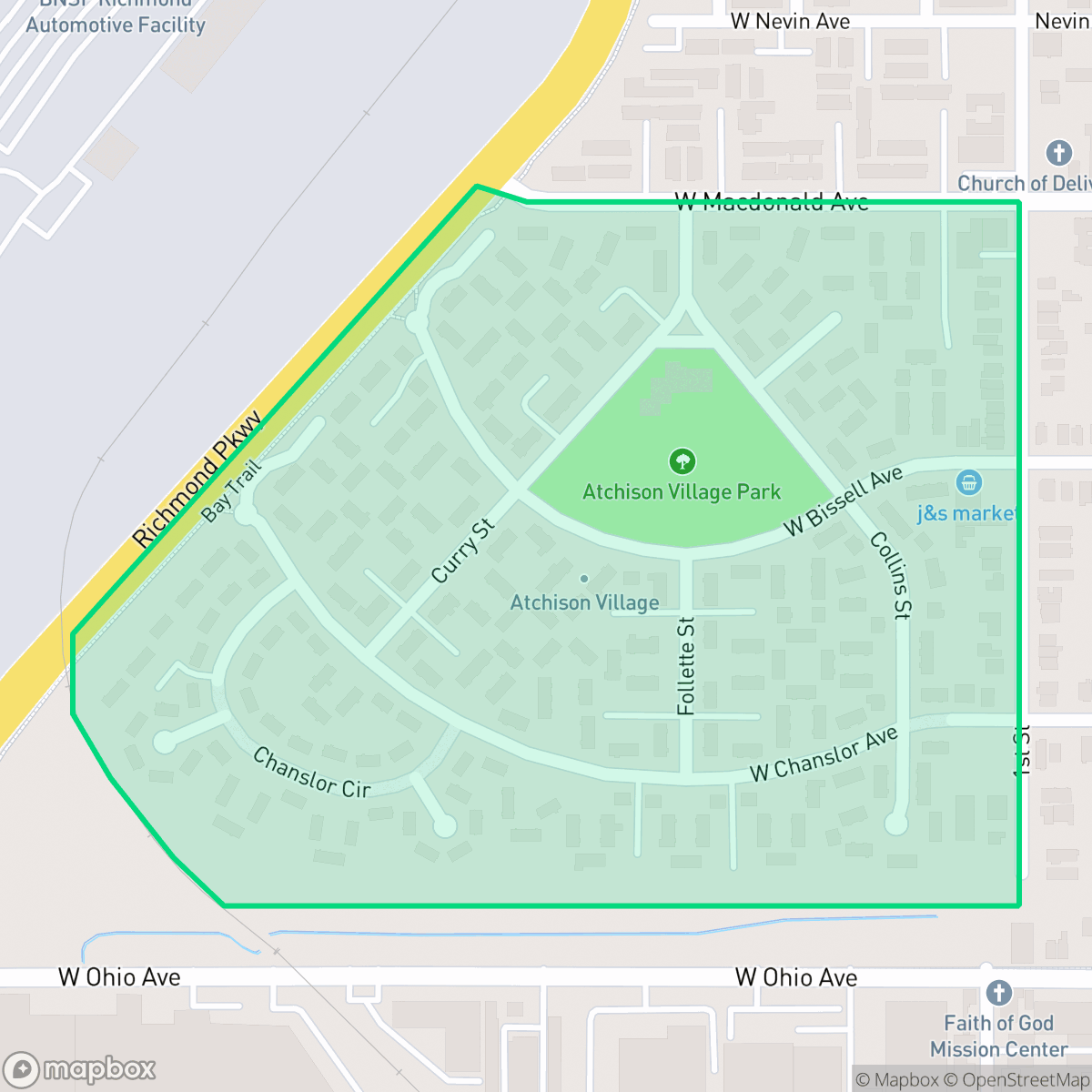
Atchison Village in Richmond, California, was built in 1941 as the city’s first public defense housing project to accommodate Kaiser Shipyard workers and managers during World War II. Designed by architects Carl Warnecke and Andrew Hass, the 30-acre neighborhood features 450 wood-frame units arranged in courtyards, drawing inspiration from the "garden city" and "city beautiful" movements. It is one of the nation's few surviving housing projects funded by the Lanham Act of 1940. To prevent demolition after the war, residents banded together in 1956 to buy the property, establishing the Atchison Village Mutual Homes Corporation—one of California's first housing cooperatives. Today, the entire neighborhood is listed on the National Register of Historic Places and serves as a satellite site of the Rosie the Riveter/World War II Home Front National Historical Park.
The neighborhood maintains a quiet, suburban feel within a dense urban grid. It serves as a distinct residential pocket, characterized by its compact, wood-frame housing units and shared green spaces. The area benefits from a consistent sidewalk network, making it relatively easy to navigate on foot, though it remains a modest, functional environment rather than a luxury destination. According to iHuus data, the area provides a unique, historic living experience that prioritizes community structure over modern, expansive amenities.
Living here involves specific trade-offs, particularly regarding acoustic comfort, as road traffic noise is a persistent factor. Prospective residents should note the proximity to industrial zones and the associated environmental considerations. Furthermore, the local school district faces significant academic and financial challenges, which may influence families with school-aged children. The area is best suited for those who value historic significance and a tight-knit cooperative structure over modern, detached living.
Neighborhood Scores Across 15 Qualities
Housing density is moderate with some variation in spacing between neighbors. While some areas feature homes positioned closely together, the level of privacy is generally consistent with the Richmond average according to iHuus data.
A consistent street grid and accessible green spaces support pedestrian movement, though walkability is slightly lower than the Richmond average. Sidewalks are present on many streets alongside safe crossings for residents.
Standard tract housing dominates the area with small yards and consistent, boxy rooflines. According to iHuus data, the visual variety in this neighborhood is lower than the Richmond city average.
Limited public park access and minimal sidewalk verges are offset by a prevalence of private fenced yards. According to iHuus data, pet owners may find fewer communal walking spaces here than in other parts of Richmond.
Residential pockets sit alongside large-scale industrial warehouses and major transportation infrastructure. This landscape offers a similar balance of built-up areas and open space as seen elsewhere in Richmond.
Low levels of commercial activity and social density make this a subdued area, with much less vibrancy than the Richmond average. Residents will find a quiet, car-oriented environment primarily characterized by light industrial zones and limited local social spots.
Frequent disturbances from nearby railroad tracks and heavy freeway traffic characterize the area. According to iHuus data, acoustic comfort is notably lower than the Richmond city average.
Air quality remains largely healthy with infrequent periods of elevated readings, though levels are slightly lower than the Richmond average according to iHuus data.
Industrial presence is notably lower here than in the rest of Richmond. Residents experience significantly less exposure to heavy warehouses and freight corridors, though some areas remain near the periphery of a Superfund site.
Health insurance enrollment among residents is lower than the Richmond average, according to iHuus data.
Voting patterns and census indicators align closely with the broader Richmond area, reflecting a deeply liberal political landscape. This political leaning is consistent with the city average, according to iHuus data.
A balanced distribution of young adults, families, and seniors characterizes the area. This age profile is slightly more concentrated toward the middle of the spectrum than the Richmond average, according to iHuus data.
Located in a coastal high-hazard zone, this area is subject to significant wave action and much higher flood risk than the rest of Richmond. Residents should prepare for elevated or potentially prohibitive flood insurance costs according to iHuus data.
Address-Level Insights for Atchison Village


iHuus Neighborhood Intelligence Insights
Get address-level neighborhood insights for Atchison Village
- Street-level scores — see how individual blocks compare, not just neighborhood averages
- Micro-zone boundaries — identify quiet pockets, flood boundaries, and walkable clusters before you visit
- 15 dimensions in full — walkability, noise, air quality, school quality, insurance coverage, population age profile, urban/rural index, and more
- Boundary risk alerts — know if your address sits near a block boundary where scores drop, the kind of detail no listing will ever mention
- School insights — individual school ratings and insights, not just district-level data
- Compare before you commit — side-by-side data across neighborhoods, down to block precision
No credit card required
Compare with Any Neighborhood
| Dimension | Atchison Village | Belding/Woods |
|---|---|---|
| 🚶 Walkabilityavg 8.38 | ||
| 🔊 Acoustic Comfortavg 2.96 | ||
| 🤫 Privacy Indexavg 4.19 | ||
| 🎨 Visual Appealavg 5.97 | ||
| 🐕 Dog Friendlinessavg 6.4 | ||
| 🗺️ Urban-Rural Indexavg 6.62 | ||
| ✨ Neighborhood Vibeavg 4.2 | ||
| 🏥 Health Insurance Coverageavg 7.31 | ||
| 🌿 Air Qualityavg 8.35 | ||
| 🏭 Industrial Proximityavg 7.37 | ||
| 🌊 Flood Safetyavg 2.2 | ||
| 🗳️ Ideological Leanavg 9.87 | ||
| 👥 Population Age Profileavg 4.89 | ||
| 🔥 Fire Safetyavg 0.24 | ||
| 🏫 School Quality |
Atchison Village Rankings
School Districts Serving Atchison Village
School Insights for Atchison Village
Below average outcomes; significant attendance and academic challenges.
School Insights
See what's really behind every school rating near Atchison Village
- Individual school ratings — each school's own score with outcome context, not just a district average
- Enrollment & class size data — student-to-teacher ratio and how it compares to the state average
- Full demographics breakdown — ethnicity and gender composition for every school in the enrollment zone
- Every school in the district — all schools within the enrollment boundary ranked by rating, not just the closest one
- Grade levels & benchmarks — elementary through high school, with below/above state-average flags
No credit card required