Village, Claremont
Updated · 1,690 residents
The Village serves as a highly walkable social hub where historic charm meets modern convenience. Residents enjoy exceptionally clean air and a vibrant local scene, though the area experiences moderate traffic noise and elevated flood risks.
Key Highlights
About Village
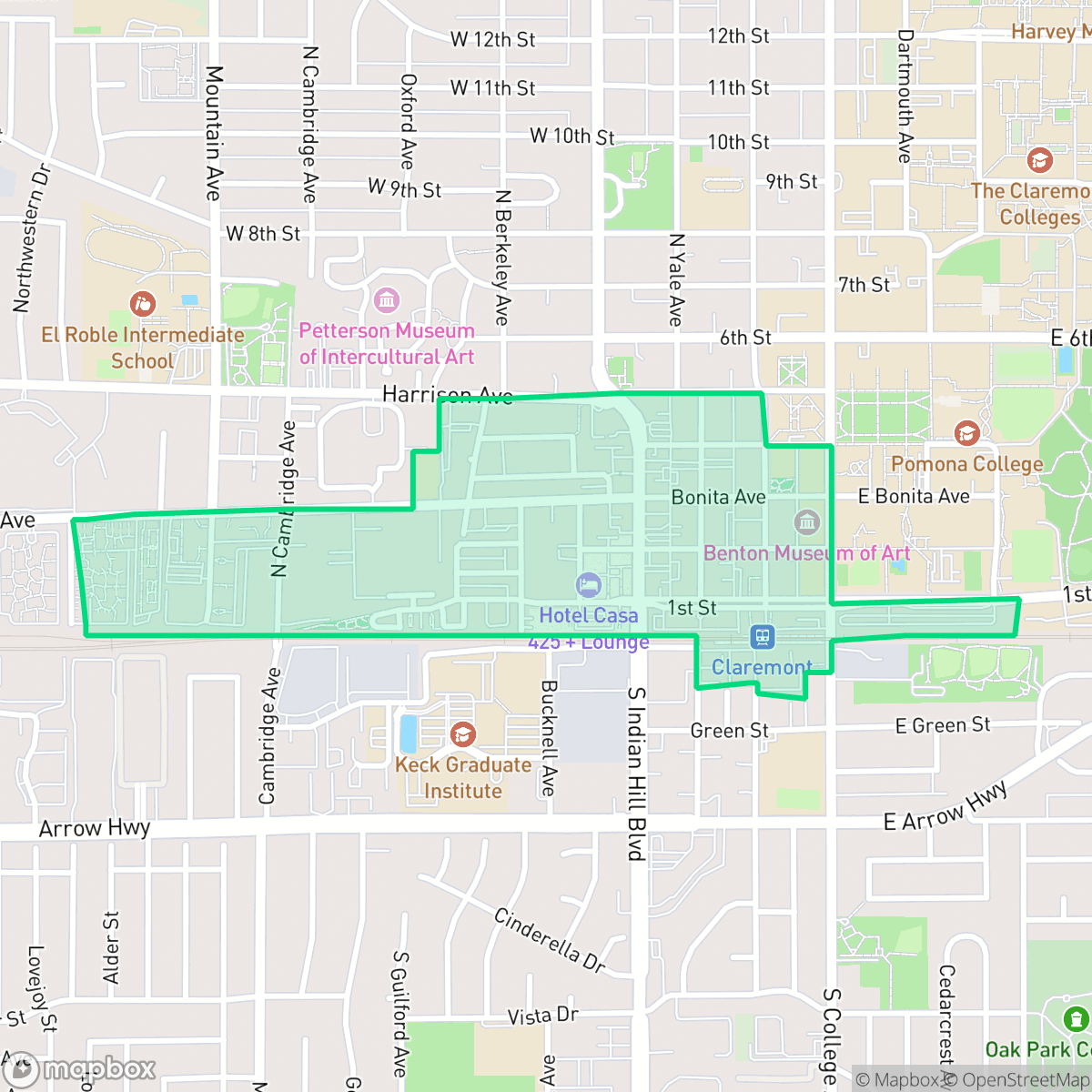
Established in 1887 alongside the Santa Fe Railroad, the Claremont Village serves as the historic commercial and cultural heart of the city. Originally a hub for the thriving citrus industry, the neighborhood transitioned as citrus groves gave way to urban development. Its architectural character is defined by a blend of Spanish Colonial Revival, Mission Revival, and Streamline Moderne styles, exemplified by landmarks like the 1927 Santa Fe Depot—now the Claremont Lewis Museum of Art—and the 1936 Post Office. The Village remains a vibrant social center, anchored by long-standing local institutions like the 1889 Some Crust Bakery and repurposed agricultural sites such as the Packing House. Its pedestrian-friendly layout and proximity to the Claremont Colleges maintain a distinct small-town atmosphere that has evolved from its origins as a railroad-era townsite into a preserved historic district.
This neighborhood functions as a lively center for dining and wellness, attracting a diverse age group that values its liberal-leaning community and high access to health insurance. While it maintains a suburban mix of housing, the area is notably well-maintained with manicured properties that contribute to its polished visual appeal. Residents benefit from a strong sense of community and a variety of local businesses that make the area a social focal point for the city.
Prospective residents should balance the high walkability and strong community engagement against the reality of moderate traffic noise from nearby thoroughfares. While the area is generally dog-friendly due to its proximity to public parks and sports fields, those considering a move should also be aware of the elevated flood risk associated with certain sections. The local schools under the Claremont Unified School District remain a primary draw for families seeking a stable and high-performing educational environment.
Neighborhood Scores Across 15 Qualities
Residential spacing varies by zone; single-family homes provide moderate buffers, while apartment clusters feature denser living arrangements. According to iHuus data, this level of separation is slightly higher than the Claremont average.
Pedestrians can rely on a dense network of sidewalks and clear paths through residential complexes. This level of accessibility is slightly below the Claremont average.
Large, well-maintained properties and private amenities characterize much of the area, resulting in a visual landscape that is slightly more polished than the Claremont average. While some sections feature standard multi-family complexes, the northeast portion of the neighborhood is notable for its expansive lots and private pools.
Access to large public parks and sports fields in the northwest quadrant makes this area more dog friendly than the Claremont average. While many homes feature private yards, public green space access is more limited near high-traffic roads.
Residential areas feature a blend of single-family homes and multi-story apartment blocks, presenting a slightly more developed landscape than the more rural outskirts of Claremont.
Local dining, coffee shops, and wellness businesses provide a noticeably higher concentration of social hubs than the Claremont average. Residents can find diverse activity near the railway corridor, although many blocks remain car-dependent.
Persistent sound from nearby thoroughfares creates a noticeable presence, though levels are higher than the typical quietude found elsewhere in Claremont. According to iHuus data, the area experiences a steady hum of local traffic.
Air quality remains consistently high with minimal health concerns; according to iHuus data, the atmosphere in this area is even cleaner than the Claremont average.
Industrial activity is very low throughout most of the area, though some warehouse facilities and truck loading bays are situated near the central rail corridor. This level of industrial proximity is slightly higher than the Claremont average according to iHuus data.
Health insurance access is widespread among residents, appearing slightly below the Claremont city average according to iHuus data.
Voting patterns and census indicators show a predominantly liberal political leaning, which is more pronounced here than in the rest of Claremont according to iHuus data.
Residents live alongside a balanced mix of young adults, families, and older individuals. This age distribution is largely in line with the broader Claremont area, according to iHuus data.
Flood risk is elevated in this area because parts of the neighborhood fall within a designated floodplain. According to iHuus data, this risk level is higher than the average for Claremont.
Address-Level Insights for Village


iHuus Neighborhood Intelligence Insights
Get address-level neighborhood insights for Village
- Street-level scores — see how individual blocks compare, not just neighborhood averages
- Micro-zone boundaries — identify quiet pockets, flood boundaries, and walkable clusters before you visit
- 15 dimensions in full — walkability, noise, air quality, school quality, insurance coverage, population age profile, urban/rural index, and more
- Boundary risk alerts — know if your address sits near a block boundary where scores drop, the kind of detail no listing will ever mention
- School insights — individual school ratings and insights, not just district-level data
- Compare before you commit — side-by-side data across neighborhoods, down to block precision
No credit card required
Compare with Any Neighborhood
| Dimension | Village | Arbol Verde |
|---|---|---|
| 🚶 Walkabilityavg 8.6 | ||
| 🔊 Acoustic Comfortavg 2.58 | ||
| 🤫 Privacy Indexavg 5.58 | ||
| 🎨 Visual Appealavg 7.17 | ||
| 🐕 Dog Friendlinessavg 6.82 | ||
| 🗺️ Urban-Rural Indexavg 6.89 | ||
| ✨ Neighborhood Vibeavg 4.64 | ||
| 🏥 Health Insurance Coverageavg 8.37 | ||
| 🌿 Air Qualityavg 9.85 | ||
| 🏭 Industrial Proximityavg 8.67 | ||
| 🌊 Flood Safetyavg 3.81 | ||
| 🗳️ Ideological Leanavg 8.75 | ||
| 👥 Population Age Profileavg 5.03 | ||
| 🔥 Fire Safetyavg 0.41 | ||
| 🏫 School Quality |
Village Rankings
School Districts Serving Village
School Insights for Village
Below average outcomes; significant attendance and academic challenges.
School Insights
See what's really behind every school rating near Village
- Individual school ratings — each school's own score with outcome context, not just a district average
- Enrollment & class size data — student-to-teacher ratio and how it compares to the state average
- Full demographics breakdown — ethnicity and gender composition for every school in the enrollment zone
- Every school in the district — all schools within the enrollment boundary ranked by rating, not just the closest one
- Grade levels & benchmarks — elementary through high school, with below/above state-average flags
No credit card required