Via Zurita, Claremont
Updated · 125 residents
Via Zurita is a highly walkable neighborhood defined by its unique architectural character and convenient access to local dining and parks. While the area offers excellent air quality and comprehensive health insurance coverage, residents should anticipate elevated noise levels from nearby road traffic.
Key Highlights
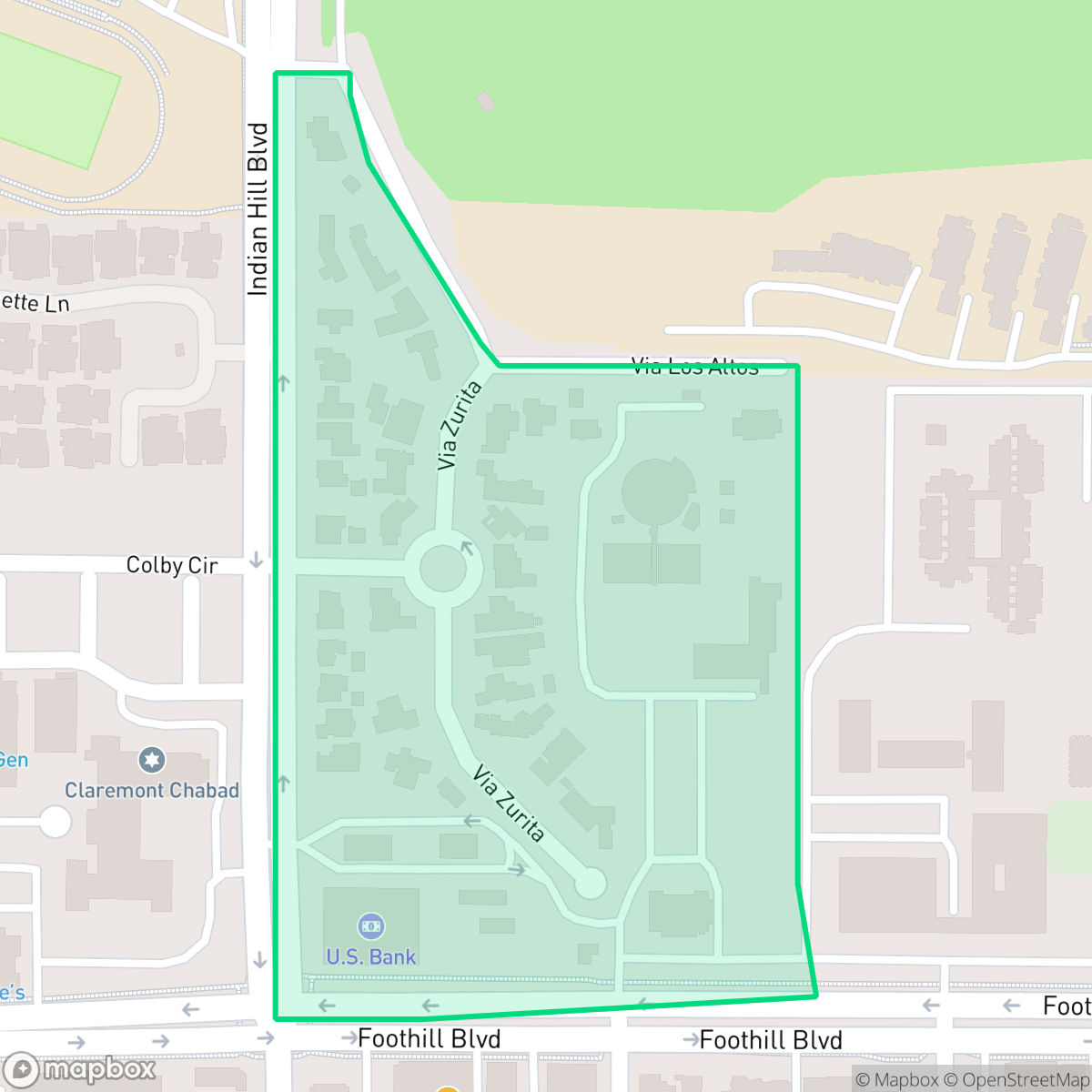
About Via Zurita
Located north of Foothill Boulevard, the secluded Via Zurita neighborhood in Claremont was developed in the late 1920s and 1930s on Scripps College trust land as a faculty enclave. Named after its defining traffic circle—with "Via Zurita" translating to "Way of the Quail"—this historic neighborhood is renowned for its custom-designed homes nestled under a canopy of heritage oaks and eucalyptus. Architectural styles range from Spanish Colonial Revival to mid-century modern, featuring designs by notable architects like Thorne and Ficker, Theodore Criley Jr., and John Longenecker. Celebrated local figures have called Via Zurita home, including renowned artist Millard Sheets, who lived in one of the original 1926 residences, and Art Clokey, the creator of Gumby, whose childhood Mediterranean Revival home still stands at the corner of Indian Hill Boulevard.
The neighborhood functions as a residential enclave that balances historic charm with modern urban convenience. Residents benefit from exceptional walkability, which allows for easy access to community staples such as Wolfe's Market and Memorial Park. The area is served by the Claremont Unified School District, which is widely recognized for its robust academic programs and strong community support, making it a stable destination for families. According to iHuus data, the area maintains a high level of ideological alignment among residents, contributing to a cohesive local atmosphere.
Prospective residents should consider the trade-offs associated with this location. While the area is highly desirable for its aesthetic appeal and pedestrian access to services, the proximity to major thoroughfares results in consistent road noise that may impact acoustic comfort. Additionally, the region faces significant fire safety challenges, a factor that requires careful evaluation. The neighborhood is best suited for those who prioritize a walkable lifestyle and architectural heritage over absolute quiet or suburban seclusion.
Neighborhood Scores Across 15 Qualities
Residential spacing offers a moderate level of separation between neighbors. According to iHuus data, this area provides slightly more buffer between properties than the Claremont average.
Pedestrian access is exceptional due to wide sidewalks and frequent crossings. Most daily errands can be completed on foot, with infrastructure that is notably more pedestrian-friendly than the Claremont average.
Large residences and well-maintained amenities create a highly attractive streetscape. According to iHuus data, the area offers more greenery and spacious property layouts than the typical Claremont neighborhood.
Connected green spaces and wide paths provide safe areas for walking pets. According to iHuus data, this level of accessibility is roughly in line with the Claremont average.
Frequent open land and scattered homes amidst woodland characterize this area. This landscape is slightly more rural than the Claremont average, according to iHuus data.
Social activity is notably higher than the Claremont average due to a concentration of local dining and community spaces. While some residential pockets near the California Botanic Garden remain quiet, many blocks feature accessible eateries and active green spaces according to iHuus data.
Frequent noise from nearby railroad tracks and freeway proximity characterizes this area. According to iHuus data, acoustic disturbances are more prevalent here than in the rest of Claremont.
Air quality is consistently clean with minimal health concerns; according to iHuus data, these levels are even higher than the Claremont average.
No warehouses, industrial facilities, or hazard sites are present in this area. This neighborhood maintains a more residential character than the Claremont average, consisting of quiet streets and open green spaces.
Nearly all residents possess health insurance, representing a level of coverage that is significantly higher than the Claremont average according to iHuus data.
Voting patterns and census indicators show a predominantly liberal leaning that is even more pronounced than the Claremont average, according to iHuus data.
A diverse range of age groups resides here, including young adults, families, and older residents. According to iHuus data, this demographic spread is slightly more varied than the average found throughout Claremont.
Residual flood risk exists within this area due to its location in a 500-year floodplain; however, the safety level remains significantly higher than the Claremont average according to iHuus data.
Address-Level Insights for Via Zurita


iHuus Neighborhood Intelligence Insights
Get address-level neighborhood insights for Via Zurita
- Street-level scores — see how individual blocks compare, not just neighborhood averages
- Micro-zone boundaries — identify quiet pockets, flood boundaries, and walkable clusters before you visit
- 15 dimensions in full — walkability, noise, air quality, school quality, insurance coverage, population age profile, urban/rural index, and more
- Boundary risk alerts — know if your address sits near a block boundary where scores drop, the kind of detail no listing will ever mention
- School insights — individual school ratings and insights, not just district-level data
- Compare before you commit — side-by-side data across neighborhoods, down to block precision
No credit card required
Compare with Any Neighborhood
| Dimension | Via Zurita | Arbol Verde |
|---|---|---|
| 🚶 Walkabilityavg 8.6 | ||
| 🔊 Acoustic Comfortavg 2.58 | ||
| 🤫 Privacy Indexavg 5.58 | ||
| 🎨 Visual Appealavg 7.17 | ||
| 🐕 Dog Friendlinessavg 6.82 | ||
| 🗺️ Urban-Rural Indexavg 6.89 | ||
| ✨ Neighborhood Vibeavg 4.64 | ||
| 🏥 Health Insurance Coverageavg 8.37 | ||
| 🌿 Air Qualityavg 9.85 | ||
| 🏭 Industrial Proximityavg 8.67 | ||
| 🌊 Flood Safetyavg 3.81 | ||
| 🗳️ Ideological Leanavg 8.75 | ||
| 👥 Population Age Profileavg 5.03 | ||
| 🔥 Fire Safetyavg 0.41 | ||
| 🏫 School Quality |
Via Zurita Rankings
School Districts Serving Via Zurita
School Insights for Via Zurita
Below average outcomes; significant attendance and academic challenges.
School Insights
See what's really behind every school rating near Via Zurita
- Individual school ratings — each school's own score with outcome context, not just a district average
- Enrollment & class size data — student-to-teacher ratio and how it compares to the state average
- Full demographics breakdown — ethnicity and gender composition for every school in the enrollment zone
- Every school in the district — all schools within the enrollment boundary ranked by rating, not just the closest one
- Grade levels & benchmarks — elementary through high school, with below/above state-average flags
No credit card required