The Claremont Colleges and Affiliated Institutions, Claremont
Updated · 4,152 residents
The Claremont Colleges and Affiliated Institutions neighborhood is a highly walkable, academic-focused area defined by its lush campus landscapes and proximity to the California Botanic Garden. Residents benefit from excellent air quality and a dog-friendly environment, though the area experiences notable road traffic noise.
Key Highlights
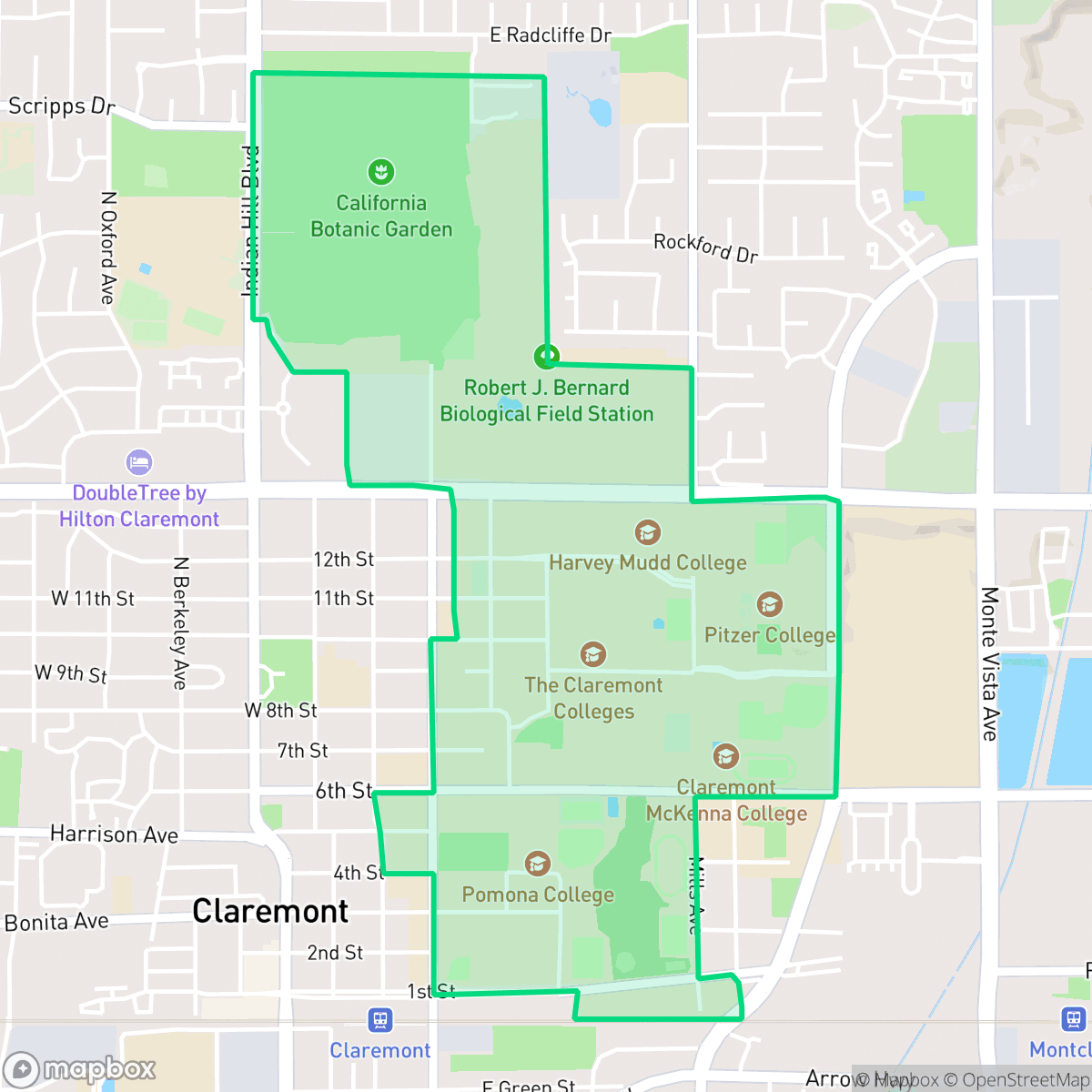
About The Claremont Colleges and Affiliated Institutions
The Claremont Colleges and Affiliated Institutions neighborhood began in 1888 when Pomona College relocated to an unfinished local hotel. In 1925, college president James Blaisdell established the unique consortium model to manage growth while maintaining a small-college feel. The neighborhood features a rich architectural legacy, including Myron Hunt’s Roman Basilica-inspired Bridges Hall of Music (1915) and Gordon Kaufmann’s Mediterranean-style Scripps College campus. Historically, the colleges relied heavily on labor from nearby Mexican-American barrios, such as Arbol Verde, to construct their early stone buildings. However, the institutional expansion of schools like Claremont McKenna College in the mid-20th century led to the controversial acquisition and displacement of parts of these historic neighborhoods through eminent domain.
This neighborhood serves as the academic and cultural heart of the city, characterized by its sprawling green spaces, institutional architecture, and quiet, pedestrian-oriented streets. Local amenities include a variety of dining options like Nuno's Bistro and Menkoi Ya Ramen, alongside cultural landmarks such as the Clark Humanities Museum. According to iHuus data, the area maintains a strong sense of community livability, supported by high walkability and excellent air quality that encourages outdoor activity. While the neighborhood offers a high quality of life, prospective residents should consider specific environmental trade-offs. The acoustic environment is influenced by road traffic, which contributes to a moderate noise level. Additionally, the area faces significant challenges regarding flood and fire safety, which are important factors for long-term planning. The neighborhood remains an ideal choice for those who value proximity to educational institutions and a lifestyle centered around pedestrian access and green space.
Neighborhood Scores Across 15 Qualities
Residential spacing is moderate with some buffers between neighbors, appearing largely consistent with the city average. Campus buildings and central park areas offer larger separations between structures.
Wide sidewalks and a structured grid system make navigating the area on foot easy. The neighborhood offers more pedestrian-oriented layouts and ample crossings than the average Claremont area, according to iHuus data.
Large institutional structures and affluent residential properties with well-kept lawns and private amenities create a highly aesthetic environment. This level of visual quality is notably higher than the Claremont average, according to iHuus data.
Extensive campus greenery and large natural areas with visible trails provide ample space for walking pets. According to iHuus data, these connected green spaces and wide paths offer a higher level of dog friendliness than the Claremont average.
Expansive natural spaces and a low-density mix of institutional and residential properties create a semi-rural feel that is slightly more open than the Claremont average. Large central greenbelts and scattered housing patterns provide significant visual breathing room according to iHuus data.
Social activity ranges from lively pockets of dining and community hubs to quieter, more secluded suburban stretches. This area offers more localized engagement and diverse amenities than the Claremont average, according to iHuus data.
Frequent noise from nearby railroad tracks and heavy freeway traffic is common here. According to iHuus data, acoustic comfort in this area is slightly lower than the Claremont average.
Air quality remains consistently high with negligible health concerns for residents. According to iHuus data, the atmospheric conditions in this area are slightly better than the average for Claremont.
The area is comprised entirely of residential, educational, and natural land uses with no detected warehouses or hazard sites. According to iHuus data, this neighborhood offers a cleaner environment than the Claremont average due to the absence of industrial facilities.
Health insurance access is exceptionally high for residents here, significantly exceeding the Claremont average according to iHuus data.
Voting patterns and census indicators show a predominantly liberal leaning that is more pronounced than the Claremont average. This political profile is reflected in the community's social and civic engagement levels according to iHuus data.
A notable presence of young adults and students exists alongside families and older residents, though the overall age distribution is slightly lower than the Claremont average according to iHuus data.
Property within the 100-year floodplain is subject to higher flood risks than much of the city. According to iHuus data, residents may find that flood insurance is typically required for properties in this area.
Extreme fire hazards are present in this area, representing a higher risk level than the Claremont average according to iHuus data. Residents should prepare for maximum protection measures due to the significant danger of wildfires.
Address-Level Insights for The Claremont Colleges and Affiliated Institutions


iHuus Neighborhood Intelligence Insights
Get address-level neighborhood insights for The Claremont Colleges and Affiliated Institutions
- Street-level scores — see how individual blocks compare, not just neighborhood averages
- Micro-zone boundaries — identify quiet pockets, flood boundaries, and walkable clusters before you visit
- 15 dimensions in full — walkability, noise, air quality, school quality, insurance coverage, population age profile, urban/rural index, and more
- Boundary risk alerts — know if your address sits near a block boundary where scores drop, the kind of detail no listing will ever mention
- School insights — individual school ratings and insights, not just district-level data
- Compare before you commit — side-by-side data across neighborhoods, down to block precision
No credit card required
Compare with Any Neighborhood
| Dimension | The Claremont Colleges and Affiliated Institutions | Arbol Verde |
|---|---|---|
| 🚶 Walkabilityavg 8.6 | ||
| 🔊 Acoustic Comfortavg 2.58 | ||
| 🤫 Privacy Indexavg 5.58 | ||
| 🎨 Visual Appealavg 7.17 | ||
| 🐕 Dog Friendlinessavg 6.82 | ||
| 🗺️ Urban-Rural Indexavg 6.89 | ||
| ✨ Neighborhood Vibeavg 4.64 | ||
| 🏥 Health Insurance Coverageavg 8.37 | ||
| 🌿 Air Qualityavg 9.85 | ||
| 🏭 Industrial Proximityavg 8.67 | ||
| 🌊 Flood Safetyavg 3.81 | ||
| 🗳️ Ideological Leanavg 8.75 | ||
| 👥 Population Age Profileavg 5.03 | ||
| 🔥 Fire Safetyavg 0.41 | ||
| 🏫 School Quality |
The Claremont Colleges and Affiliated Institutions Rankings
School Districts Serving The Claremont Colleges and Affiliated Institutions
School Insights for The Claremont Colleges and Affiliated Institutions
Below average outcomes; significant attendance and academic challenges.
School Insights
See what's really behind every school rating near The Claremont Colleges and Affiliated Institutions
- Individual school ratings — each school's own score with outcome context, not just a district average
- Enrollment & class size data — student-to-teacher ratio and how it compares to the state average
- Full demographics breakdown — ethnicity and gender composition for every school in the enrollment zone
- Every school in the district — all schools within the enrollment boundary ranked by rating, not just the closest one
- Grade levels & benchmarks — elementary through high school, with below/above state-average flags
No credit card required