Sumner, Claremont
Updated · 1,525 residents
Sumner is a quiet, residential enclave defined by its mid-century California Ranch homes and access to local green spaces like Griffith Park. While the area offers high air quality and strong educational options, residents should expect moderate noise levels from nearby road traffic. It is a stable, family-oriented community that prioritizes a suburban atmosphere over commercial activity.
Key Highlights
About Sumner
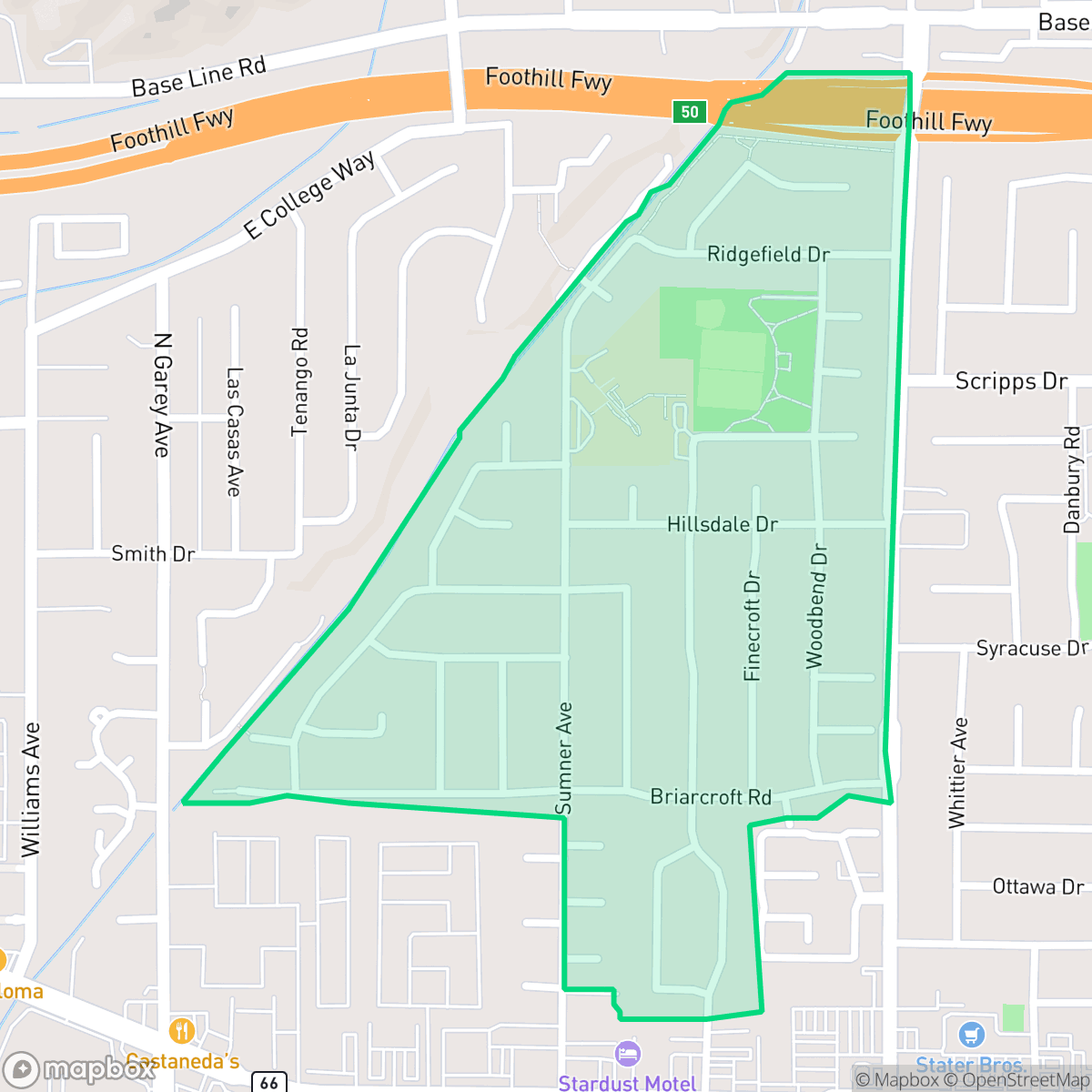
Adjacent to Piedmont Mesa, the Sumner neighborhood in Claremont, California, is a post-World War II residential subdivision defined by its mid-century suburban character. Developed primarily between the 1940s and 1960s, the neighborhood features cohesive streetscapes of single-story California Ranch-style homes. The community is centered around Griffith Park, established in 1961, and the Sumner Danbury Elementary School. The neighborhood's name shares a legacy with Reverend Charles Burt Sumner, a founding trustee of Pomona College who originally built his historic 1887 Queen Anne Victorian "Sumner House" nearby on Piedmont Mesa before it was relocated to the college campus in 1901. Today, Sumner remains a well-preserved example of Claremont's postwar expansion.
The area maintains a consistent residential character with well-preserved architecture and a significant tree canopy, contributing to high visual appeal. It serves as a quiet retreat within Claremont, benefiting from the high-performing Claremont Unified School District, which includes the local Sumner Elementary. The neighborhood is largely devoid of commercial development, reinforcing its status as a peaceful, community-focused environment. Prospective residents should note that the neighborhood experiences moderate noise levels due to its proximity to major roadways, which impacts acoustic comfort. While it offers good walkability and is considered dog-friendly, the low liveliness score reflects a lack of local nightlife or retail hubs. According to iHuus data, the area provides a secure residential experience with reliable health insurance coverage and favorable flood safety, making it a practical choice for families seeking a stable, long-term living environment.
Neighborhood Scores Across 15 Qualities
Residential spacing varies between standard suburban yards and denser clusters of apartments or mobile homes. According to iHuus data, the level of separation between neighbors is slightly lower than the Claremont average.
Sidewalks and safe crossings are available along most residential streets, though larger intersections and high-density areas can make navigation more difficult. This area is slightly less walkable than the average for Claremont.
Standard tract housing and high-density apartments characterize the landscape, resulting in a visual profile that is less varied than the Claremont average. While some affluent pockets feature private pools and well-maintained properties, the area contains significant mobile home and apartment density according to iHuus data.
Minimal public park access and few green verges make this area less ideal for dog owners compared to the Claremont average. Residents primarily rely on private yards or nearby school fields for pet exercise.
Open land and scattered homes are common throughout the area, providing a slightly more rural atmosphere than the Claremont average. Residents will find a mix of dense suburban developments and pockets of woodland or field surroundings according to iHuus data.
Suburban streets and green spaces define this area, which offers a tranquil atmosphere but lacks the commercial density found in other parts of the city. Most daily activities and dining options require a car, as business access is limited to specific pockets near civic and light industrial zones.
Frequent disturbances from nearby railroad tracks and freeway traffic characterize this area. According to iHuus data, acoustic comfort in Sumner is significantly lower than the Claremont average.
Air quality remains exceptionally clean and poses little to no health concern. This level of air purity is slightly higher than the average found throughout Claremont, according to iHuus data.
Large-scale industrial presence is virtually nonexistent in this area, though some light commercial activity and retail structures near the southern edge may introduce minor traffic. Most of the neighborhood consists of quiet streets and open green spaces, making it slightly more industrial-adjacent than the Claremont average.
Health insurance access is nearly universal among residents, sitting well above the Claremont average according to iHuus data.
Political leanings in this area trend toward the liberal side, though this is slightly less pronounced than the broader Claremont average according to iHuus data.
A balanced mix of young adults, families, and older residents characterizes the area, mirroring the general demographic spread seen across Claremont. This age distribution creates a diverse community profile according to iHuus data.
Properties in this area are situated within a designated floodplain, which implies a higher susceptibility to flooding than the Claremont average. According to iHuus data, residents may find that flood insurance is typically required for homes in this neighborhood.
Extreme fire hazards are present in this area, representing a significantly higher risk than the Claremont average according to iHuus data. Residents should prioritize maximum protection measures and fire preparedness due to the severe level of danger.
Address-Level Insights for Sumner


iHuus Neighborhood Intelligence Insights
Get address-level neighborhood insights for Sumner
- Street-level scores — see how individual blocks compare, not just neighborhood averages
- Micro-zone boundaries — identify quiet pockets, flood boundaries, and walkable clusters before you visit
- 15 dimensions in full — walkability, noise, air quality, school quality, insurance coverage, population age profile, urban/rural index, and more
- Boundary risk alerts — know if your address sits near a block boundary where scores drop, the kind of detail no listing will ever mention
- School insights — individual school ratings and insights, not just district-level data
- Compare before you commit — side-by-side data across neighborhoods, down to block precision
No credit card required
Compare with Any Neighborhood
| Dimension | Sumner | Arbol Verde |
|---|---|---|
| 🚶 Walkabilityavg 8.6 | ||
| 🔊 Acoustic Comfortavg 2.58 | ||
| 🤫 Privacy Indexavg 5.58 | ||
| 🎨 Visual Appealavg 7.17 | ||
| 🐕 Dog Friendlinessavg 6.82 | ||
| 🗺️ Urban-Rural Indexavg 6.89 | ||
| ✨ Neighborhood Vibeavg 4.64 | ||
| 🏥 Health Insurance Coverageavg 8.37 | ||
| 🌿 Air Qualityavg 9.85 | ||
| 🏭 Industrial Proximityavg 8.67 | ||
| 🌊 Flood Safetyavg 3.81 | ||
| 🗳️ Ideological Leanavg 8.75 | ||
| 👥 Population Age Profileavg 5.03 | ||
| 🔥 Fire Safetyavg 0.41 | ||
| 🏫 School Quality |
Sumner Rankings
School Districts Serving Sumner
School Insights for Sumner
Below average outcomes; significant attendance and academic challenges.
School Insights
See what's really behind every school rating near Sumner
- Individual school ratings — each school's own score with outcome context, not just a district average
- Enrollment & class size data — student-to-teacher ratio and how it compares to the state average
- Full demographics breakdown — ethnicity and gender composition for every school in the enrollment zone
- Every school in the district — all schools within the enrollment boundary ranked by rating, not just the closest one
- Grade levels & benchmarks — elementary through high school, with below/above state-average flags
No credit card required