Pilgrim Place, Claremont
Updated · 387 residents
Pilgrim Place is a unique residential enclave in Claremont known for its park-like atmosphere and strong focus on social activism. The area offers good walkability and high air quality, though residents should expect noticeable noise levels from nearby rail traffic.
Key Highlights
About Pilgrim Place
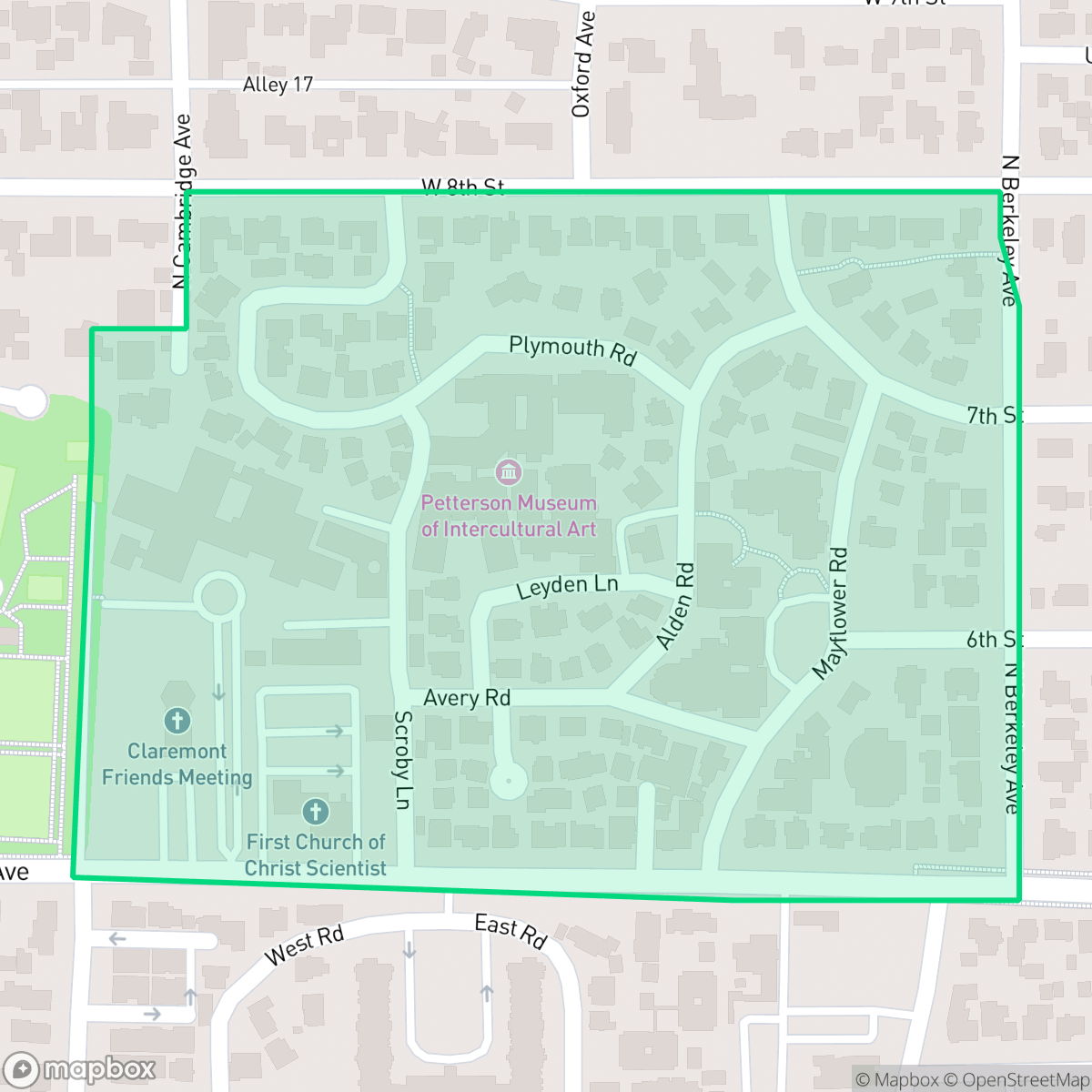
Founded in 1915 by the Congregational Church as the Claremont Missionary Home, Pilgrim Place originally provided temporary housing for furloughed missionaries. In 1924, the community relocated from the future Scripps College campus to its current 32-acre park-like site in western Claremont. The land, once a swampy area used by Pomona College students for duck hunting, was transformed into an intentional residential neighborhood. Keeping with its heritage, signature streets like Plymouth Road, Mayflower Road, and Scrooby Lane were named after historically significant English pilgrim sites. Architecturally, the neighborhood features a Spanish Colonial Revival community building commissioned in 1928, alongside historic wrought-iron entry gates installed in 1932. Today, Pilgrim Place remains a vibrant retirement community for individuals dedicated to social justice, peace, and environmental activism, and is home to the Petterson Museum of Intercultural Art.
The neighborhood serves as a distinct, quiet residential pocket characterized by its intentional layout and mature landscaping. It maintains a strong sense of community, reflected in its high ideological cohesion and active social engagement. Residents benefit from excellent air quality and a well-connected sidewalk network, making it easy to navigate the immediate area on foot. Nearby amenities, including local cafes and dining options like Bua Thai and Eureka!, contribute to a balanced suburban lifestyle that feels both secluded and connected to the broader Claremont community.
Prospective residents should consider the trade-offs of living in this specific part of the city. While the environment is visually appealing with well-maintained properties, the proximity to the southern railway corridor introduces consistent noise from passing trains. The area also sits within a zone where fire safety is a significant concern, requiring careful attention to local hazard mitigation. With its demographic leaning toward an older population and a strong emphasis on community values, the neighborhood is well-suited for those seeking a stable, intellectually engaged environment within the highly-regarded Claremont Unified School District.
Neighborhood Scores Across 15 Qualities
Residential spacing provides some buffer between neighbors, though apartment clusters feature closer quarters. This level of privacy is slightly higher than the Claremont average according to iHuus data.
Pedestrian paths are well-developed throughout the area, featuring a dense sidewalk network and clear crossings that surpass the Claremont average. According to iHuus data, the neighborhood offers reliable connectivity for those traveling on foot within residential complexes.
Large, well-maintained properties and frequent private amenities like backyard pools characterize the area. This level of aesthetic quality and property scale sits above the Claremont average, according to iHuus data.
Large public parks and sports fields in the northwest quadrant offer ample space for pets. According to iHuus data, the area provides connected paths and safe routes that are slightly above the Claremont average.
Residential layouts consist of a mix of single-family homes and multi-story apartment blocks. This area feels slightly more developed than the Claremont average, featuring a dense suburban character rather than open fields or woodland.
Local dining and coffee shops provide a noticeably higher level of activity than the Claremont average. According to iHuus data, the area features a steady concentration of social spaces and nearby parks.
Frequent noise from nearby railroad tracks and major freeways impacts the area. According to iHuus data, acoustic disturbances in this neighborhood are more prevalent than the average found across Claremont.
Air quality is exceptionally clean with minimal pollutants, performing slightly better than the Claremont average. Residents can expect highly breathable conditions and very few-related health concerns according to iHuus data.
Industrial presence is virtually nonexistent within the neighborhood, offering a cleaner environment than the Claremont average. While some large warehouses and truck loading bays are located along the southern railway corridor, the primary area consists of quiet streets and open green spaces.
Health insurance access is widespread among residents, trending higher than the Claremont average according to iHuus data.
Voting patterns and census indicators show a predominantly liberal leaning that is more pronounced than the Claremont average, according to iHuus data.
A balanced mix of young adults, families, and older residents defines the area. According to iHuus data, this demographic variety is more pronounced here than in the rest of Claremont.
Residual flood risk exists within this area due to its location in a 500-year floodplain, though safety levels remain significantly higher than the Claremont city average according to iHuus data.
Address-Level Insights for Pilgrim Place


iHuus Neighborhood Intelligence Insights
Get address-level neighborhood insights for Pilgrim Place
- Street-level scores — see how individual blocks compare, not just neighborhood averages
- Micro-zone boundaries — identify quiet pockets, flood boundaries, and walkable clusters before you visit
- 15 dimensions in full — walkability, noise, air quality, school quality, insurance coverage, population age profile, urban/rural index, and more
- Boundary risk alerts — know if your address sits near a block boundary where scores drop, the kind of detail no listing will ever mention
- School insights — individual school ratings and insights, not just district-level data
- Compare before you commit — side-by-side data across neighborhoods, down to block precision
No credit card required
Compare with Any Neighborhood
| Dimension | Pilgrim Place | Arbol Verde |
|---|---|---|
| 🚶 Walkabilityavg 8.6 | ||
| 🔊 Acoustic Comfortavg 2.58 | ||
| 🤫 Privacy Indexavg 5.58 | ||
| 🎨 Visual Appealavg 7.17 | ||
| 🐕 Dog Friendlinessavg 6.82 | ||
| 🗺️ Urban-Rural Indexavg 6.89 | ||
| ✨ Neighborhood Vibeavg 4.64 | ||
| 🏥 Health Insurance Coverageavg 8.37 | ||
| 🌿 Air Qualityavg 9.85 | ||
| 🏭 Industrial Proximityavg 8.67 | ||
| 🌊 Flood Safetyavg 3.81 | ||
| 🗳️ Ideological Leanavg 8.75 | ||
| 👥 Population Age Profileavg 5.03 | ||
| 🔥 Fire Safetyavg 0.41 | ||
| 🏫 School Quality |
Pilgrim Place Rankings
School Districts Serving Pilgrim Place
School Insights for Pilgrim Place
Below average outcomes; significant attendance and academic challenges.
School Insights
See what's really behind every school rating near Pilgrim Place
- Individual school ratings — each school's own score with outcome context, not just a district average
- Enrollment & class size data — student-to-teacher ratio and how it compares to the state average
- Full demographics breakdown — ethnicity and gender composition for every school in the enrollment zone
- Every school in the district — all schools within the enrollment boundary ranked by rating, not just the closest one
- Grade levels & benchmarks — elementary through high school, with below/above state-average flags
No credit card required