Piedmont Mesa, Claremont
Updated · 1,081 residents
Piedmont Mesa is a quiet, residential enclave in northwest Claremont defined by its post-war suburban layout and abundant greenery. The area offers exceptional air quality and high safety standards, though residents should expect consistent noise from nearby road traffic.
Key Highlights
About Piedmont Mesa
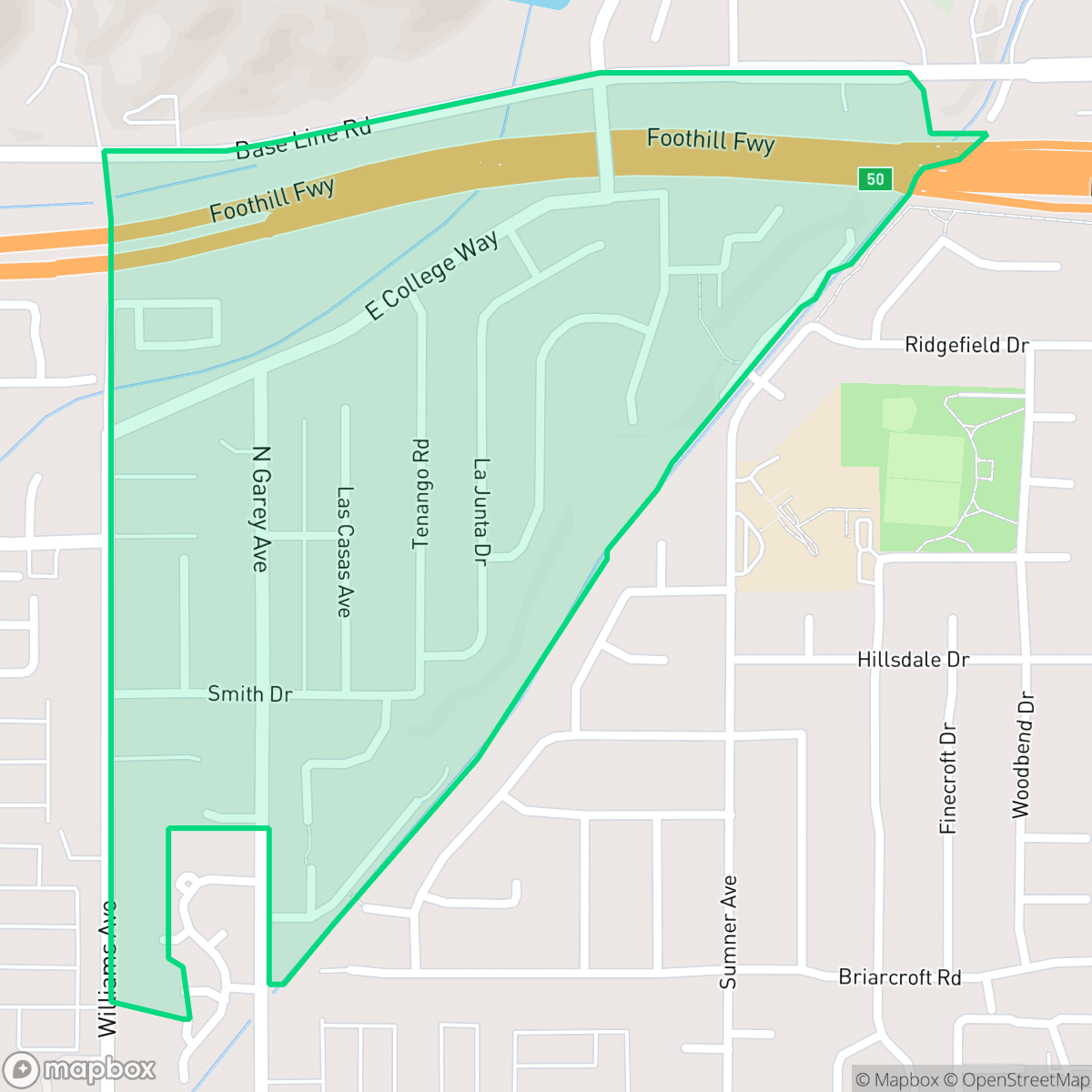
Located in northwest Claremont, California, Piedmont Mesa was originally known as Scanlon Mesa. In 1887, it was renamed Piedmont Mesa as part of a speculative plan to establish a new town called Piedmont. That same year, the founders of Pomona College selected a 120-acre parcel on the mesa, donated by trustee Henry A. Palmer, as the site for their new campus. Although a cornerstone was laid on September 26, 1888, a sudden real estate bust halted construction. The college subsequently relocated to an abandoned hotel in Claremont, and the planned town of Piedmont was abandoned. Following World War II, the mesa was transformed into a quiet, single-family residential neighborhood characterized by post-war suburban street layouts.
Piedmont Mesa is a peaceful, primarily residential area characterized by single-family homes and open green spaces. It maintains a high level of visual appeal and is well-regarded for its dog-friendly environment. The neighborhood benefits from excellent air quality and minimal industrial proximity, fostering a clean living atmosphere for its residents.
While the area is relatively walkable for a suburban setting, it lacks a vibrant commercial core, resulting in a low liveliness score. Residents trade proximity to bustling business districts for a stable, quiet environment. The community is served by the well-regarded Claremont Unified School District, making it a suitable choice for families seeking educational stability in a low-density setting.
Neighborhood Scores Across 15 Qualities
Housing density varies across the area, with some apartment and mobile home clusters presenting closer proximity to neighbors than the Claremont average. Mixed spacing provides a moderate buffer between many structures, according to iHuus data.
Sidewalks are available along main roads with safe crossings, though large intersections and high-density blocks can make navigating the area less seamless than in other parts of Claremont. According to iHuus data, the ease of walking here is slightly below the city average.
Standard tract housing and high-density apartment complexes define the local landscape. According to iHuus data, the visual variety in this area is lower than the Claremont average due to the prevalence of mobile home parks and uniform rooflines.
Public parks and green verges are scarce in this area, as most properties consist of private yards and dense mobile home parks. This lack of accessible green space makes the neighborhood less dog friendly than the Claremont average, according to iHuus data.
Open land and scattered homes provide a semi-rural atmosphere that is slightly less dense than the Claremont average. According to iHuus data, certain pockets of the area also feature more concentrated suburban developments including apartments and mobile home parks.
Local activity is limited to a few dining options and civic spaces, making the area notably quieter than the Claremont average. Most residents will find a low-density environment characterized by residential streets and significant open space near major transit corridors.
Frequent noise from nearby freeway and railroad corridors is common here. According to iHuus data, acoustic comfort in this area is notably lower than the Claremont average.
Air quality remains consistently high with minimal health concerns for residents. According to iHuus data, these conditions are slightly better than the average found throughout Claremont.
Industrial activity and heavy manufacturing are absent from this area. Residents can expect a purely residential environment with no proximity to warehouses or hazardous industrial sites, which is slightly better than the Claremont average according to iHuus data.
Health insurance access is widespread among residents, remaining very close to the Claremont average. According to iHuus data, the majority of the population is covered by a health plan.
Political leanings in this area are largely liberal, though the neighborhood is slightly less progressive than the Claremont average according to iHuus data.
Residents live alongside a diverse range of age groups, from young adults to older adults. This demographic distribution is largely consistent with the broader Claremont area, according to iHuus data.
Flood risk levels in this area are slightly above the Claremont average, though a detailed study from FEMA has not yet been completed for this specific location.
Wildfire risk is significantly higher here than the Claremont average, necessitating extreme fire protection measures for residents. According to iHuus data, the area faces a severe level of fire danger.
Address-Level Insights for Piedmont Mesa


iHuus Neighborhood Intelligence Insights
Get address-level neighborhood insights for Piedmont Mesa
- Street-level scores — see how individual blocks compare, not just neighborhood averages
- Micro-zone boundaries — identify quiet pockets, flood boundaries, and walkable clusters before you visit
- 15 dimensions in full — walkability, noise, air quality, school quality, insurance coverage, population age profile, urban/rural index, and more
- Boundary risk alerts — know if your address sits near a block boundary where scores drop, the kind of detail no listing will ever mention
- School insights — individual school ratings and insights, not just district-level data
- Compare before you commit — side-by-side data across neighborhoods, down to block precision
No credit card required
Compare with Any Neighborhood
| Dimension | Piedmont Mesa | Arbol Verde |
|---|---|---|
| 🚶 Walkabilityavg 8.6 | ||
| 🔊 Acoustic Comfortavg 2.58 | ||
| 🤫 Privacy Indexavg 5.58 | ||
| 🎨 Visual Appealavg 7.17 | ||
| 🐕 Dog Friendlinessavg 6.82 | ||
| 🗺️ Urban-Rural Indexavg 6.89 | ||
| ✨ Neighborhood Vibeavg 4.64 | ||
| 🏥 Health Insurance Coverageavg 8.37 | ||
| 🌿 Air Qualityavg 9.85 | ||
| 🏭 Industrial Proximityavg 8.67 | ||
| 🌊 Flood Safetyavg 3.81 | ||
| 🗳️ Ideological Leanavg 8.75 | ||
| 👥 Population Age Profileavg 5.03 | ||
| 🔥 Fire Safetyavg 0.41 | ||
| 🏫 School Quality |
Piedmont Mesa Rankings
School Districts Serving Piedmont Mesa
School Insights for Piedmont Mesa
Below average outcomes; significant attendance and academic challenges.
School Insights
See what's really behind every school rating near Piedmont Mesa
- Individual school ratings — each school's own score with outcome context, not just a district average
- Enrollment & class size data — student-to-teacher ratio and how it compares to the state average
- Full demographics breakdown — ethnicity and gender composition for every school in the enrollment zone
- Every school in the district — all schools within the enrollment boundary ranked by rating, not just the closest one
- Grade levels & benchmarks — elementary through high school, with below/above state-average flags
No credit card required