Old Claremont, Claremont
Updated · 843 residents
Old Claremont is a highly walkable neighborhood defined by its historic architectural charm and proximity to local amenities like Memorial Park and Wolfe's Market. While the area offers exceptional air quality and a vibrant atmosphere, residents should be prepared for higher noise levels stemming from consistent road traffic.
Key Highlights
About Old Claremont
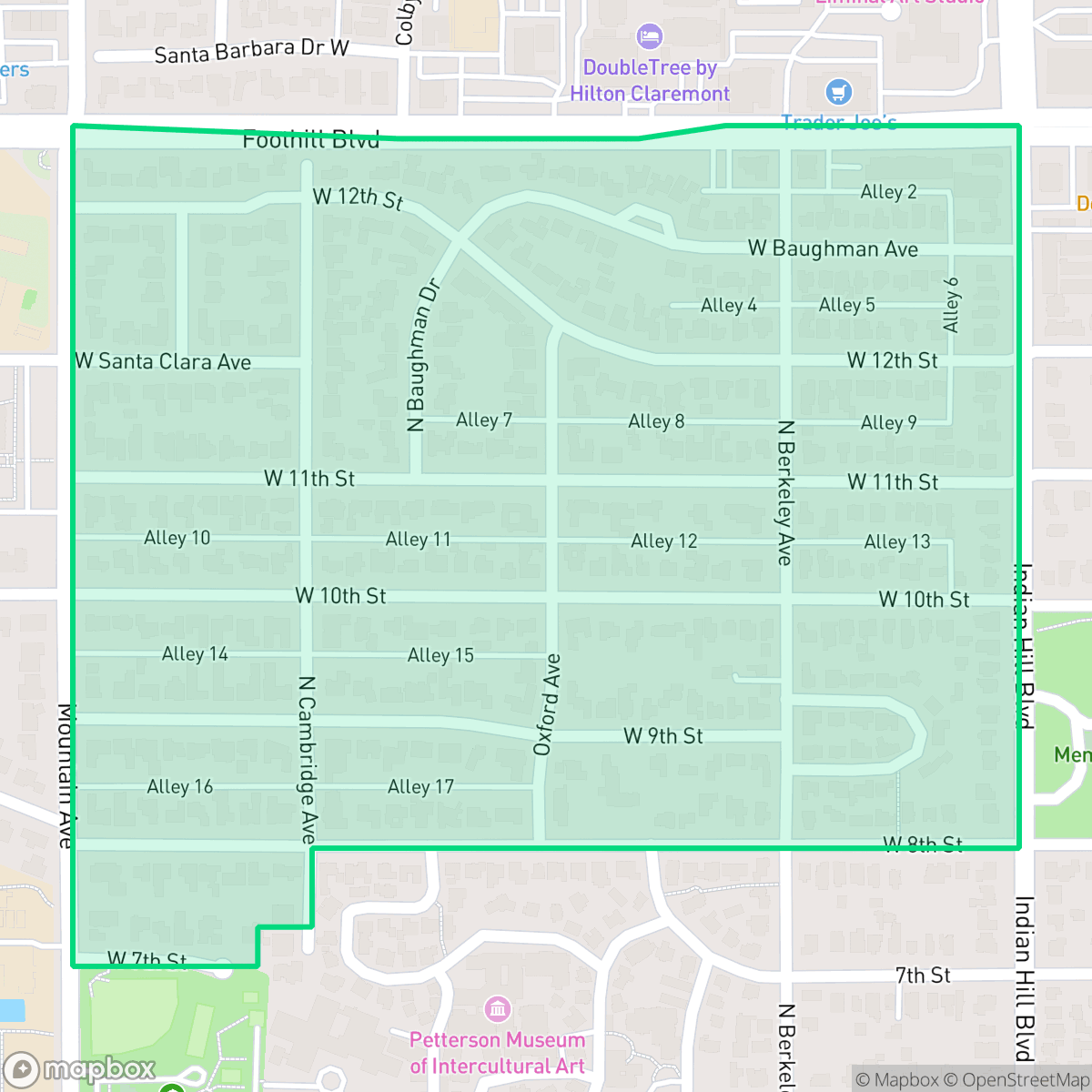
Developed primarily between the 1920s and early 1950s as the city’s first major residential expansion, the Old Claremont neighborhood lies south of Foothill Boulevard and west of the Claremont Colleges. Characterized by a compact historic grid, the neighborhood features narrow sidewalks, homes set back from the street, and rear alleyways. Its diverse architectural stock includes early Ranch-style, Spanish Colonial, and Monterey Revival homes, many of which are listed on the City’s Historic Register. A distinct enclave within the neighborhood is University Circle, a collection of homes built between 1938 and 1951 sharing a unified architectural language on smaller lots. Old Claremont is also home to Pilgrim Place, a historic 1914 retirement community founded for Christian missionaries and pastors on Harrison Avenue, whose active residents remain deeply involved in local civic life.
The neighborhood functions as a central hub of activity, characterized by its high walkability and proximity to essential services and dining options. Residents benefit from excellent air quality and a strong sense of community, with local landmarks like Memorial Park serving as social anchors. The area maintains a lively, urban-suburban feel that attracts those who value convenience and access to the Claremont Colleges.
Prospective residents should note that the neighborhood experiences elevated noise levels due to road traffic, which may impact acoustic comfort. While the area boasts high health insurance coverage and strong academic support through the local school district, the fire safety profile is a consideration for the region. It is best suited for individuals or families who prioritize a pedestrian-friendly lifestyle and proximity to the cultural heart of the city over absolute quiet.
Neighborhood Scores Across 15 Qualities
Spacing between properties is slightly higher than the Claremont average, though density varies between single-family homes and denser apartment clusters. Resident privacy depends on the specific zone, as some areas offer more buffer than others.
Pedestrian-priority areas and a dense sidewalk network make most local trips easy to complete on foot. According to iHuus data, the connectivity and availability of clear crossings are significantly higher than the Claremont average.
Large, well-maintained properties and a high density of private backyard pools characterize this area. According to iHuus data, the visual quality of the streetscape is notably higher than the Claremont average.
Access to large public parks and sports fields in the northwest quadrant provides ample green space for pets. According to iHuus data, the area features wide paths and low traffic risks that are above the Claremont average.
Residential density here is slightly lower than the Claremont average, characterized by a mix of single-family homes and multi-story apartment blocks. According to iHuus data, the landscape features frequent open land and scattered dwellings near wooded areas.
Local dining and social spots are more concentrated here than in the rest of the city. Residents can access various cafes, parks, and eateries within a balanced landscape of greenery and residential streets.
Steady traffic hum from nearby busy streets is noticeable, though the level of acoustic disturbance remains significantly lower than the Claremont average, according to iHuus data.
Air quality remains exceptionally high and poses little to no health concern for residents. This level of air purity is slightly above the Claremont average, according to iHuus data.
Industrial activity is virtually non-existent within this area, providing a more residential environment than the city average. According to iHuus data, the neighborhood is free from warehouses and hazardous industrial facilities, though some larger logistics structures are located along the southern railway corridor.
Health insurance accessibility is high within this neighborhood, sitting slightly above the Claremont average according to iHuus data.
Voting patterns and census indicators show a predominantly liberal leaning, which is more pronounced here than in the wider Claremont area according to iHuus data.
A diverse range of age groups resides here, showing a more balanced distribution of young adults, families, and seniors than the Claremont average.
Flood safety levels in Old Claremont are significantly higher than the Claremont city average. While some residual risk exists due to proximity to the 500-year floodplain, the area is generally considered much safer than many other parts of the city according to iHuus data.
Address-Level Insights for Old Claremont


iHuus Neighborhood Intelligence Insights
Get address-level neighborhood insights for Old Claremont
- Street-level scores — see how individual blocks compare, not just neighborhood averages
- Micro-zone boundaries — identify quiet pockets, flood boundaries, and walkable clusters before you visit
- 15 dimensions in full — walkability, noise, air quality, school quality, insurance coverage, population age profile, urban/rural index, and more
- Boundary risk alerts — know if your address sits near a block boundary where scores drop, the kind of detail no listing will ever mention
- School insights — individual school ratings and insights, not just district-level data
- Compare before you commit — side-by-side data across neighborhoods, down to block precision
No credit card required
Compare with Any Neighborhood
| Dimension | Old Claremont | Arbol Verde |
|---|---|---|
| 🚶 Walkabilityavg 8.6 | ||
| 🔊 Acoustic Comfortavg 2.58 | ||
| 🤫 Privacy Indexavg 5.58 | ||
| 🎨 Visual Appealavg 7.17 | ||
| 🐕 Dog Friendlinessavg 6.82 | ||
| 🗺️ Urban-Rural Indexavg 6.89 | ||
| ✨ Neighborhood Vibeavg 4.64 | ||
| 🏥 Health Insurance Coverageavg 8.37 | ||
| 🌿 Air Qualityavg 9.85 | ||
| 🏭 Industrial Proximityavg 8.67 | ||
| 🌊 Flood Safetyavg 3.81 | ||
| 🗳️ Ideological Leanavg 8.75 | ||
| 👥 Population Age Profileavg 5.03 | ||
| 🔥 Fire Safetyavg 0.41 | ||
| 🏫 School Quality |
Old Claremont Rankings
School Districts Serving Old Claremont
School Insights for Old Claremont
Below average outcomes; significant attendance and academic challenges.
School Insights
See what's really behind every school rating near Old Claremont
- Individual school ratings — each school's own score with outcome context, not just a district average
- Enrollment & class size data — student-to-teacher ratio and how it compares to the state average
- Full demographics breakdown — ethnicity and gender composition for every school in the enrollment zone
- Every school in the district — all schools within the enrollment boundary ranked by rating, not just the closest one
- Grade levels & benchmarks — elementary through high school, with below/above state-average flags
No credit card required