North Claremont, Claremont
Updated · 4,320 residents
North Claremont is defined by its scenic hillside terrain and distinct mid-century modern architecture nestled against the San Gabriel Mountains. While the area offers exceptional air quality and high visual appeal, residents experience notable noise from road traffic and must navigate a car-dependent environment.
Key Highlights
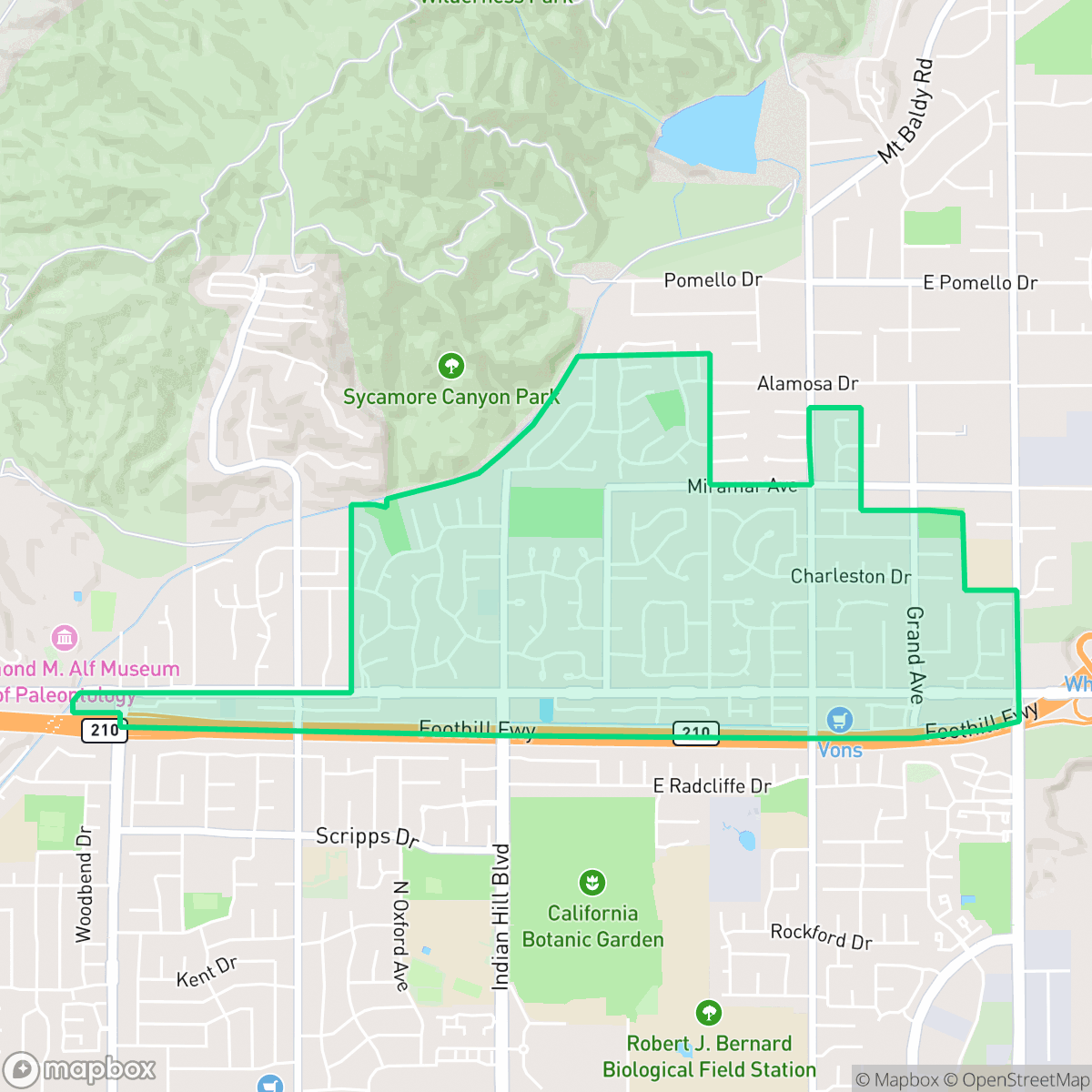
About North Claremont
North Claremont’s history is rooted in early 20th-century agriculture and mid-century architectural innovation. In 1903, Lee C. Pitzer became the area's first citrus grower, later constructing a landmark 1912 stone bungalow designed by Robert Orr. In the late 1920s, Herman Garner and local citizens established Padua Hills, a 2,000-acre artist colony at the base of the San Gabriel Mountains. This neighborhood became home to prominent artists like Millard Sheets and Harrison McIntosh, and features the historic Spanish Revival-style Padua Hills Theatre, which hosted the nation's longest-running Mexican-themed musical theater from 1931 to 1974. To the west, the Claraboya subdivision emerged in the 1960s as Claremont's premier hillside development, designed by architects Fred W. McDowell and Theodore Criley Jr. with custom, flat-roofed mid-century modern homes integrated into the mountain terrain.
The neighborhood is characterized by its quiet, residential atmosphere and proximity to expansive open green spaces. It maintains a balance between suburban living and rural charm, with almost no industrial presence in the immediate vicinity. The area is visually striking, featuring custom homes integrated into the mountain landscape that contribute to its unique aesthetic and high visual appeal score. Residents enjoy some of the best air quality in the region, making it an attractive location for those who prioritize a clean environment and natural beauty.
Living in this area requires a vehicle, as the neighborhood is not highly walkable and offers few local businesses. While it benefits from the high-performing Claremont Unified School District, potential residents should be aware of the notably high noise levels from road traffic and the significant fire safety risks associated with the hillside location. The area is best suited for those who prioritize scenic views and a tranquil, low-density setting over the convenience of urban amenities.
Neighborhood Scores Across 15 Qualities
Residential spacing offers a moderate level of separation between properties, which is slightly higher than the average for Claremont. According to iHuus data, neighbors are positioned with some buffer, though density remains mixed throughout the area.
Safe crossings and established sidewalks make navigating the area on foot easy, though walkability is slightly lower than the Claremont average according to iHuus data.
Large residences and premium amenities create an environment that is more visually polished than the Claremont average. According to iHuus data, the area features spacious driveways and well-maintained landscapes.
Connected green spaces and wide, traffic-safe paths make this area slightly more dog-friendly than the Claremont average, according to iHuus data.
Large tracts of undeveloped natural scrubland and significant tree canopy provide a semi-rural atmosphere that is slightly more open than the Claremont average. Some areas of the neighborhood transition from dense suburban estates into industrial quarry zones and utility land.
Residential life here is primarily characterized by a calm, suburban atmosphere with limited commercial activity. According to iHuus data, the area lacks the concentrated social energy found in other parts of the city, as most daily errands require a vehicle due to the low density of local businesses.
Frequent noise from nearby railroad tracks and freeway traffic makes this area significantly louder than the Claremont average. According to iHuus data, residents can expect consistent acoustic disturbances throughout the day.
Air quality is exceptionally clean and remains slightly higher than the Claremont average. According to iHuus data, residents can expect very low levels of pollution and minimal health concerns related to air particulates.
Industrial presence is minimal, making this area significantly cleaner and quieter than the Claremont average. While a large quarry operation on the eastern edge introduces some dust and noise potential, the neighborhood remains overwhelmingly residential.
Health insurance accessibility is very high among residents, appearing notably higher than the average for the city of Claremont according to iHuus data.
Political leanings in this area are largely liberal, though the community maintains a more moderate profile than the broader Claremont area according to iHuus data.
Residents live alongside a balanced variety of young adults, families, and older individuals. This demographic distribution is slightly more varied than the average found across the rest of Claremont.
Residual flood risk exists within this area as it sits within a 500-year floodplain, though safety levels are notably higher than the Claremont average according to iHuus data.
Extreme fire hazards are present in this area, representing a significantly higher risk than the Claremont average. According to iHuus data, residents must prioritize maximum protection and emergency preparedness measures.
Address-Level Insights for North Claremont


iHuus Neighborhood Intelligence Insights
Get address-level neighborhood insights for North Claremont
- Street-level scores — see how individual blocks compare, not just neighborhood averages
- Micro-zone boundaries — identify quiet pockets, flood boundaries, and walkable clusters before you visit
- 15 dimensions in full — walkability, noise, air quality, school quality, insurance coverage, population age profile, urban/rural index, and more
- Boundary risk alerts — know if your address sits near a block boundary where scores drop, the kind of detail no listing will ever mention
- School insights — individual school ratings and insights, not just district-level data
- Compare before you commit — side-by-side data across neighborhoods, down to block precision
No credit card required
Compare with Any Neighborhood
| Dimension | North Claremont | Arbol Verde |
|---|---|---|
| 🚶 Walkabilityavg 8.6 | ||
| 🔊 Acoustic Comfortavg 2.58 | ||
| 🤫 Privacy Indexavg 5.58 | ||
| 🎨 Visual Appealavg 7.17 | ||
| 🐕 Dog Friendlinessavg 6.82 | ||
| 🗺️ Urban-Rural Indexavg 6.89 | ||
| ✨ Neighborhood Vibeavg 4.64 | ||
| 🏥 Health Insurance Coverageavg 8.37 | ||
| 🌿 Air Qualityavg 9.85 | ||
| 🏭 Industrial Proximityavg 8.67 | ||
| 🌊 Flood Safetyavg 3.81 | ||
| 🗳️ Ideological Leanavg 8.75 | ||
| 👥 Population Age Profileavg 5.03 | ||
| 🔥 Fire Safetyavg 0.41 | ||
| 🏫 School Quality |
North Claremont Rankings
School Districts Serving North Claremont
School Insights for North Claremont
Below average outcomes; significant attendance and academic challenges.
School Insights
See what's really behind every school rating near North Claremont
- Individual school ratings — each school's own score with outcome context, not just a district average
- Enrollment & class size data — student-to-teacher ratio and how it compares to the state average
- Full demographics breakdown — ethnicity and gender composition for every school in the enrollment zone
- Every school in the district — all schools within the enrollment boundary ranked by rating, not just the closest one
- Grade levels & benchmarks — elementary through high school, with below/above state-average flags
No credit card required