Mountain View, Claremont
Updated · 1,338 residents
Mountain View is an exceptionally walkable residential enclave known for its high concentration of mid-century homes and proximity to local dining hubs. While the area offers a vibrant atmosphere and easy access to community parks, residents should note that road traffic noise is a persistent feature of the local environment.
Key Highlights
About Mountain View
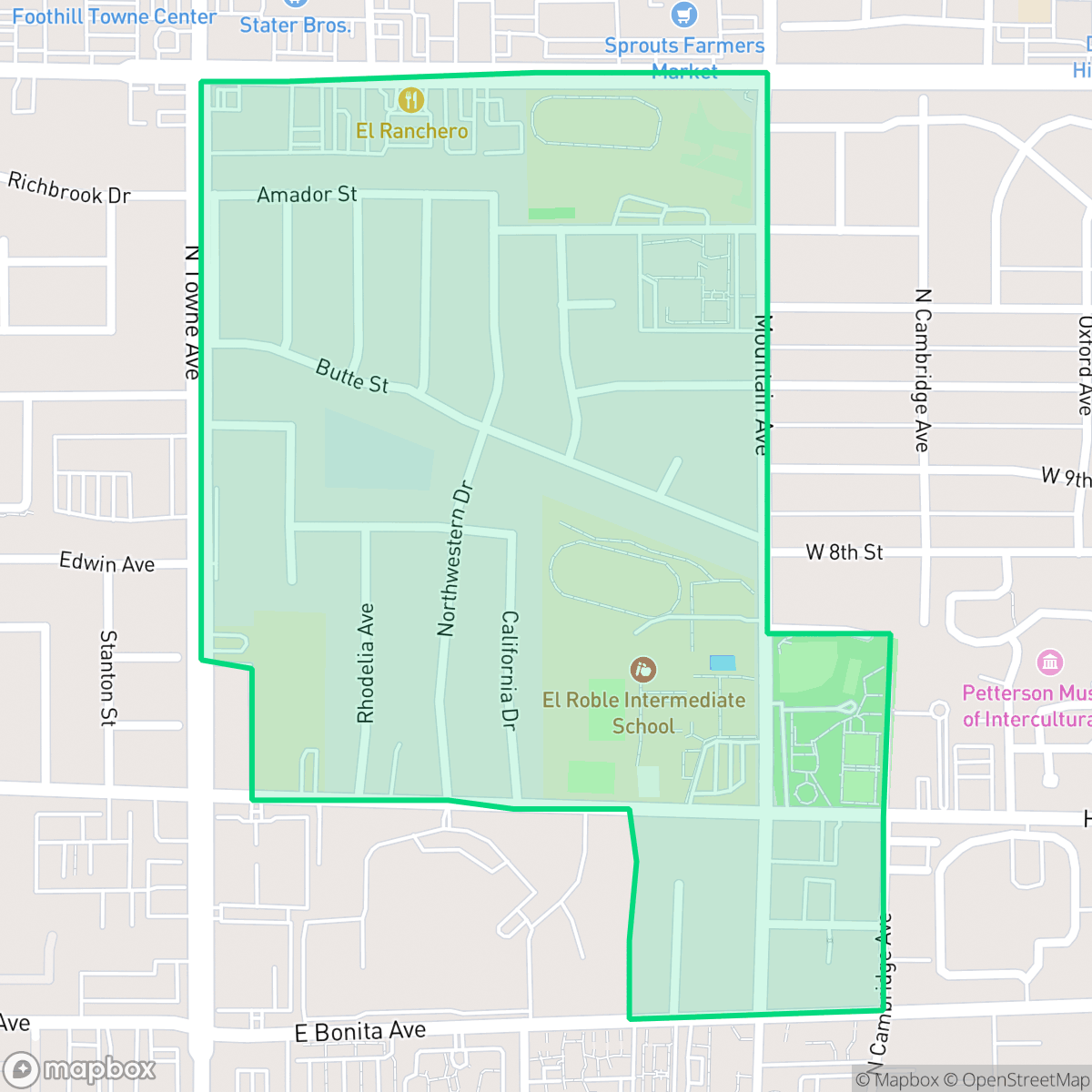
Located south of Foothill Boulevard in Claremont, California, the Mountain View neighborhood is a mid-century residential community named after Mountain View Elementary School. Developed primarily in the mid-1950s, the neighborhood is architecturally distinguished from other local tracts of its era by its unusually high concentration of two-story homes. A defining geographic feature is Butte Street, which cuts diagonally through the community to connect Eighth Street, Towne Avenue, and Mountain Avenue. In addition to its namesake elementary school, Mountain View is home to El Roble Intermediate School—Claremont's only public middle school—and the private Foothill Country Day School. The neighborhood centers around Larkin Park, a popular local public space, making it a highly recognizable and cohesive residential pocket within the city.
The neighborhood functions as a central residential hub, characterized by its high walkability and proximity to amenities like Sanctuary Coffee and various dining establishments. According to iHuus data, the area maintains a distinctively lively vibe compared to the broader Claremont city average, supported by the presence of Larkin Park and a high density of residential properties. Its layout encourages pedestrian activity, making it a convenient option for those who prioritize accessibility to local services and public spaces. Prospective residents should consider the trade-offs associated with the location, specifically regarding acoustic comfort. The neighborhood experiences notable road traffic noise, which is a factor for those sensitive to sound. Additionally, while the community benefits from excellent air quality and high health insurance coverage, it faces challenges regarding fire safety. Families may find the area appealing due to the proximity of El Roble Intermediate School, though it is important to weigh the performance metrics of the Claremont Unified School District against personal educational priorities.
Neighborhood Scores Across 15 Qualities
Residential spacing offers a moderate level of buffer between neighbors, which is slightly higher than the Claremont average. Property layouts vary between detached single-family homes and denser multi-unit clusters according to iHuus data.
Continuous sidewalks and dedicated pedestrian paths are available on most streets and through residential complexes. This network offers slightly better connectivity for pedestrians than the average area in Claremont.
Large, well-maintained properties and frequent private backyard pools characterize much of this area; however, the overall visual appeal is slightly below the Claremont average due to pockets of higher density housing and standard tract developments. According to iHuus data, the northeast section features more prominent upscale amenities and expansive driveways.
Public park access and green spaces are somewhat limited compared to the Claremont average. While certain areas near the northwest quadrant offer excellent field access, other parts of the neighborhood rely primarily on private yards and narrow street verges.
Residential pockets feature a blend of single-family homes and apartment complexes alongside commercial zones. This landscape is slightly less open than the typical Claremont area, characterized by established suburban density rather than widespread open land.
A steady mix of residential streets, light industrial zones, and local dining establishments creates a functional environment that is slightly more active than the Claremont average. Residents can access various services and green spaces, though the area maintains a primarily calm, suburban character.
Steady noise from nearby busy streets is present, though the acoustic environment remains notably calmer than the average for Claremont. According to iHuus data, residents may experience a consistent level of ambient traffic sound.
Air quality remains consistently high with negligible health concerns for residents. According to iHuus data, these levels are slightly better than the average found throughout Claremont.
Light commercial activity and warehouse structures are concentrated near the southern railway corridor, making the area slightly more industrial than the Claremont average. Most streets remain predominantly residential with quiet, open green spaces.
Health insurance access is high among residents, though slightly below the average for the city of Claremont. According to iHuus data, a significant majority of the population maintains coverage.
Voting patterns and census indicators reflect a predominantly liberal community, which is more pronounced here than in the rest of Claremont. According to iHuus data, this area maintains a highly progressive ideological lean.
Residents live among a balanced mix of young adults, families, and older adults. According to iHuus data, this demographic spread is more diverse than the typical Claremont age profile.
Located within a documented floodplain, this area faces a significantly higher risk of flooding than most of Claremont. According to iHuus data, residents should expect a heightened need for flood insurance and preparedness.
Address-Level Insights for Mountain View


iHuus Neighborhood Intelligence Insights
Get address-level neighborhood insights for Mountain View
- Street-level scores — see how individual blocks compare, not just neighborhood averages
- Micro-zone boundaries — identify quiet pockets, flood boundaries, and walkable clusters before you visit
- 15 dimensions in full — walkability, noise, air quality, school quality, insurance coverage, population age profile, urban/rural index, and more
- Boundary risk alerts — know if your address sits near a block boundary where scores drop, the kind of detail no listing will ever mention
- School insights — individual school ratings and insights, not just district-level data
- Compare before you commit — side-by-side data across neighborhoods, down to block precision
No credit card required
Compare with Any Neighborhood
| Dimension | Mountain View | Arbol Verde |
|---|---|---|
| 🚶 Walkabilityavg 8.6 | ||
| 🔊 Acoustic Comfortavg 2.58 | ||
| 🤫 Privacy Indexavg 5.58 | ||
| 🎨 Visual Appealavg 7.17 | ||
| 🐕 Dog Friendlinessavg 6.82 | ||
| 🗺️ Urban-Rural Indexavg 6.89 | ||
| ✨ Neighborhood Vibeavg 4.64 | ||
| 🏥 Health Insurance Coverageavg 8.37 | ||
| 🌿 Air Qualityavg 9.85 | ||
| 🏭 Industrial Proximityavg 8.67 | ||
| 🌊 Flood Safetyavg 3.81 | ||
| 🗳️ Ideological Leanavg 8.75 | ||
| 👥 Population Age Profileavg 5.03 | ||
| 🔥 Fire Safetyavg 0.41 | ||
| 🏫 School Quality |
Mountain View Rankings
School Districts Serving Mountain View
School Insights for Mountain View
Below average outcomes; significant attendance and academic challenges.
School Insights
See what's really behind every school rating near Mountain View
- Individual school ratings — each school's own score with outcome context, not just a district average
- Enrollment & class size data — student-to-teacher ratio and how it compares to the state average
- Full demographics breakdown — ethnicity and gender composition for every school in the enrollment zone
- Every school in the district — all schools within the enrollment boundary ranked by rating, not just the closest one
- Grade levels & benchmarks — elementary through high school, with below/above state-average flags
No credit card required