Historic Claremont, Claremont
Updated · 1,099 residents
Historic Claremont is defined by its exceptional walkability and vibrant local atmosphere, featuring a mix of established dining and community gathering spots. While the area offers high air quality and strong health insurance coverage, residents should note the significant road traffic noise and elevated fire safety risks.
Key Highlights
About Historic Claremont
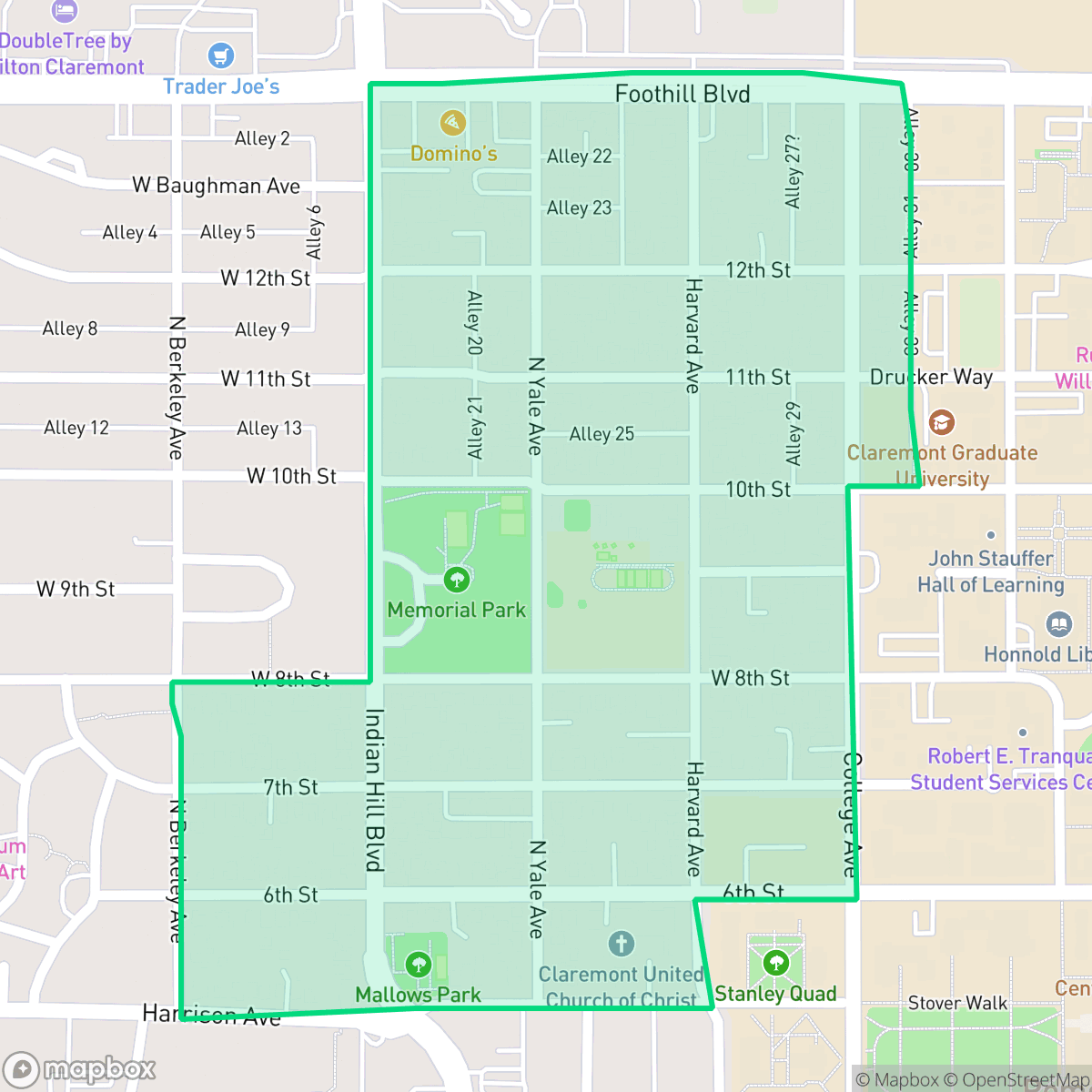
The Historic Claremont neighborhood, situated in Claremont, California, represents the city’s early residential core. It is generally bounded by Foothill Boulevard, College Avenue, Harrison Avenue, Eighth Street, and Berkeley Avenue. Developing alongside the Santa Fe Railroad and Pomona College in the late 19th and early 20th centuries, the neighborhood is renowned for its diverse, well-preserved architectural styles. Notable homes include the 1903 Mary R. Darling House, a Swiss Chalet-style bungalow that was architects Greene & Greene’s first major commission outside Pasadena, and a classic 1895 American Foursquare. The neighborhood also features Memorial Park, home to the 1926 Spanish Colonial Revival Garner House, which serves as the headquarters for the local preservation organization, Claremont Heritage.
The neighborhood functions as a highly accessible urban hub where residents can easily reach local markets like Wolfe's Market and various dining establishments on foot. This walkability contributes to a lively, engaged community atmosphere that benefits from proximity to academic and cultural institutions. According to data, the area maintains a high level of health insurance coverage and excellent air quality, supporting a healthy lifestyle for its inhabitants. Prospective residents should consider that the neighborhood experiences notable noise levels, primarily due to consistent road traffic. Additionally, while the area is well-regarded for its educational opportunities, including the top-rated Sycamore Elementary, it faces significant challenges regarding fire safety. This location is best suited for those who prioritize a walkable, socially active environment and are prepared to manage the specific environmental and acoustic trade-offs inherent to this central part of the city.
Neighborhood Scores Across 15 Qualities
Residential spacing provides a modest buffer between neighbors, though apartment clusters feature closer proximity than the single-family homes near the central park. This level of privacy is slightly higher than the Claremont city average according to iHuus data.
Pedestrian-oriented streets and a dense sidewalk network make navigating the area on foot easy. This neighborhood offers superior connectivity and more accessible crossings than the Claremont average.
Large, well-kept properties and a high density of private pools contribute to a visual landscape that is more polished than the Claremont average. According to iHuus data, the area features prominent greenery and substantial residential lots throughout the northeast section.
Abundant green spaces and wide, connected trails offer much better access for walking dogs than the Claremont average. Large public parks and extensive campus greenery provide safe, traffic-free areas for pets to roam.
Frequent open land and large central natural spaces provide a more semi-rural atmosphere than the typical Claremont suburban landscape. This mix of woodland and scattered homes offers more open space than the city average, according to iHuus data.
Local dining, coffee shops, and cultural hubs provide a noticeably higher level of activity and social variety than the Claremont average. Residents have access to a diverse mix of social spaces, including parks and dining near the railway and local museums.
Ongoing noise from nearby busy streets creates a consistent ambient sound, though acoustic levels remain more favorable than the Claremont average.
Air quality remains consistently high with minimal health concerns for residents. According to iHuus data, levels in this neighborhood are slightly cleaner than the Claremont average.
Industrial activity is virtually non-existent in this area, as the neighborhood consists primarily of residential, educational, and natural land uses. According to iHuus data, the area maintains a higher level of separation from warehouses and hazardous sites than the rest of the city.
Health insurance access is exceptionally high among residents, surpassing the average found throughout the city. According to iHuus data, the vast majority of the population is covered.
Voting patterns and census indicators show a predominantly liberal leaning that is more pronounced than the Claremont city average, according to iHuus data.
A balanced mix of young adults, families, and older residents characterizes the area, reflecting a demographic profile that is nearly identical to the Claremont average.
Flood risk in this area is consistent with the city average, as portions of the neighborhood fall within a designated floodplain. Residents may find that flood insurance is typically required for properties in these zones according to iHuus data.
Address-Level Insights for Historic Claremont


iHuus Neighborhood Intelligence Insights
Get address-level neighborhood insights for Historic Claremont
- Street-level scores — see how individual blocks compare, not just neighborhood averages
- Micro-zone boundaries — identify quiet pockets, flood boundaries, and walkable clusters before you visit
- 15 dimensions in full — walkability, noise, air quality, school quality, insurance coverage, population age profile, urban/rural index, and more
- Boundary risk alerts — know if your address sits near a block boundary where scores drop, the kind of detail no listing will ever mention
- School insights — individual school ratings and insights, not just district-level data
- Compare before you commit — side-by-side data across neighborhoods, down to block precision
No credit card required
Compare with Any Neighborhood
| Dimension | Historic Claremont | Arbol Verde |
|---|---|---|
| 🚶 Walkabilityavg 8.6 | ||
| 🔊 Acoustic Comfortavg 2.58 | ||
| 🤫 Privacy Indexavg 5.58 | ||
| 🎨 Visual Appealavg 7.17 | ||
| 🐕 Dog Friendlinessavg 6.82 | ||
| 🗺️ Urban-Rural Indexavg 6.89 | ||
| ✨ Neighborhood Vibeavg 4.64 | ||
| 🏥 Health Insurance Coverageavg 8.37 | ||
| 🌿 Air Qualityavg 9.85 | ||
| 🏭 Industrial Proximityavg 8.67 | ||
| 🌊 Flood Safetyavg 3.81 | ||
| 🗳️ Ideological Leanavg 8.75 | ||
| 👥 Population Age Profileavg 5.03 | ||
| 🔥 Fire Safetyavg 0.41 | ||
| 🏫 School Quality |
Historic Claremont Rankings
School Districts Serving Historic Claremont
School Insights for Historic Claremont
Below average outcomes; significant attendance and academic challenges.
School Insights
See what's really behind every school rating near Historic Claremont
- Individual school ratings — each school's own score with outcome context, not just a district average
- Enrollment & class size data — student-to-teacher ratio and how it compares to the state average
- Full demographics breakdown — ethnicity and gender composition for every school in the enrollment zone
- Every school in the district — all schools within the enrollment boundary ranked by rating, not just the closest one
- Grade levels & benchmarks — elementary through high school, with below/above state-average flags
No credit card required