Condit, Claremont
Updated · 2,523 residents
Condit is a highly walkable residential neighborhood defined by its mid-century suburban layout and proximity to expansive local parks. While the area offers excellent air quality and convenient access to community amenities, residents should be aware of significant ambient noise levels resulting from nearby highway traffic.
Key Highlights
About Condit
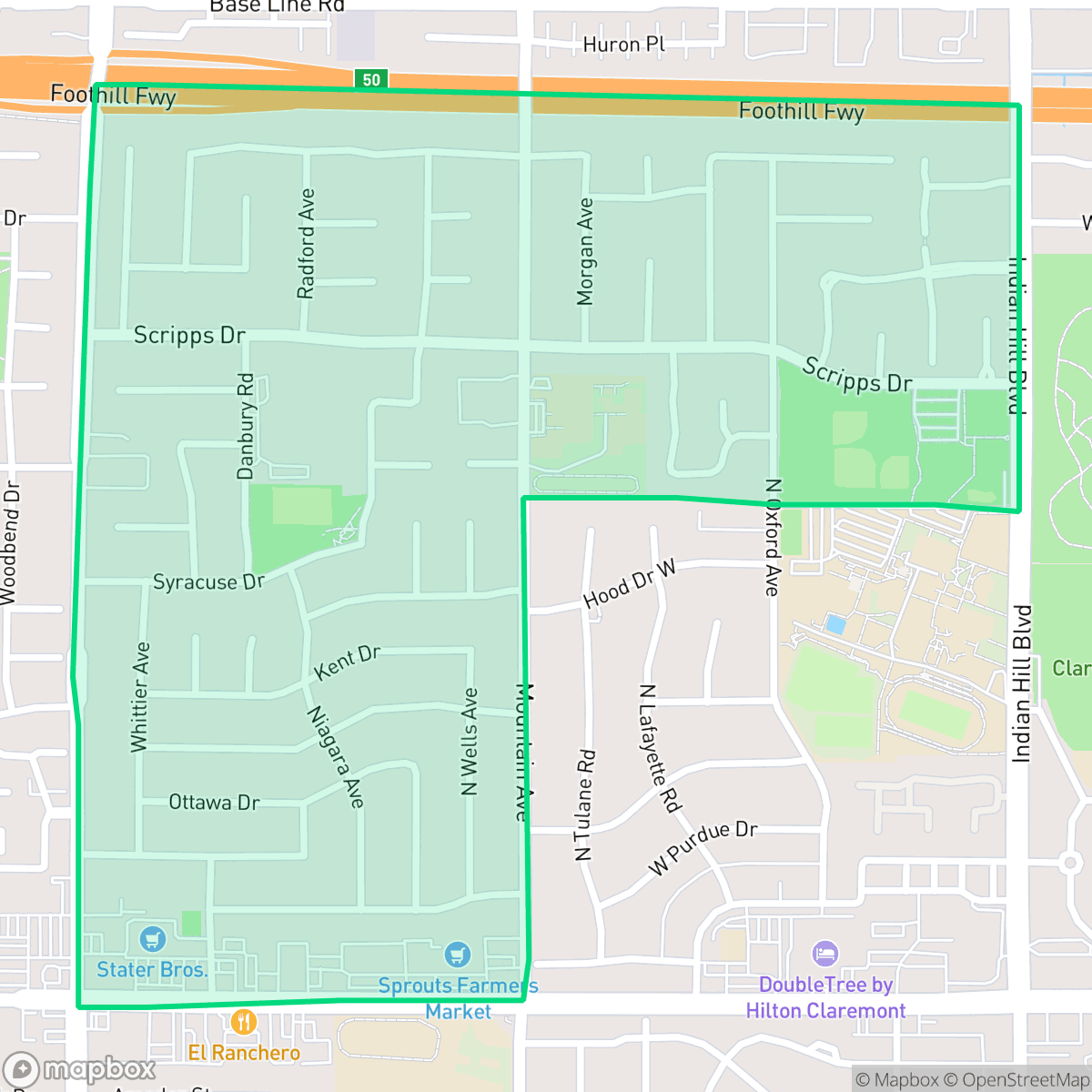
The Condit neighborhood in Claremont, California, is a suburban residential district bounded by the 210 Freeway, Foothill Boulevard, Indian Hill Boulevard, and Towne Avenue. Developed primarily by Lewis Homes during the 1960s and 1970s, the neighborhood features mid-century single-family homes arranged along long blocks and cul-de-sacs. The area is centered around Condit Elementary School, which opened in 1958 and was named in honor of Eleanor Daly Condit, a pioneering local educator who worked to desegregate Claremont’s classrooms. Key community landmarks within the neighborhood include Cahuilla Park, established in 1971 as Claremont's largest developed park, and the Alexander Hughes Community Center, which represents the adaptive reuse of a former elementary school.
The neighborhood is characterized by a consistent suburban aesthetic, featuring long residential blocks and cul-de-sacs that foster a pedestrian-friendly environment. With top-tier air quality and a lack of industrial activity, the area provides a clean, residential atmosphere. Its central location makes it easy for residents to access local schools and public green spaces, including the extensive facilities at Cahuilla Park and the Alexander Hughes Community Center.
Prospective residents should consider the trade-offs of this location, particularly regarding acoustic comfort. Due to its proximity to major transportation corridors, the area experiences elevated noise levels from road traffic. Additionally, while the neighborhood is well-suited for families seeking stable school districts and walkable streets, it is important to note the local fire safety profile, which requires proactive awareness from homeowners. The area is best suited for those who prioritize walkability and community access over a quiet environment.
Neighborhood Scores Across 15 Qualities
Residential spacing provides a moderate level of separation between homes, offering slightly more buffer between neighbors than the Claremont average. Most properties feature private fenced backyards and standard suburban distances between structures.
Pedestrians benefit from continuous sidewalks on both sides of residential streets and well-marked crossings. This area offers superior walkability compared to the Claremont average.
Large, well-maintained homes and frequent private amenities like backyard pools contribute to a visual landscape that is more polished than the Claremont average. According to iHuus data, the area features spacious driveways and an overall high level of manicured greenery.
Wide residential verges and connected green spaces provide ample room for walking pets. According to iHuus data, the availability of park and school fields in the northeast corner makes this area slightly more dog friendly than the Claremont average.
Residential areas feature a mix of single-family homes and commercial centers, mirroring the overall landscape found across Claremont. While some pockets maintain a semi-rural feel with open land, the area primarily consists of developed suburban blocks according to iHuus data.
Suburban streets and green spaces dominate the landscape, offering a calmer rhythm than the Claremont average. While some pockets near Larkin Park provide accessible dining and coffee, much of the area is characterized by low-density residential blocks and limited social hubs.
Frequent acoustic disturbances from nearby railroad tracks and major freeways characterize this area. According to iHuus data, noise levels are slightly higher than the average for Claremont.
Air quality in this area is exceptionally high, staying slightly above the Claremont average. Residents can expect very clear conditions with minimal pollution-related health concerns, according to iHuus data.
Residential streets and open green spaces dominate the area, with very few industrial or warehouse facilities detected. While some commercial structures to the south may introduce moderate traffic, the neighborhood remains slightly more free of industrial proximity than the Claremont average according to iHuus data.
Health insurance access is exceptionally high among residents, significantly outpacing the Claremont city average according to iHuus data.
Political leanings in this area are predominantly liberal, though this is slightly less pronounced than the average seen across Claremont.
Residents live alongside a balanced mix of young adults, families, and older individuals. According to iHuus data, this age distribution is slightly more varied than the Claremont average.
Flood risk levels in this area are currently undetermined because FEMA has not completed a detailed study for this neighborhood. According to iHuus data, the local risk appears higher than the average for Claremont.
Address-Level Insights for Condit


iHuus Neighborhood Intelligence Insights
Get address-level neighborhood insights for Condit
- Street-level scores — see how individual blocks compare, not just neighborhood averages
- Micro-zone boundaries — identify quiet pockets, flood boundaries, and walkable clusters before you visit
- 15 dimensions in full — walkability, noise, air quality, school quality, insurance coverage, population age profile, urban/rural index, and more
- Boundary risk alerts — know if your address sits near a block boundary where scores drop, the kind of detail no listing will ever mention
- School insights — individual school ratings and insights, not just district-level data
- Compare before you commit — side-by-side data across neighborhoods, down to block precision
No credit card required
Compare with Any Neighborhood
| Dimension | Condit | Arbol Verde |
|---|---|---|
| 🚶 Walkabilityavg 8.6 | ||
| 🔊 Acoustic Comfortavg 2.58 | ||
| 🤫 Privacy Indexavg 5.58 | ||
| 🎨 Visual Appealavg 7.17 | ||
| 🐕 Dog Friendlinessavg 6.82 | ||
| 🗺️ Urban-Rural Indexavg 6.89 | ||
| ✨ Neighborhood Vibeavg 4.64 | ||
| 🏥 Health Insurance Coverageavg 8.37 | ||
| 🌿 Air Qualityavg 9.85 | ||
| 🏭 Industrial Proximityavg 8.67 | ||
| 🌊 Flood Safetyavg 3.81 | ||
| 🗳️ Ideological Leanavg 8.75 | ||
| 👥 Population Age Profileavg 5.03 | ||
| 🔥 Fire Safetyavg 0.41 | ||
| 🏫 School Quality |
Condit Rankings
School Districts Serving Condit
School Insights for Condit
Below average outcomes; significant attendance and academic challenges.
School Insights
See what's really behind every school rating near Condit
- Individual school ratings — each school's own score with outcome context, not just a district average
- Enrollment & class size data — student-to-teacher ratio and how it compares to the state average
- Full demographics breakdown — ethnicity and gender composition for every school in the enrollment zone
- Every school in the district — all schools within the enrollment boundary ranked by rating, not just the closest one
- Grade levels & benchmarks — elementary through high school, with below/above state-average flags
No credit card required