Chaparral, Claremont
Updated · 1,802 residents
Chaparral is a quiet, highly walkable residential community in Claremont defined by its mid-century suburban layout and proximity to local green spaces. While the area offers excellent air quality and access to top-rated schools, residents should be prepared for significant noise levels resulting from nearby highway traffic.
Key Highlights
About Chaparral
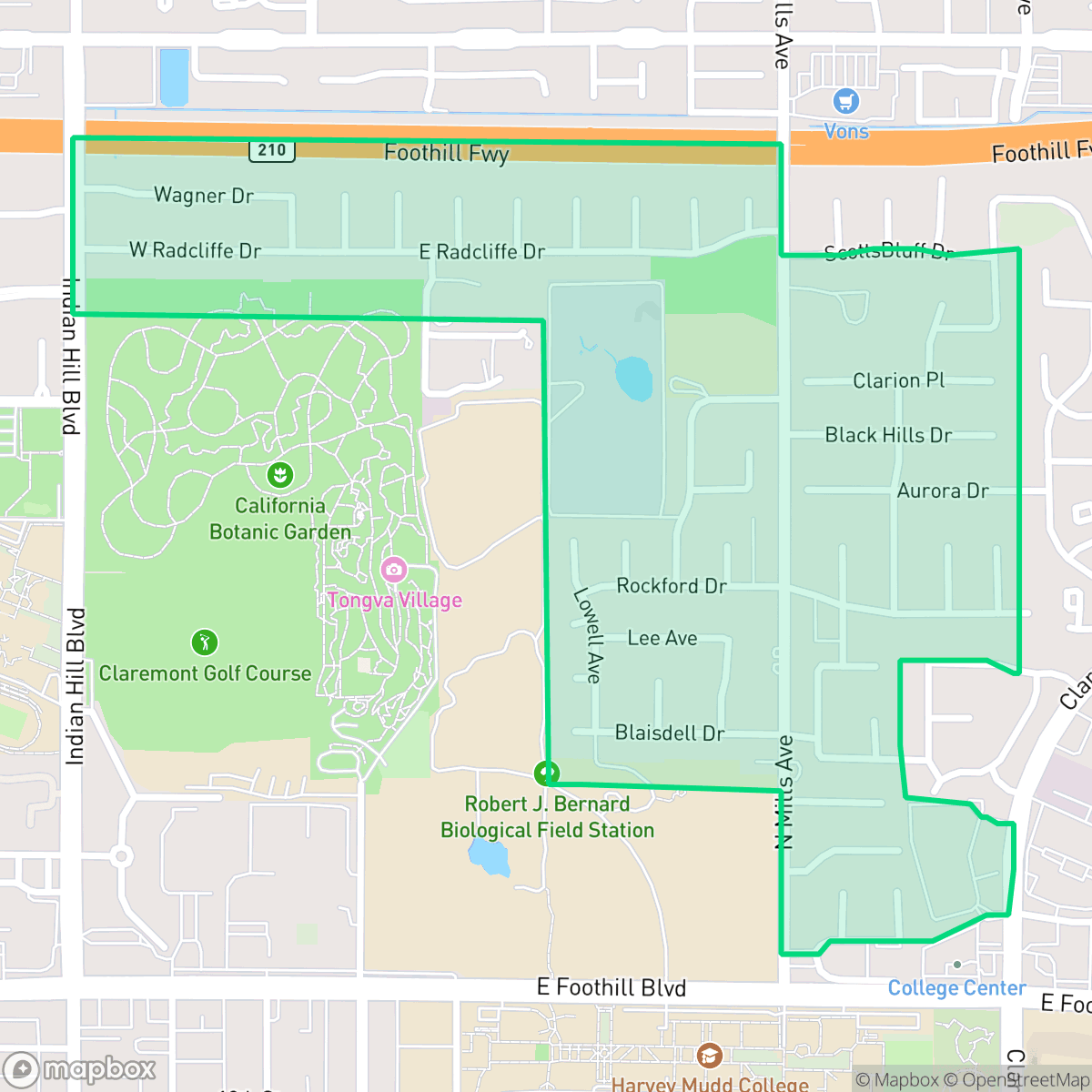
The Chaparral neighborhood in Claremont, California, is a suburban residential enclave developed primarily by Lewis Homes during the 1960s and 1970s. Characterized by a conventional suburban layout of cul-de-sacs feeding into collector streets, the neighborhood features one- and two-story single-family homes alongside the Padua Terrace and Brighton Park apartments. At the heart of the community are Chaparral Elementary School, which opened its original facilities in 1964, and the adjacent three-acre Chaparral Park. The land for the park was acquired using funds from a 1963 park bond approved by Claremont voters, and the park itself was established in 1976 to provide passive recreation space for the surrounding neighborhood.
The neighborhood maintains a consistent suburban character, defined by its conventional layout of cul-de-sacs and quiet residential streets. It is a highly accessible area for pedestrians, consistently ranking among the most walkable parts of the city. Residents benefit from exceptional air quality and near-universal health insurance coverage, contributing to a stable, family-oriented environment. The presence of highly rated local education facilities further cements the area as a destination for those prioritizing academic access and community-focused living.
Despite these benefits, the area presents specific livability trade-offs. The proximity to a major highway results in elevated noise levels, which may impact those sensitive to acoustic disturbances. The neighborhood lacks a diverse commercial core, with few local businesses beyond a single dining option, necessitating travel for most retail needs. Furthermore, prospective residents should be aware of elevated environmental risks, specifically regarding flood and fire safety, which are important considerations for property stability in this region.
Neighborhood Scores Across 15 Qualities
Residential spacing offers a moderate buffer between neighbors, which is slightly higher than the Claremont average. According to iHuus data, larger gaps between structures are particularly noticeable around campus buildings and the central park.
Pedestrian-friendly infrastructure, including wide sidewalks on both sides of the street and clear crossings, makes navigating the area on foot easy. This level of walkability is slightly above the Claremont average according to iHuus data.
Manicured lawns, private pools, and large residential estates define the local landscape. This area offers a more polished aesthetic than the Claremont average, according to iHuus data.
Extensive campus greenery and interconnected natural trails provide ample space for pets. According to iHuus data, the availability of wide, traffic-safe paths is notably higher than the Claremont average.
Open natural spaces and scattered residential pockets create a more rural feel than the Claremont average. According to iHuus data, the area features a low-density mix of institutional and residential uses situated around a large central natural area.
Residential blocks are primarily characterized by low-density greenery and limited commercial activity. This area offers a more subdued atmosphere than the Claremont average, with social hubs restricted to specific locations like the California Botanic Garden or scattered wellness spots.
Frequent aircraft noise from the nearby airport runway is a constant presence in this area. According to iHuus data, acoustic comfort is significantly lower than the Claremont average.
Air quality in this area is exceptionally clean, remaining slightly above the Claremont average. Residents can expect very low levels of pollutants and minimal health concerns related to air particulate matter.
Industrial activity is absent from this area, which consists solely of residential, educational, and natural land uses. According to iHuus data, this neighborhood offers a higher level of separation from warehouses and manufacturing sites than the city average.
Health insurance accessibility is exceptionally high among residents, remaining significantly above the Claremont average according to iHuus data.
Political leanings in this area are predominantly liberal, aligning closely with the broader trends seen throughout Claremont. According to iHuus data, a moderate conservative presence exists alongside the liberal majority.
A varied demographic of young adults, families, and seniors resides here, representing a slightly more diverse age distribution than the Claremont average according to iHuus data.
Properties in this area are located within a designated floodplain, which may necessitate the purchase of flood insurance. According to iHuus data, the risk level here is slightly higher than the average for Claremont.
Wildfire hazards in this area are exceptionally high, reflecting a level of danger that is slightly above the Claremont average. Residents should remain vigilant and ensure all necessary emergency preparedness measures are in place according to iHuus data.
Address-Level Insights for Chaparral


iHuus Neighborhood Intelligence Insights
Get address-level neighborhood insights for Chaparral
- Street-level scores — see how individual blocks compare, not just neighborhood averages
- Micro-zone boundaries — identify quiet pockets, flood boundaries, and walkable clusters before you visit
- 15 dimensions in full — walkability, noise, air quality, school quality, insurance coverage, population age profile, urban/rural index, and more
- Boundary risk alerts — know if your address sits near a block boundary where scores drop, the kind of detail no listing will ever mention
- School insights — individual school ratings and insights, not just district-level data
- Compare before you commit — side-by-side data across neighborhoods, down to block precision
No credit card required
Compare with Any Neighborhood
| Dimension | Chaparral | Arbol Verde |
|---|---|---|
| 🚶 Walkabilityavg 8.6 | ||
| 🔊 Acoustic Comfortavg 2.58 | ||
| 🤫 Privacy Indexavg 5.58 | ||
| 🎨 Visual Appealavg 7.17 | ||
| 🐕 Dog Friendlinessavg 6.82 | ||
| 🗺️ Urban-Rural Indexavg 6.89 | ||
| ✨ Neighborhood Vibeavg 4.64 | ||
| 🏥 Health Insurance Coverageavg 8.37 | ||
| 🌿 Air Qualityavg 9.85 | ||
| 🏭 Industrial Proximityavg 8.67 | ||
| 🌊 Flood Safetyavg 3.81 | ||
| 🗳️ Ideological Leanavg 8.75 | ||
| 👥 Population Age Profileavg 5.03 | ||
| 🔥 Fire Safetyavg 0.41 | ||
| 🏫 School Quality |
Chaparral Rankings
School Districts Serving Chaparral
School Insights for Chaparral
Below average outcomes; significant attendance and academic challenges.
School Insights
See what's really behind every school rating near Chaparral
- Individual school ratings — each school's own score with outcome context, not just a district average
- Enrollment & class size data — student-to-teacher ratio and how it compares to the state average
- Full demographics breakdown — ethnicity and gender composition for every school in the enrollment zone
- Every school in the district — all schools within the enrollment boundary ranked by rating, not just the closest one
- Grade levels & benchmarks — elementary through high school, with below/above state-average flags
No credit card required