Santa Rita, San Angelo
Updated · 5,177 residents
Santa Rita is defined by its historic architecture and mature, tree-lined streets that provide a distinct visual character within San Angelo. According to iHuus data, the neighborhood features above-average walkability and a more vibrant social atmosphere than the citywide norm, offering a stable residential environment.
Key Highlights
About Santa Rita
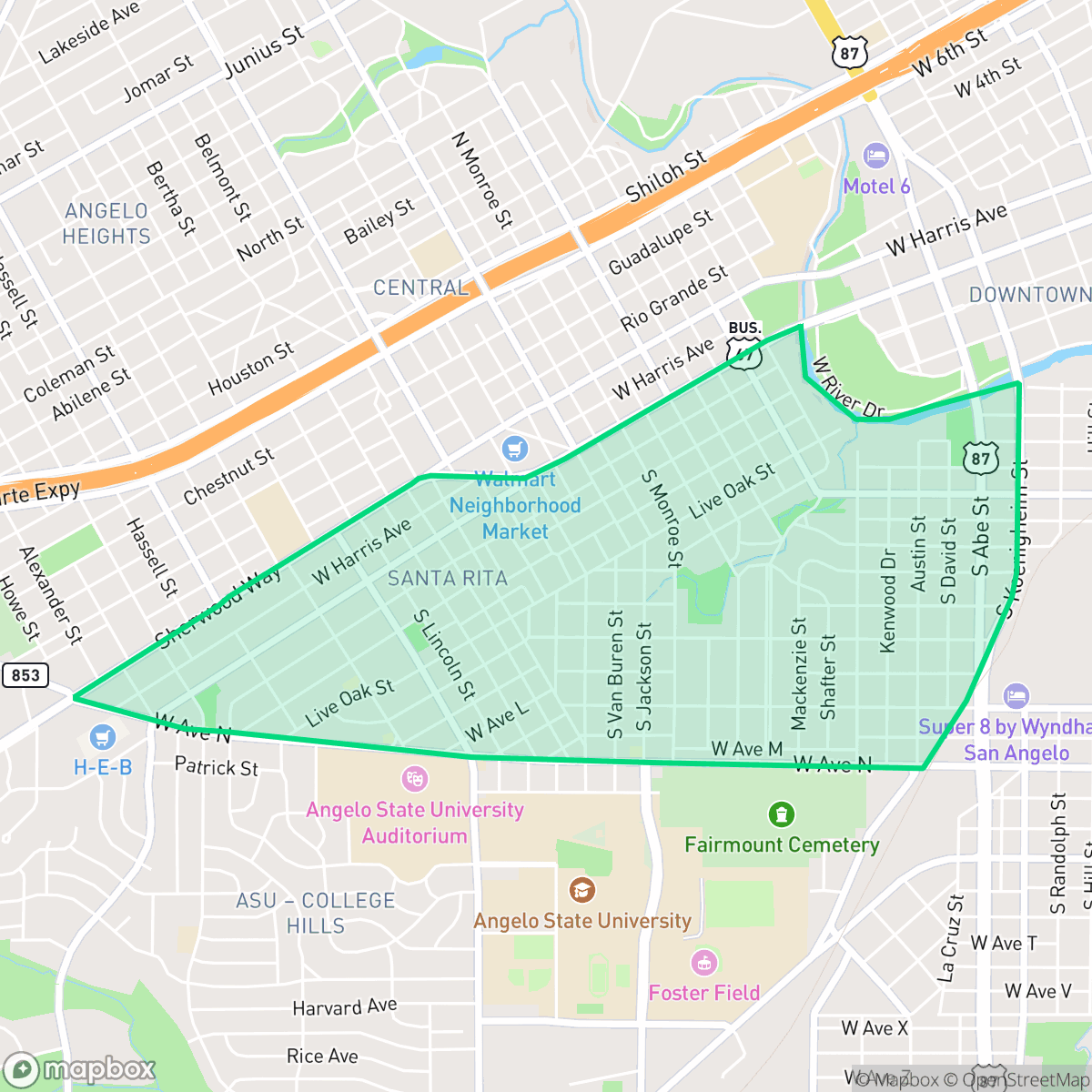
Established in the 1920s as San Angelo expanded westward across the Concho River, the historic Santa Rita neighborhood was named in honor of the Santa Rita No. 1 oil rig, the famous 1923 West Texas oil strike. The neighborhood is celebrated for its tree-lined streets and eclectic architectural character, featuring a mix of grand historic mansions and cozy bungalows locally known as "Santa Rita charmers". Key local landmarks include Santa Rita Park, located at the corner of Jefferson and Madison Streets, and the historic Santa Rita Elementary School, which opened in 1927. This quiet, highly desirable residential area remains one of San Angelo's most iconic and culturally distinct neighborhoods, blending historic preservation with a strong sense of community.
The neighborhood maintains a balance between quiet residential blocks and pockets of local activity. Residents have access to a variety of dining options and cultural landmarks, such as the Mayer Museum, which contribute to a more active local vibe than is typical for the surrounding city. While the area is primarily residential, its proximity to light commercial units and diverse eateries provides convenience without sacrificing the character of its historic streets. The local community benefits from high-performing educational facilities, including Santa Rita Elementary, which stands out for its academic performance within the broader San Angelo Independent School District.
Living in this area involves navigating the trade-offs of a mid-sized suburban environment. While the neighborhood boasts high levels of health insurance coverage and minimal exposure to industrial hazards, residents should expect moderate noise levels primarily generated by road traffic. The broader school district faces challenges related to enrollment and budget, though the local elementary school remains a significant asset. Overall, the area is well-suited for those who value architectural preservation, a sense of community, and a location that performs better than the city average in both visual appeal and pedestrian accessibility, as noted in iHuus data.
Neighborhood Scores Across 15 Qualities
Residential spacing provides a balanced level of separation between neighbors, remaining largely in line with the San Angelo average. According to iHuus data, the area features mixed density with some buffering between adjacent properties.
Low traffic and calm streets allow for easy walking, even though sidewalks are not present throughout the area. This level of walkability is slightly higher than the San Angelo average according to iHuus data.
Standard tract housing with tidy but small yards defines the area. This level of visual interest is slightly above the San Angelo average according to iHuus data.
Opportunities for pet exercise are somewhat restricted due to a lack of direct park access or wide green verges. This level of accessibility is slightly below the average found throughout San Angelo, according to iHuus data.
Frequent open land and scattered homes amid fields or woodland characterize this area, which feels less densely developed than the San Angelo average according to iHuus data.
A mix of calm residential streets and lively commercial pockets provides more activity than the typical San Angelo neighborhood. While diverse dining and local landmarks are accessible, most errands will require a car due to the suburban layout.
Steady sound from nearby busy streets is present, though levels are comparable to the San Angelo average.
Industrial activity is nonexistent here, providing a landscape free of warehouses or hazardous facilities. This area offers a higher level of separation from industrial zones than the San Angelo average according to iHuus data.
Health insurance coverage among residents is higher than the San Angelo average, according to iHuus data. Most people living in this area have access to medical coverage.
Voting patterns and census indicators show a predominantly conservative political leaning, which is consistent with the average seen across San Angelo.
A diverse mix of young adults, families, and seniors resides here, mirroring the general age distribution found across San Angelo. According to iHuus data, this creates a stable demographic profile without a heavy concentration in any single age group.
Flood risk levels in this area are higher than the San Angelo average, though the specific level of danger remains undetermined due to a lack of detailed federal studies. Residents should remain aware of potential seasonal water accumulation according to iHuus data.
Address-Level Insights for Santa Rita


iHuus Neighborhood Intelligence Insights
Get address-level neighborhood insights for Santa Rita
- Street-level scores — see how individual blocks compare, not just neighborhood averages
- Micro-zone boundaries — identify quiet pockets, flood boundaries, and walkable clusters before you visit
- 15 dimensions in full — walkability, noise, air quality, school quality, insurance coverage, population age profile, urban/rural index, and more
- Boundary risk alerts — know if your address sits near a block boundary where scores drop, the kind of detail no listing will ever mention
- School insights — individual school ratings and insights, not just district-level data
- Compare before you commit — side-by-side data across neighborhoods, down to block precision
No credit card required
Compare with Any Neighborhood
| Dimension | Santa Rita | Angelo Heights |
|---|---|---|
| 🚶 Walkabilityavg 5.86 | ||
| 🔊 Acoustic Comfortavg 4.52 | ||
| 🤫 Privacy Indexavg 6.06 | ||
| 🎨 Visual Appealavg 5.61 | ||
| 🐕 Dog Friendlinessavg 5.82 | ||
| 🗺️ Urban-Rural Indexavg 7.3 | ||
| ✨ Neighborhood Vibeavg 4.15 | ||
| 🏥 Health Insurance Coverageavg 6.22 | ||
| 🌿 Air Quality | ||
| 🏭 Industrial Proximityavg 8.42 | ||
| 🌊 Flood Safetyavg 3.02 | ||
| 🗳️ Ideological Leanavg 1.23 | ||
| 👥 Population Age Profileavg 4.73 | ||
| 🔥 Fire Safety | ||
| 🏫 School Quality |
Santa Rita Rankings
School Districts Serving Santa Rita
School Insights for Santa Rita
Below average outcomes; significant attendance and academic challenges.
School Insights
See what's really behind every school rating near Santa Rita
- Individual school ratings — each school's own score with outcome context, not just a district average
- Enrollment & class size data — student-to-teacher ratio and how it compares to the state average
- Full demographics breakdown — ethnicity and gender composition for every school in the enrollment zone
- Every school in the district — all schools within the enrollment boundary ranked by rating, not just the closest one
- Grade levels & benchmarks — elementary through high school, with below/above state-average flags
No credit card required