Reagan, San Angelo
Updated · 5,744 residents
Reagan is a historic residential enclave in northeast San Angelo, characterized by its mid-century housing and a vibrant local dining scene. While the neighborhood offers a calm suburban atmosphere, residents rely on vehicles for daily errands due to its car-dependent layout and proximity to light industrial zones.
Key Highlights
About Reagan
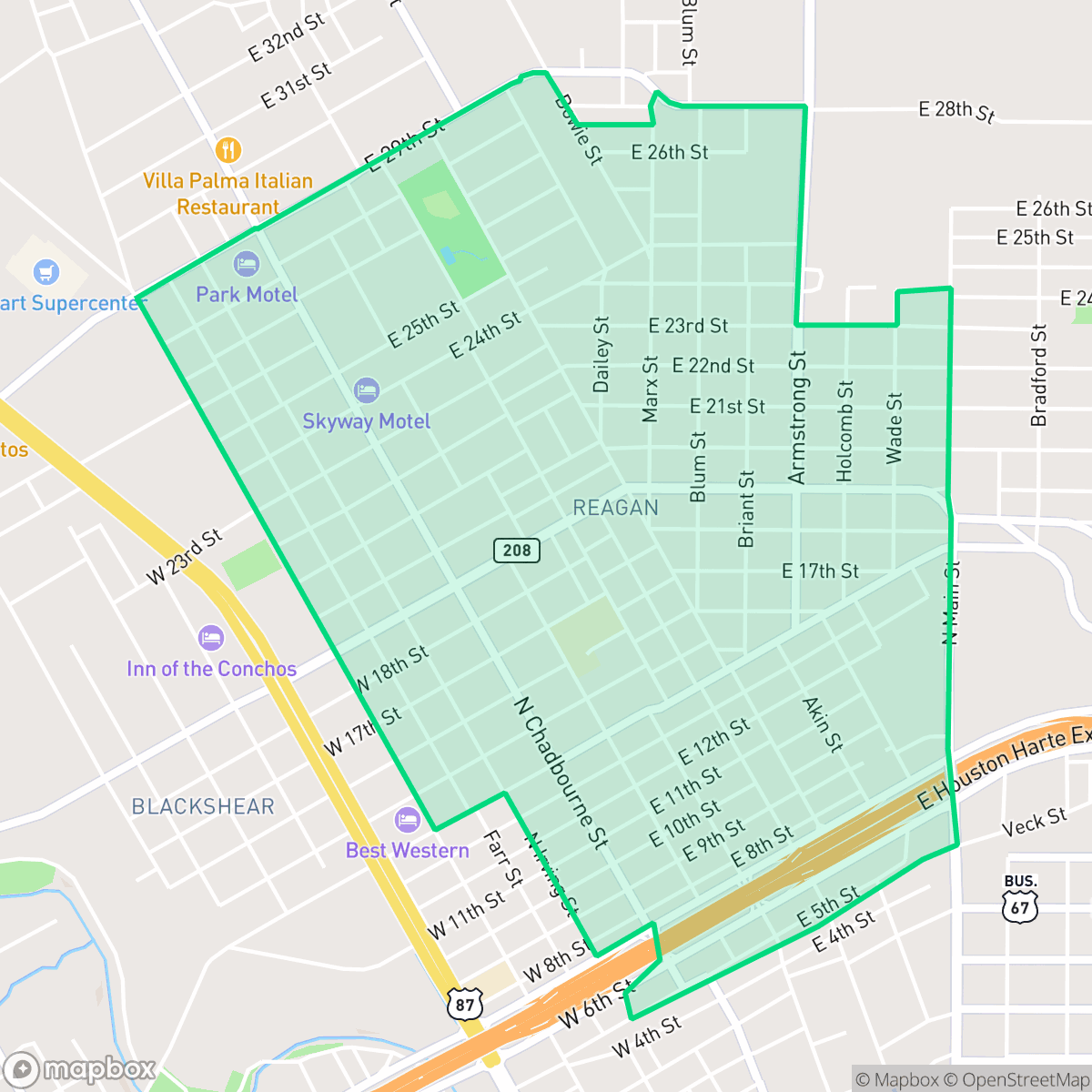
Located in the northeast section of San Angelo, Texas, the historic Reagan neighborhood—originally known as the North Ward—is bounded by 29th Street, North Chadbourne Street, and the Houston Harte Expressway. The area's central landmark is the John H. Reagan Elementary School on Volney Street. Built in 1909 as the North Ward School, it is one of only two surviving original ward schools in the city. Reagan's housing stock consists primarily of established, mid-century single-family homes built between 1940 and 1969. Historically a working-class enclave, the neighborhood maintains a strong cultural identity rooted in its high concentration of manufacturing laborers and its rich Mexican-American heritage. In recent decades, Reagan has been a primary focus of the city's Neighborhood Revitalization Program, aimed at preserving its residential character and rehabilitating its aging homes.
The area balances quiet, low-density residential streets with pockets of commercial activity near major thoroughfares. According to iHuus data, the neighborhood maintains a lively vibe compared to the city average, supported by local establishments like Los Gallos Bakery, La Esperanza, and Panchita's Tortilla Factory. The physical landscape is a mix of suburban green spaces and light industrial yards, which creates a functional but utilitarian aesthetic. Residents benefit from a consistent, moderate acoustic environment, though the proximity to industrial sites and major highway access influences the overall character of the streets.
Living in this neighborhood requires a car, as walkability is limited and amenities are often spread out. Prospective residents should note that the local school district, San Angelo ISD, is currently navigating significant consolidation and budgetary challenges. Additionally, the area faces specific environmental considerations, including limited air quality and flood safety concerns. It is best suited for those seeking an established, culturally rich community who prioritize proximity to local dining and a traditional suburban lifestyle over high walkability or modern infrastructure.
Neighborhood Scores Across 15 Qualities
Residential spacing provides a moderate level of separation between properties. According to iHuus data, this neighborhood offers a similar degree of density and neighbor buffering as the rest of San Angelo.
Low traffic and quiet streets make for pleasant walking, though the lack of sidewalks means pedestrians must share the road with vehicles. This level of walkability is slightly below the San Angelo average according to iHuus data.
Standard tract housing dominates the landscape, featuring simple rooflines and modest yards. According to iHuus data, the visual variety in this area is lower than the San Angelo average.
Access to public parks and wide green verges is sparse in this area. According to iHuus data, the neighborhood offers fewer pet-friendly walking options than the San Angelo average.
Open scrubland and scattered development characterize this area, providing a less dense landscape than the San Angelo average according to iHuus data.
A diverse mix of dining options and local services creates a more active atmosphere than the San Angelo average. While some blocks offer a steady rhythm of activity, much of the neighborhood remains car-dependent with a quiet, suburban feel.
Steady traffic sounds from a nearby busy street are noticeable, though the acoustic environment remains more peaceful than the average area in San Angelo.
Minimal industrial activity characterizes this area, which features mostly residential streets and occasional light commercial zones. According to iHuus data, the level of industrial proximity is slightly lower than the San Angelo average.
Health insurance access is notably lower in this area than the San Angelo average, according to iHuus data. Residents may face greater challenges accessing employer-sponsored or private medical coverage compared to the rest of the city.
Conservative values are prevalent among the local population, representing a more conservative political leaning than the San Angelo city average, according to iHuus data.
Residents live alongside a balanced blend of young adults, families, and older populations. This demographic distribution is slightly more varied than the typical profile found across San Angelo.
Significant flood hazards exist here, notably exceeding the San Angelo average for coastal high-hazard zones. Residents should anticipate elevated or potentially prohibitive flood insurance costs according to iHuus data.
Address-Level Insights for Reagan


iHuus Neighborhood Intelligence Insights
Get address-level neighborhood insights for Reagan
- Street-level scores — see how individual blocks compare, not just neighborhood averages
- Micro-zone boundaries — identify quiet pockets, flood boundaries, and walkable clusters before you visit
- 15 dimensions in full — walkability, noise, air quality, school quality, insurance coverage, population age profile, urban/rural index, and more
- Boundary risk alerts — know if your address sits near a block boundary where scores drop, the kind of detail no listing will ever mention
- School insights — individual school ratings and insights, not just district-level data
- Compare before you commit — side-by-side data across neighborhoods, down to block precision
No credit card required
Compare with Any Neighborhood
| Dimension | Reagan | Angelo Heights |
|---|---|---|
| 🚶 Walkabilityavg 5.86 | ||
| 🔊 Acoustic Comfortavg 4.52 | ||
| 🤫 Privacy Indexavg 6.06 | ||
| 🎨 Visual Appealavg 5.61 | ||
| 🐕 Dog Friendlinessavg 5.82 | ||
| 🗺️ Urban-Rural Indexavg 7.3 | ||
| ✨ Neighborhood Vibeavg 4.15 | ||
| 🏥 Health Insurance Coverageavg 6.22 | ||
| 🌿 Air Quality | ||
| 🏭 Industrial Proximityavg 8.42 | ||
| 🌊 Flood Safetyavg 3.02 | ||
| 🗳️ Ideological Leanavg 1.23 | ||
| 👥 Population Age Profileavg 4.73 | ||
| 🔥 Fire Safety | ||
| 🏫 School Quality |
Reagan Rankings
School Districts Serving Reagan
School Insights for Reagan
Below average outcomes; significant attendance and academic challenges.
School Insights
See what's really behind every school rating near Reagan
- Individual school ratings — each school's own score with outcome context, not just a district average
- Enrollment & class size data — student-to-teacher ratio and how it compares to the state average
- Full demographics breakdown — ethnicity and gender composition for every school in the enrollment zone
- Every school in the district — all schools within the enrollment boundary ranked by rating, not just the closest one
- Grade levels & benchmarks — elementary through high school, with below/above state-average flags
No credit card required