Lake View, San Angelo
Updated · 4,246 residents
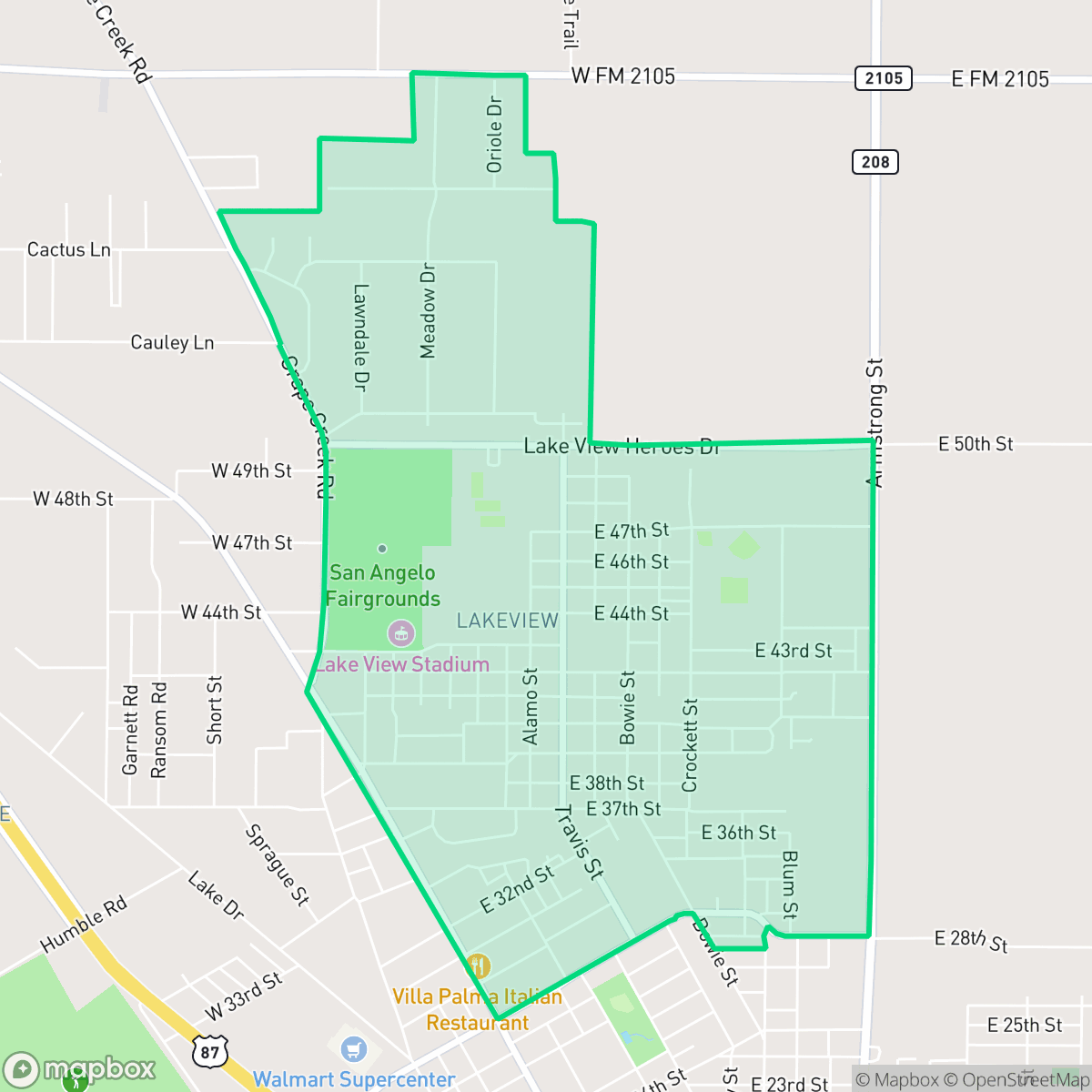
Lake View is a serene, semi-rural community on the northern edge of San Angelo defined by its low-density residential streets and expansive open space. The neighborhood offers a quiet environment with minimal traffic noise, though it lacks a centralized commercial core and requires a vehicle for most daily errands.
Key Highlights
About Lake View
Originally a dispersed rural community on the northern edge of San Angelo, Lake View (historically spelled Lakeview) began developing its distinct local identity in the early 20th century, with its first school established around 1905 and the name "Lake View" formally used by 1911. The area operated as its own independent school district from 1927 until it was annexed by San Angelo in 1967. A defining moment in the neighborhood's history occurred on May 11, 1953, when a devastating tornado swept through Lake View, destroying much of the community and its school facilities, which were quickly rebuilt through local grit. Today, this heritage is preserved at the Lake View Monument on 42nd Street and Bowie, constructed using salvaged bricks from the former Lincoln Junior High School.
This area functions as a quiet transition zone between urban San Angelo and the surrounding rural landscape. The streetscape is characterized by a mix of large-lot residential properties, scattered structures, and patches of scrubland, creating a sense of privacy that is often absent in the city center. While the presence of the Wells Fargo Pavilion and various social services provides occasional activity, the neighborhood maintains a low-density atmosphere with almost no distinct commercial districts.
The area is best suited for residents who prioritize acoustic comfort and space over walkability or immediate access to retail and dining. Prospective residents should note that the neighborhood is car-oriented, and daily life typically involves commuting to more developed parts of San Angelo for essential services. Additionally, families should consider the local school options, which include Lake View High School, Goliad Elementary, and Lincoln Middle School, while remaining aware of the broader challenges currently facing the San Angelo Independent School District.
Neighborhood Scores Across 15 Qualities
Residential lots feature significant separation between structures, providing a sense of privacy that is slightly higher than the San Angelo average.
Low traffic and peaceful streets allow for easy strolling, though a lack of sidewalks makes it less pedestrian-friendly than the San Angelo average.
Dense housing and small yards characterize this area, which offers less visual variety than the San Angelo average. According to iHuus data, the landscape consists primarily of functional residential structures with minimal greenery or amenities.
Minimal access to public parks and a lack of wide green verges make this area less ideal for dog owners. According to iHuus data, pet-friendly infrastructure in Lake View is below the San Angelo average.
Open lands and scattered homes characterize this area, providing a more spacious and less dense environment than the typical San Angelo neighborhood. According to iHuus data, the landscape features a mix of large lots and scrubland compared to the more developed city average.
Low density and significant open space create a tranquil environment, though the area is less lively than the San Angelo average. Residents will find a mostly car-oriented landscape where local social hubs and essential services are sparse.
Acoustic levels are notably lower than the San Angelo average, with only infrequent sounds from distant traffic or trains. According to iHuus data, this provides a peaceful environment for residents.
Residential life remains largely uninterrupted by heavy industry, as the area consists primarily of housing and light commercial services. This lack of significant industrial activity is slightly better than the San Angelo average, according to iHuus data.
Health insurance coverage among residents is notably lower than the San Angelo average. According to iHuus data, a minority of the population in Lake View maintains active health coverage.
Voting patterns and census indicators in Lake View reflect a strong conservative lean that is more pronounced than the average for San Angelo. According to iHuus data, the area maintains a notably conservative political identity.
Residents live alongside a balanced distribution of young adults, families, and seniors. According to iHuus data, this age spread is very similar to the typical demographic found across San Angelo.
Flood risk in this area is difficult to precisely determine because FEMA has not yet completed a detailed study for this location. According to iHuus data, the potential for flooding is slightly higher than the average found across San Angelo.
Address-Level Insights for Lake View


iHuus Neighborhood Intelligence Insights
Get address-level neighborhood insights for Lake View
- Street-level scores — see how individual blocks compare, not just neighborhood averages
- Micro-zone boundaries — identify quiet pockets, flood boundaries, and walkable clusters before you visit
- 15 dimensions in full — walkability, noise, air quality, school quality, insurance coverage, population age profile, urban/rural index, and more
- Boundary risk alerts — know if your address sits near a block boundary where scores drop, the kind of detail no listing will ever mention
- School insights — individual school ratings and insights, not just district-level data
- Compare before you commit — side-by-side data across neighborhoods, down to block precision
No credit card required
Compare with Any Neighborhood
| Dimension | Lake View | Angelo Heights |
|---|---|---|
| 🚶 Walkabilityavg 5.86 | ||
| 🔊 Acoustic Comfortavg 4.52 | ||
| 🤫 Privacy Indexavg 6.06 | ||
| 🎨 Visual Appealavg 5.61 | ||
| 🐕 Dog Friendlinessavg 5.82 | ||
| 🗺️ Urban-Rural Indexavg 7.3 | ||
| ✨ Neighborhood Vibeavg 4.15 | ||
| 🏥 Health Insurance Coverageavg 6.22 | ||
| 🌿 Air Quality | ||
| 🏭 Industrial Proximityavg 8.42 | ||
| 🌊 Flood Safetyavg 3.02 | ||
| 🗳️ Ideological Leanavg 1.23 | ||
| 👥 Population Age Profileavg 4.73 | ||
| 🔥 Fire Safety | ||
| 🏫 School Quality |
Lake View Rankings
School Districts Serving Lake View
School Insights for Lake View
Below average outcomes; significant attendance and academic challenges.
School Insights
See what's really behind every school rating near Lake View
- Individual school ratings — each school's own score with outcome context, not just a district average
- Enrollment & class size data — student-to-teacher ratio and how it compares to the state average
- Full demographics breakdown — ethnicity and gender composition for every school in the enrollment zone
- Every school in the district — all schools within the enrollment boundary ranked by rating, not just the closest one
- Grade levels & benchmarks — elementary through high school, with below/above state-average flags
No credit card required