Goodfellow Air Force Base, San Angelo
Updated · 3,088 residents
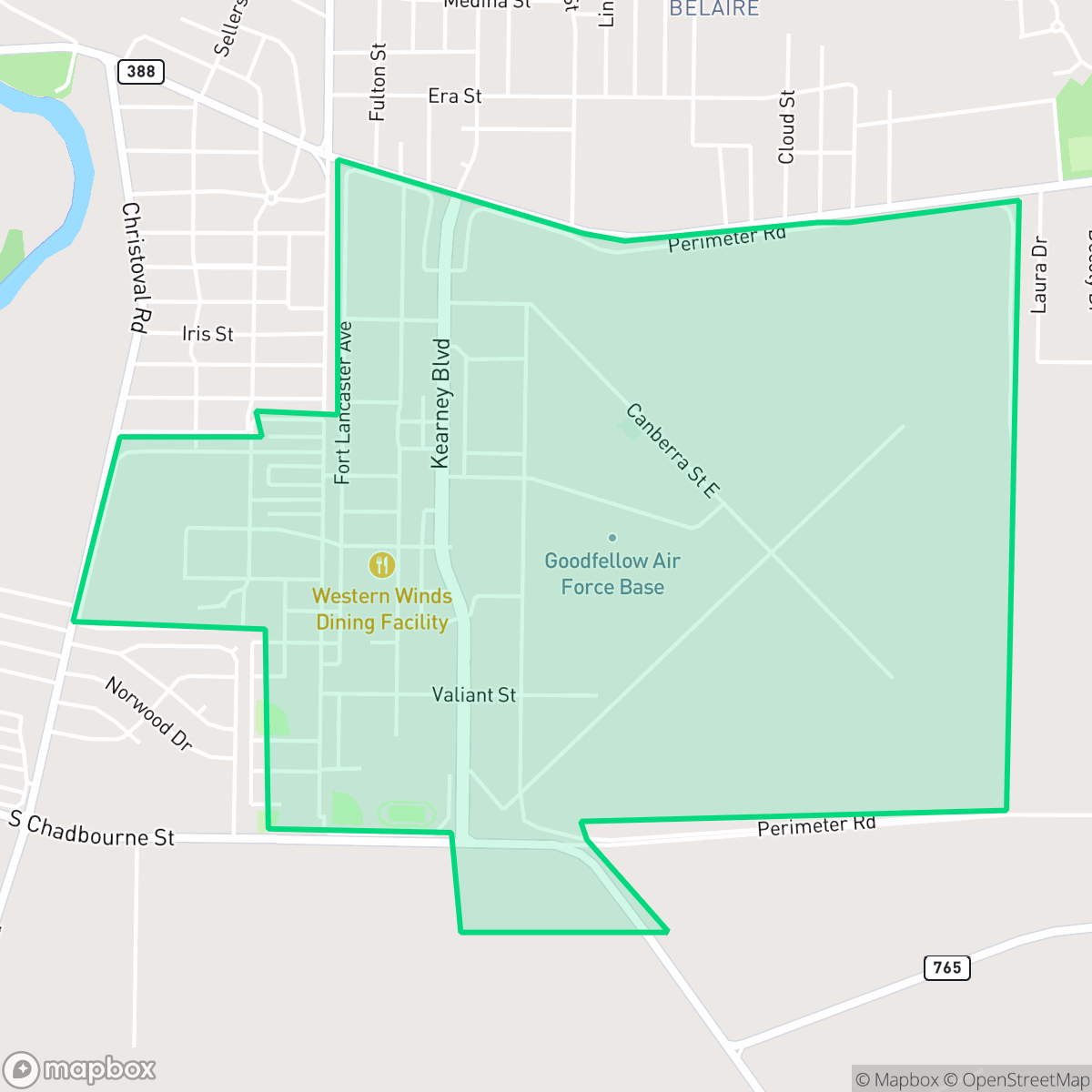
Goodfellow Air Force Base is a quiet, low-density neighborhood defined by its expansive open spaces and proximity to military infrastructure. While the area offers a serene atmosphere and higher-than-average walkability for the region, residents should expect limited social amenities and consistent noise from nearby airfield operations.
Key Highlights
About Goodfellow Air Force Base
Established in August 1940, Goodfellow Air Force Base originated as the San Angelo Air Corps Basic Flying Training School, built on 640 acres secured by local civic leaders for a nominal lease of one dollar per year. In 1941, the installation was officially named Goodfellow Field to honor Lieutenant John J. Goodfellow Jr., a San Angelo native and World War I aviator killed in action in France. During World War II, the base served as a vital pilot training facility, graduating more than 10,000 aviators. With the advent of jet aviation in 1958, the base transitioned from flight training to intelligence, cryptology, and security training for all branches of the United States military. Today, as home to the 17th Training Wing, it remains a premier Department of Defense center for intelligence and military firefighting training.
The area surrounding the base is characterized by a mix of institutional facilities, light industrial units, and quiet residential streets. It maintains a distinct rural-suburban feel with significant open land, providing a sense of seclusion that is rare in more developed parts of San Angelo. While the neighborhood lacks a dense commercial core, it offers essential local services and remains a dog-friendly environment with ample space for outdoor activity.
Prospective residents should weigh the tranquil, remote setting against specific environmental trade-offs, including low flood safety ratings and the acoustic impact of active flight training. The neighborhood serves a specific demographic, often appealing to those connected to the military installation or individuals seeking a quiet, lower-density lifestyle. Educational options vary significantly, as the area is served by both the high-performing Wall Independent School District and the San Angelo Independent School District.
Neighborhood Scores Across 15 Qualities
Residential spacing provides a moderate level of separation between neighbors, which is slightly higher than the San Angelo average according to iHuus data.
Low traffic volumes and quiet streets provide a peaceful environment for walking, though the lack of sidewalks means pedestrians must share the roadway with vehicles. This level of walkability is roughly in line with the San Angelo average according to iHuus data.
Modest, uniform housing characterizes the area, featuring tidy yards and simple rooflines. This landscape is slightly less visually varied than the San Angelo average, according to iHuus data.
Access to connected green spaces and wide, low-traffic paths makes this area more suitable for dog owners than the San Angelo average, according to iHuus data.
Vast landscapes and runway infrastructure create a semi-rural atmosphere characterized by frequent open land and sparse buildings. This level of openness is slightly lower than the San Angelo average according to iHuus data.
Limited local business activity and significant open space create a tranquil environment, though the area lacks the social energy found in the rest of San Angelo. Residents will find a sparse landscape of light industrial units and essential services that requires a car for most errands.
Frequent aircraft activity and proximity to flight paths create significantly higher noise levels than the San Angelo average. Residents can expect persistent auditory disturbances throughout the day.
Industrial activity is virtually absent from this area, making it slightly cleaner of heavy manufacturing than the San Angelo average. Residents should note, however, that the active airfield and flight line introduce significant noise hazards and heavy equipment traffic.
Health insurance accessibility is slightly lower than the San Angelo average. According to iHuus data, a portion of the resident population lacks coverage.
Political leanings in this area are predominantly conservative, reflecting a trend that is very similar to the broader San Angelo area according to iHuus data.
A significant majority of the population consists of young adults, making the demographic profile notably younger than the San Angelo average. This concentration of young residents is accompanied by a smaller presence of families and older adults, according to iHuus data.
Flood risk in this area is significantly higher than the San Angelo average. Residents should anticipate much higher insurance premiums and potential hazards related to coastal-style wave action and flooding.
Address-Level Insights for Goodfellow Air Force Base


iHuus Neighborhood Intelligence Insights
Get address-level neighborhood insights for Goodfellow Air Force Base
- Street-level scores — see how individual blocks compare, not just neighborhood averages
- Micro-zone boundaries — identify quiet pockets, flood boundaries, and walkable clusters before you visit
- 15 dimensions in full — walkability, noise, air quality, school quality, insurance coverage, population age profile, urban/rural index, and more
- Boundary risk alerts — know if your address sits near a block boundary where scores drop, the kind of detail no listing will ever mention
- School insights — individual school ratings and insights, not just district-level data
- Compare before you commit — side-by-side data across neighborhoods, down to block precision
No credit card required
Compare with Any Neighborhood
| Dimension | Goodfellow Air Force Base | Angelo Heights |
|---|---|---|
| 🚶 Walkabilityavg 5.86 | ||
| 🔊 Acoustic Comfortavg 4.52 | ||
| 🤫 Privacy Indexavg 6.06 | ||
| 🎨 Visual Appealavg 5.61 | ||
| 🐕 Dog Friendlinessavg 5.82 | ||
| 🗺️ Urban-Rural Indexavg 7.3 | ||
| ✨ Neighborhood Vibeavg 4.15 | ||
| 🏥 Health Insurance Coverageavg 6.22 | ||
| 🌿 Air Quality | ||
| 🏭 Industrial Proximityavg 8.42 | ||
| 🌊 Flood Safetyavg 3.02 | ||
| 🗳️ Ideological Leanavg 1.23 | ||
| 👥 Population Age Profileavg 4.73 | ||
| 🔥 Fire Safety | ||
| 🏫 School Quality |
Goodfellow Air Force Base Rankings
School Districts Serving Goodfellow Air Force Base
School Insights for Goodfellow Air Force Base
Below average outcomes; significant attendance and academic challenges.
School Insights
See what's really behind every school rating near Goodfellow Air Force Base
- Individual school ratings — each school's own score with outcome context, not just a district average
- Enrollment & class size data — student-to-teacher ratio and how it compares to the state average
- Full demographics breakdown — ethnicity and gender composition for every school in the enrollment zone
- Every school in the district — all schools within the enrollment boundary ranked by rating, not just the closest one
- Grade levels & benchmarks — elementary through high school, with below/above state-average flags
No credit card required