Country Club, San Angelo
Updated · 3,907 residents
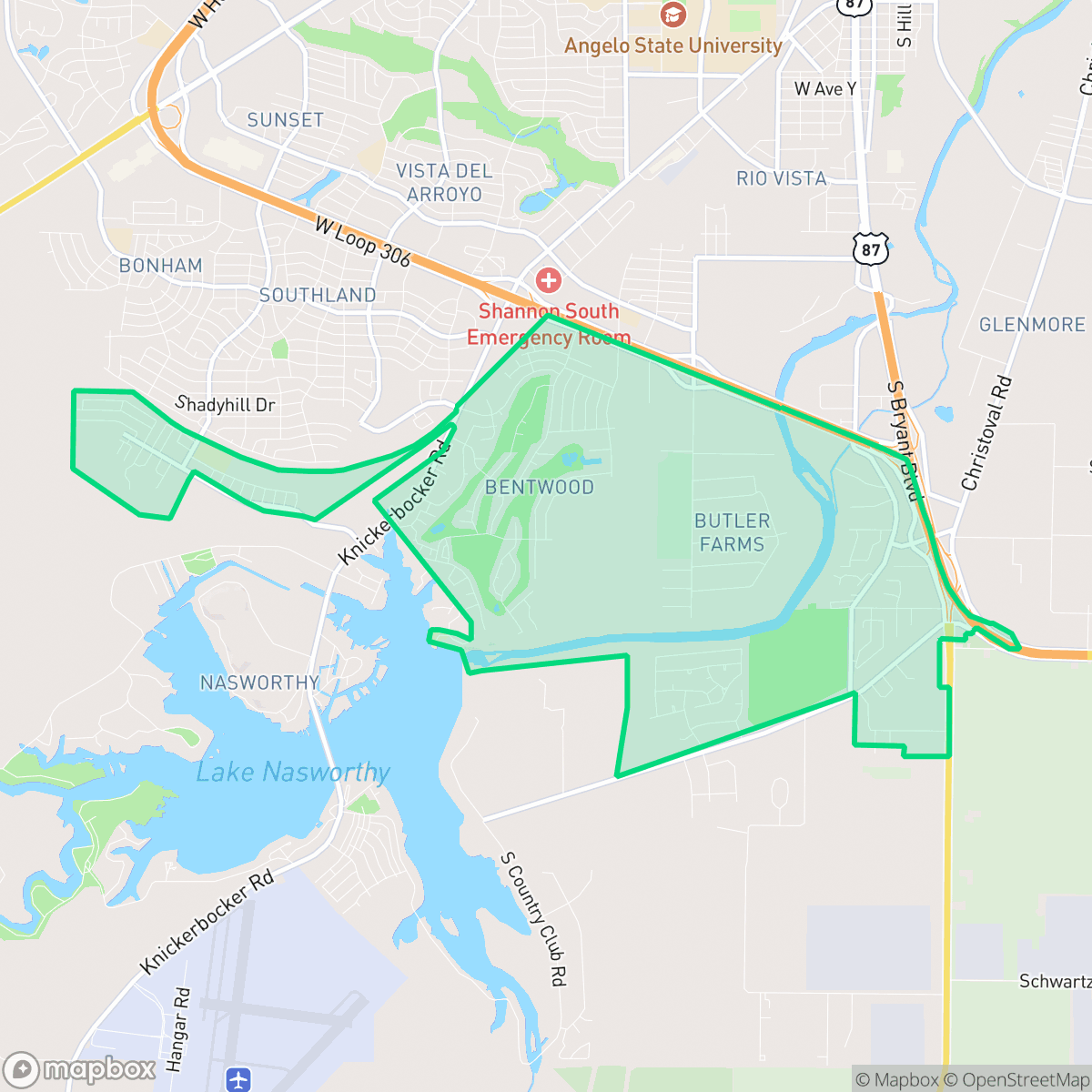
Centered around a historic golf course and the Concho River, this neighborhood offers an upscale, semi-rural environment defined by large residential properties and quiet streets. Residents enjoy a tranquil atmosphere with high health insurance coverage and a clean, industrial-free living space.
Key Highlights
About Country Club
The Country Club neighborhood in San Angelo centers on the historic San Angelo Country Club, established in 1921 on land formerly known as the John Findlater farm. Founded by Bernie Alexander, Dwight Hunter, and C.C. McBurnett, the club was developed along the Concho River to serve the growing community during the 1920s oil boom. The original clubhouse, affectionately nicknamed 'La Casa Grande,' featured a ballroom and verandas overlooking the river, serving as a prominent social landmark. The site is historically significant for its golf course, designed by renowned architect John Bredemus, which holds the distinction of being the first in Texas to feature bent-grass greens. The neighborhood’s character remains defined by this legacy of early 20th-century development, hilly terrain, and its enduring connection to the river landscape.
The area maintains a polished aesthetic characterized by spacious lots and a peaceful, low-density environment. It serves as a quiet enclave that feels distinct from the more active urban centers of San Angelo, providing a serene setting for those who value privacy and open space. The absence of industrial infrastructure ensures a clean, residential-focused atmosphere that is well-suited for a diverse demographic of families and older residents.
While the neighborhood offers a tranquil lifestyle, prospective residents should note the consistent background hum from nearby traffic and the lack of immediate commercial amenities. The area is served by two school districts, providing a significant contrast between the highly-rated Wall Independent School District and the more challenged San Angelo Independent School District. Additionally, while the neighborhood is generally dog-friendly, residents should remain aware of potential flood risks, as official assessments for this specific zone remain incomplete.
Neighborhood Scores Across 15 Qualities
Residential plots feature mixed spacing with some buffer between neighbors, making the level of privacy roughly comparable to the San Angelo average.
Quiet streets allow for easy walking, though the area lacks formal sidewalks. This level of walkability is consistent with the average for San Angelo.
Large homes and frequent upscale amenities provide a more polished landscape than the San Angelo average, according to iHuus data.
Access to connected green spaces and wide, low-traffic paths makes this area more dog friendly than the San Angelo average. According to iHuus data, the layout of the neighborhood supports easy walks for pet owners.
Open land and scattered residences characterize this area, which feels more semi-rural than the typical San Angelo landscape. According to iHuus data, the neighborhood features a transition from residential plots toward heavy industrial and highway infrastructure.
Low density and significant open space create a serene, tranquil environment, though the area lacks the commercial variety found in more active parts of San Angelo. Most sections are primarily residential or rural in character, offering a peaceful atmosphere with very few local business destinations.
Frequent sounds from nearby busy streets create a consistent background hum. This level of acoustic activity is slightly higher than the average found across San Angelo, according to iHuus data.
Residential life is free from warehouses, industrial facilities, or hazard sites, offering a much cleaner environment than the San Angelo average. According to iHuus data, the area consists of quiet streets and open green spaces without the presence of heavy industrial infrastructure.
Health insurance accessibility is notably higher in this area than the San Angelo average, according to iHuus data.
Voting patterns and census indicators show a distinctly conservative leaning, which is more pronounced here than the city average according to iHuus data.
A balanced mix of young adults, families, and older residents defines the area. According to iHuus data, this demographic spread is slightly more varied than the San Angelo city average.
Flood risk levels in this area are higher than the San Angelo average, though a lack of detailed FEMA studies means the precise danger level remains undetermined. Residents should exercise caution as official assessments for this specific zone are currently incomplete.
Address-Level Insights for Country Club


iHuus Neighborhood Intelligence Insights
Get address-level neighborhood insights for Country Club
- Street-level scores — see how individual blocks compare, not just neighborhood averages
- Micro-zone boundaries — identify quiet pockets, flood boundaries, and walkable clusters before you visit
- 15 dimensions in full — walkability, noise, air quality, school quality, insurance coverage, population age profile, urban/rural index, and more
- Boundary risk alerts — know if your address sits near a block boundary where scores drop, the kind of detail no listing will ever mention
- School insights — individual school ratings and insights, not just district-level data
- Compare before you commit — side-by-side data across neighborhoods, down to block precision
No credit card required
Compare with Any Neighborhood
| Dimension | Country Club | Angelo Heights |
|---|---|---|
| 🚶 Walkabilityavg 5.86 | ||
| 🔊 Acoustic Comfortavg 4.52 | ||
| 🤫 Privacy Indexavg 6.06 | ||
| 🎨 Visual Appealavg 5.61 | ||
| 🐕 Dog Friendlinessavg 5.82 | ||
| 🗺️ Urban-Rural Indexavg 7.3 | ||
| ✨ Neighborhood Vibeavg 4.15 | ||
| 🏥 Health Insurance Coverageavg 6.22 | ||
| 🌿 Air Quality | ||
| 🏭 Industrial Proximityavg 8.42 | ||
| 🌊 Flood Safetyavg 3.02 | ||
| 🗳️ Ideological Leanavg 1.23 | ||
| 👥 Population Age Profileavg 4.73 | ||
| 🔥 Fire Safety | ||
| 🏫 School Quality |
Country Club Rankings
School Districts Serving Country Club
School Insights for Country Club
Below average outcomes; significant attendance and academic challenges.
School Insights
See what's really behind every school rating near Country Club
- Individual school ratings — each school's own score with outcome context, not just a district average
- Enrollment & class size data — student-to-teacher ratio and how it compares to the state average
- Full demographics breakdown — ethnicity and gender composition for every school in the enrollment zone
- Every school in the district — all schools within the enrollment boundary ranked by rating, not just the closest one
- Grade levels & benchmarks — elementary through high school, with below/above state-average flags
No credit card required