Blackshear, San Angelo
Updated · 1,959 residents
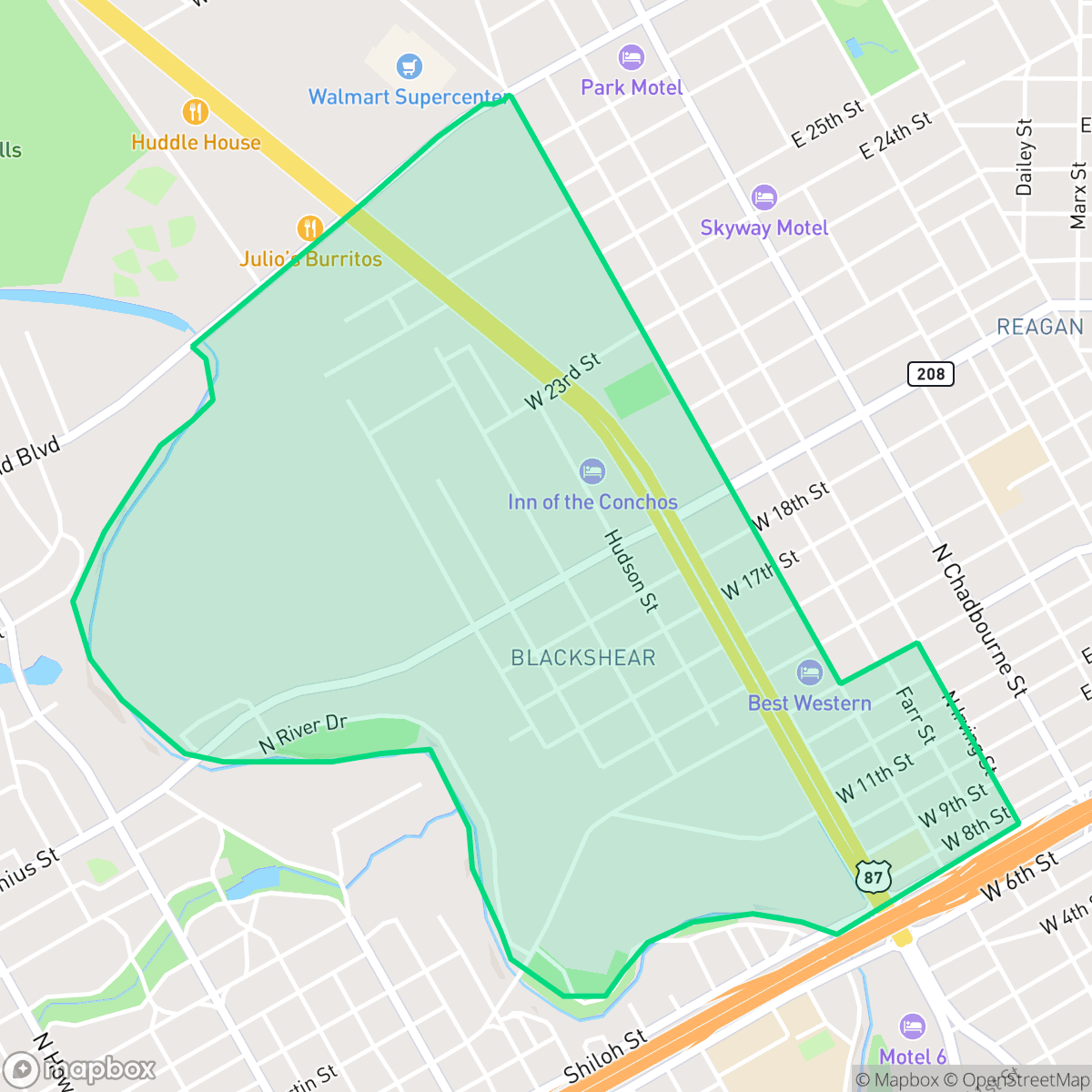
Blackshear is a historically significant neighborhood in San Angelo that maintains a quiet, low-density suburban atmosphere. While the area features a mix of residential zones and industrial spaces, residents experience moderate walkability and a notable presence of road traffic noise.
Key Highlights
About Blackshear
Prior to public school desegregation in 1958, the Blackshear neighborhood served as the cultural and residential hub for the vast majority of San Angelo’s African American community. Legally and informally segregated, the neighborhood developed its own self-sustaining institutions, including dozens of Black-owned businesses, local churches, and the Blackshear School. A major neighborhood landmark is the historic Paul Dunbar Memorial Library on Martin Luther King Boulevard, which operated as San Angelo’s only Black library from 1932 to 1972 and was preserved and reopened as a museum in 2017. The neighborhood also celebrates the legacy of the Blackshear High School Leopards, who won the 1950 Prairie View Interscholastic League Class AA state football championship, a historic achievement commemorated today inside the restored library and the modern Blackshear Learning Center.
The area is characterized by a blend of residential streets, light industrial units, and open green spaces. It serves as a quiet, suburban environment where warehouses and logistics yards sit near major thoroughfares. Local amenities include a selection of dining options and religious institutions, creating a functional, if understated, daily experience for residents. The neighborhood maintains a distinct identity rooted in its history, providing a low-density landscape that contrasts with more densely populated parts of the city.
Living here involves certain trade-offs, particularly regarding environmental factors like road noise and industrial proximity. The neighborhood is best suited for those who prioritize a low-density setting and do not mind the presence of nearby logistics operations. Prospective residents should note that the local school district is currently managing significant consolidation efforts, and the area faces challenges related to flood safety and air quality metrics.
Neighborhood Scores Across 15 Qualities
Residential spacing offers a moderate amount of separation between neighbors, which is roughly in line with the San Angelo average. According to iHuus data, this mix of density provides a balance of personal buffer and community proximity.
Low sidewalk availability is offset by quiet residential streets that are suitable for walking. This level of walkability is slightly below the San Angelo average, according to iHuus data.
Standard tract housing with modest yards characterizes the area. According to iHuus data, the visual variety in this neighborhood is lower than the San Angelo average.
Public park access and green spaces are relatively limited in this area, sitting slightly below the San Angelo average. According to iHuus data, residents may find fewer opportunities for off-leash exercise compared to other parts of the city.
Open land and scattered residential plots define the landscape, providing a sense of space that is slightly less dense than the typical San Angelo area. According to iHuus data, the neighborhood features a mix of undeveloped green space and industrial yards.
A steady rhythm of residential life and light industrial activity defines this area, which maintains a level of liveliness similar to the San Angelo average. The landscape is characterized by low-density spaces and a car-dependent layout, though several local dining options are accessible near major transit corridors.
Steady traffic sounds from a nearby busy street create a consistent hum. This level of acoustic activity is slightly higher than the average found elsewhere in San Angelo.
Residential streets remain largely peaceful, though some areas near logistics yards may experience occasional dust or heavy truck activity. This level of industrial proximity is lower than the San Angelo average according to iHuus data.
Health insurance accessibility is significantly lower in Blackshear than the San Angelo average. According to iHuus data, a small minority of local residents maintain active health insurance coverage.
Conservative values represent the majority of the community, showing a more pronounced lean than the San Angelo average according to iHuus data.
Residents live alongside a balanced mix of young adults, families, and older individuals. This age distribution is roughly in line with the average seen across San Angelo.
Frequent flooding is a concern in this area as portions of the neighborhood sit within a designated floodplain. According to iHuus data, the risk of flooding is notably higher here than the San Angelo city average.
Address-Level Insights for Blackshear


iHuus Neighborhood Intelligence Insights
Get address-level neighborhood insights for Blackshear
- Street-level scores — see how individual blocks compare, not just neighborhood averages
- Micro-zone boundaries — identify quiet pockets, flood boundaries, and walkable clusters before you visit
- 15 dimensions in full — walkability, noise, air quality, school quality, insurance coverage, population age profile, urban/rural index, and more
- Boundary risk alerts — know if your address sits near a block boundary where scores drop, the kind of detail no listing will ever mention
- School insights — individual school ratings and insights, not just district-level data
- Compare before you commit — side-by-side data across neighborhoods, down to block precision
No credit card required
Compare with Any Neighborhood
| Dimension | Blackshear | Angelo Heights |
|---|---|---|
| 🚶 Walkabilityavg 5.86 | ||
| 🔊 Acoustic Comfortavg 4.52 | ||
| 🤫 Privacy Indexavg 6.06 | ||
| 🎨 Visual Appealavg 5.61 | ||
| 🐕 Dog Friendlinessavg 5.82 | ||
| 🗺️ Urban-Rural Indexavg 7.3 | ||
| ✨ Neighborhood Vibeavg 4.15 | ||
| 🏥 Health Insurance Coverageavg 6.22 | ||
| 🌿 Air Quality | ||
| 🏭 Industrial Proximityavg 8.42 | ||
| 🌊 Flood Safetyavg 3.02 | ||
| 🗳️ Ideological Leanavg 1.23 | ||
| 👥 Population Age Profileavg 4.73 | ||
| 🔥 Fire Safety | ||
| 🏫 School Quality |
Blackshear Rankings
School Districts Serving Blackshear
School Insights for Blackshear
Below average outcomes; significant attendance and academic challenges.
School Insights
See what's really behind every school rating near Blackshear
- Individual school ratings — each school's own score with outcome context, not just a district average
- Enrollment & class size data — student-to-teacher ratio and how it compares to the state average
- Full demographics breakdown — ethnicity and gender composition for every school in the enrollment zone
- Every school in the district — all schools within the enrollment boundary ranked by rating, not just the closest one
- Grade levels & benchmarks — elementary through high school, with below/above state-average flags
No credit card required